UK Visa Refusal Paragraph V 4.2a: How to Challenge and Reapply Successfully
Receiving an adverse decision under Appendix V of the Immigration Rules can be frustrating, especially when an Entry Clearance Officer questions your true intentions.
A uk visa refusal paragraph v 4.2a means the Home Office is not convinced you are a genuine visitor who will leave the country at the end of your stay.
Instead, the entry clearance officer suspects you might seek illegal work, overstay your permission, or settle permanently in the UK under the disguise of a leisure trip.
Overturning this refusal requires more than basic flight bookings and hotel vouchers; you must address the exact civil standards UKVI decision-makers rely on.
Related Master Guide: If your refusal letter lists multiple grounds alongside intention, study our complete breakdown on the uk standard visitor visa refusal guide before planning your next step.
Understanding UK Visa Refusal Paragraph V 4.2a: What It Actually Means
Paragraph V 4.2 of Appendix V: Visitor requires every applicant to satisfy the decision-maker that they meet the genuine visitor requirement. Specifically, under sub-clause (a), you must prove that you will leave the UK at the end of your visit. Although the statutory text is brief, officers evaluate it through strict administrative benchmarks behind closed doors.
The Balance of Probabilities Standard
UKVI caseworkers assess standard visitor visa applications using a civil legal standard known as the balance of probabilities.
This means the officer does not need conclusive evidence that you plan to break immigration laws.
They only need to believe it is more than 50% likely that you will not depart the UK as stated.
If your supporting documents are vague, unverified, or poorly authenticated, your credibility score dips below that critical threshold.
The entry clearance officer does not have to disprove your statements; the legal obligation to prove your good faith rests completely on your shoulders.
The Connection Between Paragraph V 4.2(a) and Paragraph V 4.2(c)
In most refusal notices, sub-clause (a) does not appear in isolation. Caseworkers routinely combine it with Paragraph V 4.2(c) to construct a dual refusal ground.
- Paragraph V 4.2(a) targets your intention to leave: Do your professional obligations, family responsibilities, and domestic anchors guarantee you will depart the UK when your visa ends?
- Paragraph V 4.2(c) targets your genuine purpose: Is your declared itinerary, purpose of visit, and reason for traveling authentic, transparent, and permitted under visitor rules?
When an officer doubts your claimed holiday or family visit under V 4.2(c), they almost always conclude under V 4.2(a) that you intend to remain in the UK rather than return home.
To successfully challenge this outcome in a fresh application, your evidence must simultaneously satisfy your intention to leave and your declared travel purpose.
2. Why Caseworkers Issue V 4.2(a): The Unspoken Internal Triggers
Home Office caseworkers do not evaluate visitor applications on guesswork.
They follow internal decision-maker guidance designed to detect subtle behavioral, financial, and personal inconsistencies.
When an Entry Clearance Officer issues a refusal under Paragraph V 4.2(a), it almost always stems from one of four unspoken operational triggers.
1. Disproportionate Trip Costs Against Real Income
Caseworkers constantly weigh your declared holiday budget against your actual economic standing at home.
If spending two weeks in London exhausts three or four months of your net disposable earnings, the trip fails the proportionality test.
An officer immediately questions why a rational person would deplete their core family savings on a brief holiday.
In the eyes of UKVI, spending an unreasonable share of your liquid capital strongly suggests an intention to stay and recoup that money through local work.
2. Fragile Employment and Unverified Income
Holding a job is not enough on its own; caseworkers scrutinize how easily that job can be abandoned:
- Short Job Tenure: Applying for leave when you have only been with an employer for three to six months suggests minimal career investment.
- Cash Salaries: Earnings handed over in cash without tax records, payslips, or direct bank deposits carry near-zero weight in decision-making.
- Easily Replaced Positions: If your role lacks specialized credentials, seniority, or clear operational responsibilities, officers assume leaving the post permanently carries very little financial loss.
When your current work provides weak economic security, the incentive to return home drops dramatically.
3. The Third-Country Expatriate Vulnerability
Expatriates living and working outside their country of origin (such as foreign professionals across the Gulf region) face elevated scrutiny under Paragraph V 4.2(a).
Because temporary residency permits eventually expire, caseworkers often doubt the long-term pulling power of a second home.
If you are an expatriate facing these hurdles, review our targeted framework on how to prove genuine visitor intention for uk visa to address temporary residency assumptions effectively.
| Expatriate Profile Factor | Internal Caseworker Assumption |
|---|---|
| Short-Term Work Visa | The applicant lacks permanent settlement rights and may seek long-term stability in the UK. |
| Family in Home Country | With close relatives living elsewhere, the applicant has limited emotional ties to their country of residence. |
| Fully Remote Roles | Digital and portable jobs create a major risk of working informally while inside the UK as a tourist. |
To clear this hurdle, temporary residents must prove their current career and legal status abroad are far too valuable to forfeit.
4. Undisclosed Travel History and Past Refusals
Nothing triggers a Paragraph V 4.2(a) refusal faster than inconsistencies in your international travel history.
UKVI shares immigration data with the United States, Canada, Australia, and New Zealand through the Five Country Conference database.
If you fail to declare a past refusal or an overstay from any of these jurisdictions, caseworkers will instantly doubt every other document you provide.
Once your general honesty is compromised, the officer will routinely conclude that your stated visitor intentions cannot be trusted.
3. The Forensic Evidentiary Matrix: Refusal Triggers vs Approval Standard
When an Entry Clearance Officer reviews your file, they compare your papers against strict evidentiary benchmarks set out in the GOV.UK Visit Caseworker Guidance.
Submitting generic paperwork almost guarantees a refusal under Paragraph V 4.2(a).
To secure an approval, you must replace weak claims with verified, third-party corroborated records.
| Profile Area | Refusal-Triggering Evidence (Weak) | Approval Standard Evidence (Airtight) |
|---|---|---|
| Employment Ties | A simple Leave Certificate stating your vacation dates and monthly salary. | Certified HR NOC letter confirming your start date, permanent role, approved return-to-work date, plus 6 months of matched payslips and bank salary credits. |
| Business Ownership | Submitting only a basic Trade License or Certificate of Incorporation. | Active company bank statements (6 months), verified Corporate Tax returns, current client invoices, and utility records for physical premises. |
| Financial Resources | Submitting a bank statement with recent, large, unexplained cash deposits. | Clear 6-month transaction trail showing steady income accumulation, supported by tax filings, liquid DPS encashments, or property sale documentation. |
| Domestic Anchors | Submitting a written statement that you live with elderly parents or extended family. | Registered tenancy agreements, title deeds with utility bills in your name, marriage records, and documentation proving legal and financial dependents. |
| Travel Intentions | Generic flight itineraries and unpaid dummy hotel bookings. | Realistic day-by-day itinerary, pre-booked event or conference registrations, and detailed breakdown of costs matching your disposable income. |

Building an Unbroken Evidentiary Trail
An Entry Clearance Officer will not fill in the blanks for you.
If your bank statements show sudden lump-sum inflows right before applying, caseworkers treat it as borrowed capital, known in immigration law as funds parking.
To prevent this from undermining your intentions, review our detailed forensic guide on large cash deposits in uk visa bank statement to properly trace capital before submitting financial records.
Similarly, if you are a remote professional or contractor, standard employment letters will not satisfy the caseworker.
You must provide reconciled accounting audits, client service contracts, and steady overseas remittance trails to prove your trade is legitimate, fully operational, and rooted in your place of residence.
4. Step-by-Step Legal Rebuttal Framework for Reapplication
Challenging a uk visa refusal paragraph v 4.2a does not mean arguing emotionally in your cover letter.
Caseworkers will not overturn a decision simply because you express frustration or restate your original claims.
To turn a refusal into an approval, you must build a structured legal rebuttal that addresses the officer’s exact words using fresh, contemporaneous evidence.
1. Dissect the Decision Notice Sentence by Sentence
Before preparing any new papers, break down your refusal letter line by line.
Identify every factual concern raised by the Entry Clearance Officer.
Common caseworker phrases under Paragraph V 4.2(a) include:
- “You state you are employed as X, however I have not seen sufficient evidence of your financial standing.”
- “The origin of the funds in your account has not been demonstrated.”
- “I am not satisfied you have demonstrated ties to your country of residence that would encourage you to leave the UK.”
Each of these sentences highlights a specific evidentiary gap.
Your new submission must supply the exact missing pieces rather than generic written assurances.
2. Construct an Evidentiary Rebuttal Table
The most effective way to present your corrected case is through an Evidentiary Rebuttal Table placed at the beginning of your reapplication package.
This side-by-side format forces the new officer to review your corrective documents immediately:
| Caseworker Refusal Ground | New Legal Rebuttal Evidence Submitted |
|---|---|
| Weak Career Commitment | Certified employer letter confirming permanent tenure, 6 months of matched payslips with bank salary deposits, and guaranteed job resumption. |
| Unverified Liquid Funds | Official bank encashment voucher showing liquidation of a long-term fixed deposit, eliminating suspicion of funds parking. |
| Insufficient Domestic Roots | Registered land title deeds, tenancy contracts, utility bills in your name, and legal proof of dependent family members requiring your care. |
3. Rely on Contemporaneous Third-Party Evidence
Caseworkers place almost zero weight on newly manufactured affidavits drafted right after a visa rejection.
They look for contemporaneous evidence—records created in the normal course of daily life before your refusal occurred:
- Official Tax Records: Government tax returns, assessment slips, or formal corporate filings.
- Direct Banking Trails: Verifiable electronic bank statements bearing bank stamps, QR codes, or formal branch manager letters.
- Institutional Records: Trade licenses, pension funds, or government-certified civil registry certificates.
4. Draft a Focused Rebuttal Cover Letter
Your cover letter is your primary voice before the entry clearance officer.
Structure the letter with clarity and legal discipline:
- Acknowledge the Prior Decision: State clearly that your visa was refused under Paragraph V 4.2(a), citing your previous UKVI reference number and decision date.
- Present Point-by-Point Clarifications: Use the exact headings from your refusal letter to explain why the previous doubts arose, acknowledging what was missing.
- Direct the Officer to Exhibits: Reference your new rebuttal documents clearly (e.g., “See Exhibit A for verified tax clearance”).
If drafting this document feels challenging, review our comprehensive legal guide on how to write a uk visa reapplication cover letter to ensure your representation meets Home Office expectations.
5. Real Case Study: Reversing a V 4.2(a) Refusal
Examining a real-world refusal demonstrates how internal caseworker doubts operate and how a targeted evidentiary rebuttal overturns them.
The Initial Applicant Profile
Tariq, a senior network engineer residing in Kuwait on a private sector work permit, applied for a 12-day tourist visa to visit London.
His initial submission included:
- A basic employment letter stating his job title and salary.
- Three months of personal bank statements showing a closing balance of £8,200.
- A generic travel plan with an unpaid hotel reservation.
The Entry Clearance Refusal Notice
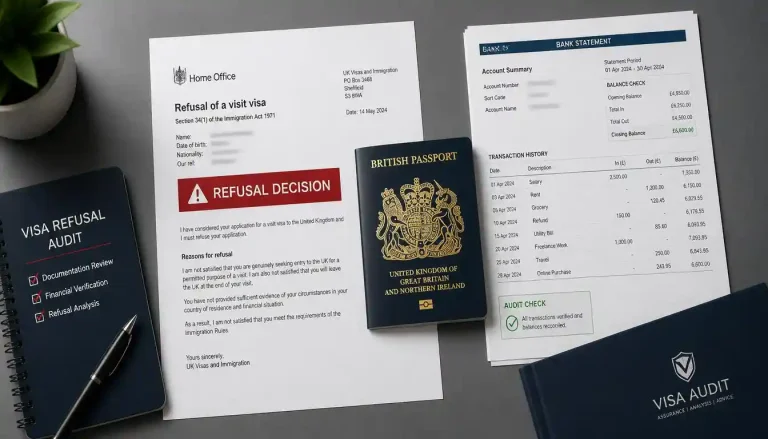
Two weeks later, UKVI issued a refusal letter citing Paragraph V 4.2(a). The caseworker wrote:
“You claim to be employed as a network engineer earning 950 KWD per month. However, your bank statements show significant lump-sum credits that do not correspond with your declared earnings. Furthermore, you hold temporary residency in Kuwait and have not demonstrated sufficient domestic ties to your home country. I am not satisfied that you are a genuine visitor who will leave the UK at the end of your visit.”
The Forensic Diagnosis of the Failure
Tariq made three critical errors common to Paragraph V 4.2(a) refusals:
- Unexplained Income Spikes: His bank account received transfers from private IT consultations without contracts or official tax receipts.
- Fragile Residence Anchors: Submitting only a civil identification card failed to prove his career stability or long-term commitments outside the UK.
- Lack of Departure Evidence: The officer had no documentary reason to believe Tariq would return to his job once in the UK.
Expatriates living under temporary contracts must actively establish their departure incentives. To navigate these residency challenges, examine our focused guide on how to prove genuine visitor intention for uk visa before submitting temporary work papers.
The Corrective Reapplication Strategy
Rather than rushing into an immediate reapplication with the same records, Tariq spent four weeks compiling contemporaneous third-party documents.
His second application presented an entirely restructured evidentiary bundle:
| Original Refusal Ground | The Corrective Evidentiary Bundle |
|---|---|
| Unverified Bank Inflows | Submitted a 6-month Wage Protection System (WPS) payroll statement, accompanied by signed consulting contracts and client remittance advice for every deposit. |
| Weak Expatriate Ties | Provided an attested company NOC detailing six years of continuous employment, approved paid leave dates, and a registered long-term apartment lease. |
| Doubt Over Departure Intent | Submitted verified commercial assets, family civil registrations showing elderly parents dependent on his local presence, and proof of fixed property abroad. |
Alongside these documents, Tariq included a point-by-point Rebuttal Cover Letter reconciling every line of the previous refusal.
Within eleven working days, the entry clearance officer reversed the prior doubt and granted a standard visitor visa.
6. Challenging the Decision: Fresh Application vs. Pre-Action Protocol (PAP)
When an Entry Clearance Officer refuses your visa under Paragraph V 4.2(a), you do not have an automatic right of administrative appeal unless human rights grounds were explicitly raised.
This leaves two procedural routes to challenge the refusal: submitting a fresh application or filing a Pre-Action Protocol (PAP) for Judicial Review under the official GOV.UK Pre-Action Protocol Guidance.
Choosing the incorrect path costs significant time and legal expense without solving the core evidentiary issue.
Understanding the Pre-Action Protocol (PAP)
A Pre-Action Protocol (PAP) letter is a formal legal notice sent to the Home Office Litigation Operations team before launching a Judicial Review in the Upper Tribunal.
It asserts that the caseworker’s decision was legally flawed, irrational, or made without considering material evidence submitted in the original file.
You should consider a PAP challenge only under specific, documented conditions:
- Material Fact Ignored: The caseworker stated that you provided no bank statements, yet complete, stamped statements were uploaded and acknowledged in the receipt checklist.
- Perverse Rationale: The officer applied a standard outside the Immigration Rules, such as requiring a minimum account balance that does not exist in law.
- Procedural Unfairness: The decision-maker relied on external checks without providing you a fair opportunity to verify or clarify alleged discrepancies.
A PAP challenge does not allow you to introduce new documents that were missing from your first submission; it only evaluates whether the officer acted unlawfully based on the evidence already before them.
Why a Fresh Application is the Stronger Strategic Move
In over 90% of Paragraph V 4.2(a) refusals, the decision is not legally unlawful; it is an evidentiary failure under the civil standard of proof.
The officer concluded on the balance of probabilities that your ties were inadequate because your original documentation was incomplete or ambiguous.
Submitting a fresh application provides distinct operational advantages:
| Decision Factor | Fresh Application Strategy | Pre-Action Protocol (PAP) Route |
|---|---|---|
| New Evidence | Full liberty to introduce contemporaneous records, affidavits, and updated audits. | Strictly limited to records already submitted in the original application. |
| Processing Speed | Standard processing takes 3 weeks (or priority within 5 working days). | 14 days for Home Office response, with potential tribunal delays running 3 to 6 months. |
| Legal Expenditure | Standard visa application fees plus translation or document certification costs. | Legal representation and potential court fees often exceeding £1,500 to £3,000. |
If your original package lacked clear proof of domestic anchors, employment continuity, or funds tracing, a Judicial Review will almost certainly fail.
Filing a meticulously prepared fresh application—backed by a structured rebuttal addressing each point in the decision notice—remains the most reliable route to obtaining entry clearance.
FAQs
Does a Paragraph V 4.2(a) refusal trigger a 10-year UK entry ban?
No. Paragraph V 4.2(a) is an evidentiary refusal about your visitor intentions, not a ban. A mandatory 10-year ban under Part 9 only applies if an applicant submits false documents, forged funds, or conceals past visa refusals.
Is there a mandatory waiting or cooling-off period before reapplying?
No statutory waiting period exists. You can technically reapply immediately, but doing so without introducing fresh, third-party corroborated records will result in a rapid second refusal.
Does this refusal harm future visa applications to the US, Canada, or Schengen?
It causes no automatic refusal, but it must be formally declared. The UK shares immigration data with the US, Canada, Australia, and New Zealand. Failing to disclose this refusal triggers immediate rejection for deception.
Can a wealthy UK citizen sponsor fix a Paragraph V 4.2(a) refusal?
No. A sponsor can only cover your finances under Paragraph V 4.2(e). They cannot prove your personal intention to leave the UK, which depends entirely on your own domestic and economic roots at home.
Final Action Plan: How to Prepare Your Reapplication
Overcoming a uk visa refusal paragraph v 4.2a requires disciplined evidence rather than emotional arguments.Entry clearance officers decide applications under the strict balance of probabilities, and your task is simply to ensure your verifiable home ties clearly outweigh their previous doubts.
Before submitting a new application, audit your previous decision notice line by line, gather contemporaneous third-party records to plug every evidentiary gap, and present your case with a dedicated uk visa reapplication cover letter to address the caseworker’s concerns directly.
Official Legal References & Immigration Sources
For absolute legal certainty, the regulatory frameworks, standards of proof, and procedural guidelines analyzed in this guide are derived directly from official UK government immigration records:
- Statutory Visitor Framework: Read the direct legislative text governing visitor entry under the GOV.UK Immigration Rules Appendix V: Visitor.
- Caseworker Assessment Standards: Review the internal evaluation benchmarks and civil balance of probabilities criteria in the GOV.UK Visit Caseworker Guidance.
- Evidentiary Documentation Checklist: Access the formal list of acceptable and prohibited records via the GOV.UK Visitor Supporting Documents Guide.
- Legal Decisions Protocol: Check the formal pre-litigation steps for unlawful entry clearance decisions under the GOV.UK Pre-Action Protocol Guidance.
- Deception and Ban Rules: Verify the statutory thresholds for ten-year entry bans outlined in the GOV.UK Part 9 Grounds for Refusal.