Securing a UK standard visitor visa self employed requires a tiered evidence dossier split into business legitimacy, financial liquidity, and domestic economic ties.
Under Appendix V (Paragraph V 4.2c), caseworkers will only approve your visa if you can clearly prove that your active business obligations back home physically compel you to return.
How to Prove Self Employment for UK Visa Applications
Self-employment for a UK visitor visa is strictly verified under Immigration Rules Appendix V (Paragraph V 4.2).
Caseworkers do not rely on unverified personal claims. Instead, they assess your commercial viability and statutory compliance through independent third-party filings.
Many applicants face instant visa refusals because they treat their business as a casual gig rather than a strictly documented legal entity.
An Entry Clearance Officer (ECO) always begins with skepticism. They assume anyone who controls their own schedule could easily abandon their enterprise to work illegally in the UK.
Your objective is to systematically invert this risk. You must demonstrate that your business operates as an independent, legally anchored economic entity.
Remember, caseworkers will never accept self-generated invoices or simple self-written affidavits as primary proof.
To prove your business is genuine, you must show that it is officially registered, pays local taxes, and maintains a continuous 12-month track record of active commercial trading.
Caseworker Verification Flow
- Stage 1: Entity Legality Audit – Officers independently cross-reference corporate incorporation registries and official tax databases (e.g., Companies House, HMRC, or domestic equivalents) to confirm the business is actively trading rather than a shell entity.
- Stage 2: Financial Proportionality Test – Caseworkers evaluate declared trip expenditure against historic net earnings to verify that travel expenses remain below 25% of annual profits and leave sufficient liquid reserves behind.
- Stage 3: Departure Compulsion Check – The caseworker audits active supplier contracts, upcoming project milestones, and physical operating assets to ensure genuine economic pressure compels a prompt return before visa expiry.

Refusal Notice Excerpt (Immigration Rules Paragraph V 4.2 a & c):
“You state that you are the proprietor of [Business Name] earning [Amount] monthly. However, you have provided no independent evidence of your business registration or statutory tax filings to substantiate these earnings. I am not satisfied that you are a genuine visitor or that you intend to leave the UK at the end of your visit.”
The verification process follows a strict hierarchy based on your formal business vehicle:
Sole Trader vs. Limited Company Director: Filing Thresholds
- Sole Proprietors / Freelancers: You bear individual financial liability, meaning your business records and personal affairs often overlap. You must present personal income tax returns covering the most recent assessment cycle, individual trade licenses, and explicit documentation proving that client receivables flow consistently into your declared accounts.
- Limited Company Directors / Shareholders: You are legally distinct from the corporate entity. Caseworkers require the formal Certificate of Incorporation, current Shareholder Register, and corporate tax certificates. Any income claimed must be reconciled via formal board dividend vouchers or documented director drawings, rather than irregular ad-hoc account transfers.
A common industry pitfall is assuming that a well-funded business bank account excuses an applicant from documenting their exact legal structure. If an officer cannot confirm your operational authority and tax standing through recognized public registries, your liquid funds will be treated as unverified capital.
For broader filing parameters and general visitor guidance, review our foundational UK Standard Visitor Visa application guide. Establish your corporate or professional standing first; financial verification rests entirely on the legitimacy of your business foundation.
UK Visa Business Registration Documents Checklist
A compliant uk visa business registration documents checklist requires an active Certificate of Incorporation or Trade License, an official Tax Registration Certificate, and operational commercial proof spanning the preceding 12 months. Documents must originate from competent government licensing bodies to pass statutory verification checks.
Document Verification Standard
- Tier 1: Official Issuer ClearanceEvery evidentiary document must originate directly from a recognized licensing body, regulated financial institution, or national revenue authority.
- Tier 2: Active Registry StandingBusiness registration numbers and municipal trade permits must be live, unexpired, and instantly verifiable on official public digital portals.
- Tier 3: 12-Month Operational TrailThe commercial record must demonstrate unbroken corporate banking activity, recurring client invoices, and continuous tax filings spanning a full 12-month timeline.
In routine file reviews, submission packages frequently collapse because applicants submit outdated licenses or unregistered trade names. UK Visas and Immigration (UKVI) officers cross-check company registration numbers directly against national public databases.
If your enterprise is marked as dormant, pending dissolution, or missing statutory annual filings, the file fails the fundamental authenticity threshold under Paragraph V 4.2.
Casual partnerships and unincorporated ventures must take special precautions. An informal operating agreement carries zero evidentiary weight unless backed by registered municipal permissions and official revenue department credentials. Every piece of paper must tie your name directly to the trading profile of the entity.
Business Structure & Mandatory Evidence Matrix
The evidentiary threshold varies significantly depending on your commercial structure. The table below outlines the mandatory legal filings and specific caseworker scrutiny metrics across different self-employed business models:
| Business Model | Primary Registration & Tax Evidence | Key UKVI Verification Metric |
|---|---|---|
| Sole Proprietor / Trader | Valid Trade License / Municipal Registration, Personal Tax Returns showing trading revenue, and 12-month current business account statements. | Direct statutory link between business license holder and operational banking activity. |
| Limited Company Director | Certificate of Incorporation, Memorandum / Articles of Association, Corporate Tax Returns, and official Company Registry live standing printout. | Clear differentiation between corporate entity liquidity and individual director drawings. |
| Freelancer / Independent Contractor | Statutory self-assessment tax certificates, recurring enterprise service agreements, and verifiable digital escrow/payment remittance logs. | Long-term client pipeline proving sustainable post-trip earnings and ongoing domestic work. |
| Partnership Firm | Registered Partnership Deed, Partner Tax Returns, and firm bank statements accompanied by a formal ‘No Objection’ board resolution. | Unanimous partner consent and independent operational continuity during the applicant’s absence. |
Case Study 2: The Freelancer’s Success Story
Sarah is a full-time digital marketer working on platforms like Upwork and Fiverr. She does not have a physical office, a corporate registration, or a traditional trade license.
Many local agencies told her she would be refused because she isn’t a “standard” business owner. But Sarah applied smartly.
Instead of a traditional trade license, she submitted her official Upwork Certificate of Earnings, her last two years of national tax returns, and digital payment remittance receipts that perfectly matched her bank deposits.
Her visa was approved without a single question.
- The Lesson: You do not need a physical shop or corporate office to prove self-employment. Verifiable digital contracts, platform earnings, and official tax clearances are just as powerful as traditional business licenses.
Caseworker Audit Warning (Paragraph V 4.2 b):
Submitting certificates with unverified translations represents an immediate rejection trigger. Any non-English commercial registration document must feature an unbroken chain of custody: a full certified translation stating the translator’s credentials, contact information, date, and original signature.
Primary Legal Credentials
- Active Operating License: Submit your baseline municipal, provincial, or national trade license showing continuous renewal history. Lapsed licenses renewed merely days before the visa lodging date raise severe suspicions of an application manufactured solely for travel facilitation.
- Corporate Tax Mandate: Provide your statutory corporate tax identification document along with the latest clearance or acknowledgment receipt. This proves the enterprise is compliant with state regulatory frameworks and active within the formal economy.
Supplementary Commercial Substantiation
- Proof of Real-Time Trading: Supplement official state licenses with external commercial evidence. This includes recent utility bills in the business’s name, supplier invoices paid over the last quarter, or verified contracts demonstrating ongoing project deliveries.
- Professional Accreditations: If your self-employment falls under regulated sectors (such as legal consulting, engineering, medical private practice, or accountancy), you must provide current practicing certificates from your recognized professional regulatory board.
To ensure your supporting travel paperwork aligns with these commercial filings, refer to our detailed walkthrough on how to prove genuine visitor intention for UK visa.
Once corporate and statutory standing is firmly anchored through verifiable registries, the caseworker moves to the financial core: forensic examination of your trading cashflow and personal liquidity.
UK Visa Self Employed Bank Statement Requirements
Meeting the requirements for a UK standard visitor visa self employed applicant mandates submitting at least 6 consecutive months of formal bank statements for both business and personal accounts.
Officers strictly check if your bank deposits match your declared income. If they spot a sudden, unexplained lump sum of cash, your visa will be refused immediately under Paragraph V 4.2(e).
Financial Scrutiny Model
- Phase 1: Turnover Verification Caseworkers cross-reference declared business turnover against 12 months of consecutive commercial bank deposits and filed corporate tax records.
- Phase 2: Fund Origin Audit Visa officers scrutinize every large deposit to ensure the money came directly from real clients, not just borrowed funds parked in your account to make you look wealthy.
- Phase 3: Mathematical Proportionality Test The total projected trip expense is benchmarked against annual net earnings (capped at 25%) while ensuring accessible post-travel liquidity remains at least three times the trip budget.
A common misconception among self-employed applicants is that presenting a high closing balance guarantees approval. Entry clearance officers review the flow of funds across the entire six-month cycle rather than a single closing figure.
If statements show sudden spikes in deposits right before filing, officers view the balance as “parked capital” or borrowed funds intended solely to deceive immigration controls.
Entrepreneurs must present both business and personal banking trails. Business statements demonstrate genuine commercial trade and solvency, while personal statements prove the funds are legally yours to spend without stripping working capital from the enterprise.
Core Financial Scrutiny Benchmarks
UKVI caseworkers assess self-employed banking records against strict numerical thresholds rather than subjective personal claims. The table below details the core financial benchmarks and primary grounds for refusal under Appendix V:
| Financial Assessment Metric | Caseworker Audit Threshold | Primary Rejection Trigger |
|---|---|---|
| Personal Disposable Liquidity | Balance ≥ 3x total estimated trip cost | Unencumbered funds drop below emergency margins after trip expenses are deducted. |
| Trip Expense Proportionality | Total trip cost ≤ 25% of annual net profit | Trip expenses consume a disproportionate share of annual net business income. |
| Deposit Origin Verification | 100% of non-standard deposits traceable to invoices | Unexplained cash or third-party bank transfers lacking contractual documentation. |
| Statement Continuity | 6 continuous months without missing days or pages | Ad-hoc summary sheets or missing intermediate transaction periods. |
Refusal Assessment Excerpt (Paragraph V 4.2 e):
“Your personal bank statement reflects several large, uncharacteristic deposits totaling [Amount] in the weeks preceding this application. You have supplied no verifiable audit trail or third-party documentation to establish the economic origin of these funds. Consequently, I am not satisfied these funds are genuinely available for your use.”
- The Core Issue: Sudden, undocumented lump-sum transfers are classified as “funds parking” under Paragraph V 4.2(e). Caseworkers automatically reject personal assertions unless every unusual credit is backed by client invoices, sales contracts, or official liquidation receipts.
Mathematical Benchmarks for Self-Employed Solvency
- The 3x Liquidity Rule: Maintain an unencumbered personal balance equal to or greater than three times your total projected travel budget (Balance ≥ 3x trip cost). This proves to caseworkers that visiting the UK will not leave you financially destitute upon return.
- The 25% Revenue Ceiling: Your declared journey expenses should not exceed one-fourth of your certified annual post-tax profit (Trip cost ≤ 25% of annual net earnings). Allocating excessive savings to short-term holiday itineraries undermines credibility.
Handling Unexplained Deposits and Irregular Invoices
- Reconcile Invoices with Deposits: Every commercial credit exceeding your baseline transaction average must link directly to an invoice, contract, or cleared client payment milestone.
- Exclude Direct Cash Lodgements: Over-the-counter physical cash deposits are heavily scrutinized. If your business collects physical cash, you must present formal sales books, municipal receipt registers, and official tax filings accounting for the funds.
- Account for Seasonal Fluctuations: If your enterprise experiences cyclical revenue, detail these patterns in your financial filings so periodic troughs are not interpreted as insolvency.
Documenting the liquidity path through structured bank statements establishes transactional credibility. The next critical checkpoint is aligning these banking figures with certified tax assessment returns.
Case Study 1: The “Funds Parking” Trap
Meet Rahul, a freelance consultant who earns a steady £1,500 per month.
Just ten days before applying for his UK visa, he borrowed £4,000 from his brother and deposited it into his bank account to make his savings look much stronger. The result? The caseworker immediately rejected his application under Paragraph V 4.2(e).
Why? Because the sudden £4,000 lump sum did not match his regular monthly income history. The officer classified it as “funds parking”—money borrowed temporarily just to deceive immigration controls.
- The Lesson: Never drop sudden, unexplained cash into your account right before applying. Caseworkers look at the steady, natural flow of your 6-month transaction history, not just your final closing balance.
UK Visa Proof of Income Self Employed Standards
Meeting official UK visa proof of income self-employed standards requires submitting state-certified tax returns for the minimum preceding 1 to 2 consecutive assessment years, complete audited financial accounts, and traceable drawings or dividend statements.
Caseworkers evaluate third-party fiscal records rather than unverified personal estimates to confirm declared operational revenue.
A high bank balance means nothing if it does not match your official tax returns. Applications often fail because the declared income simply does not add up to the money sitting in the bank.
A prominent bank balance carries zero weight if declared annual profits on your statutory tax acknowledgment indicate minimal or non-existent commercial earnings.
UK Visas and Immigration caseworkers cross-reference your net declared profits against your bank transactions to verify that revenues represent taxable business income rather than informal, untaxed capital.
For limited liability owners and single proprietors, the standard of proof differs sharply. A sole trader must present their personal tax assessment forms alongside formal profit and loss statements.
Corporate directors must supply audited business balance sheets, board-approved dividend distributions, and matching bank deposits showing the actual withdrawal of personal funds.
Recognized vs Unacceptable Proof of Income Evidence
Caseworkers differentiate strictly between state-validated fiscal filings and unverified internal records. The table below outlines the accepted statutory documentation versus informal submissions that lead to immediate refusals:
| Document Category | Recognized Statutory Proof | Rejected Informal Documentation |
|---|---|---|
| Tax Clearance | Official revenue department acknowledgment (such as SA302 or national tax authority returns) for the last 1–2 consecutive fiscal years stamped by authorities | Self-prepared tax calculations or informal software printouts lacking state clearance barcodes. |
| Business Profitability | Audited Profit & Loss Statement and Balance Sheet signed by an independent certified accountant | Unverified internal spreadsheets, simple Excel cashbook exports, or handwritten logbooks. |
| Personal Fund Extraction | Certified dividend vouchers or formal director drawings with matching personal bank entries | Irregular cash withdrawals from business accounts without documented board resolutions. |
| Client Billing | Sequential numbered commercial invoices accompanied by corresponding bank clearing credits | Standalone quotation estimates, unpaid pro-forma slips, or informal text message payment receipts. |
Caseworker Assessment Standard (Paragraph V 4.2 c):
“You have declared a monthly net income of [Amount] from your trading activities. However, your official tax documentation reflects declared earnings substantially below this figure. In the absence of audited accounts or third-party corroboration to reconcile this discrepancy, I cannot be satisfied your financial circumstances are as represented.”
- The Core Issue: Any numerical gap between visa application earnings and sovereign tax disclosures destroys applicant credibility. Caseworkers rely strictly on government-verified tax filings rather than self-declared income figures under Paragraph V 4.2(c).
Statutory Earnings Alignment Rules
- The Multi-Year Assessment Mandate: Submit certified tax documentation covering at least the preceding 1 to 2 full assessment years. Presenting a single, recently filed return after years of non-filing flags the account for intense forensic review.
- The Tax-to-Banking Reconciliation Rule: The cumulative net profit declared on your statutory tax submission must mathematically align with the total positive credits shown on your business banking statements over that fiscal year.
- The Independent Auditor Mandate: When presenting annual profit and loss statements, engage a licensed, accredited charter or certified public accountant. The report must display the accountant’s regulatory membership number, letterhead, and physical signature.
Reconciling Drawings and Personal Reserves
- Establish Regular Payment Schedules: Rather than sporadic, uncalculated fund transfers, maintain a structured schedule of monthly or quarterly director drawings that match your stated personal cost of living.
- Separate Operational Capital: Never pay personal holiday expenses directly from a business trading account. The funds allocated for your journey must be transferred systematically into your personal account as taxed earnings well in advance of lodging your application.
To verify how your documented revenues balance with total expedition costs, read our companion reference on UK visitor visa bank balance requirements.
Once net revenues and statutory tax documentation are verified, you must organize these individual papers into a unified, refusal-proof submission dossier.
UK Standard Visitor Visa Self Employed Document Checklist
A complete submission following our UK Standard Visitor Visa document checklist requires a tiered evidence dossier split into business legitimacy, financial liquidity, and domestic economic ties.
Under Appendix V (Paragraph V 4.2c), caseworkers grant clearance only when active home obligations prove that ongoing commercial operations compel your physical return.
Dossier Tier Structure
- Tier 1: Mandatory Legal & Solvency Proofs: Primary statutory documents demonstrating corporate incorporation, active trade licensing, audited tax filings, and uninterrupted banking solvency.
- Tier 2: Domestic & Economic Return Anchors: Operational ties including unfulfilled client contracts, commercial lease deeds, payroll commitments, and family roots that prove continuous domestic obligation.
In casework assessments, self-employed applicants frequently satisfy financial balance checks but receive refusal notices under Paragraph V 4.2(c) for failing to demonstrate substantive ties to their country of origin.
If an officer concludes that your business can run indefinitely without your presence, or that your domestic ties do not guarantee departure, your application will be refused.
To eliminate discretionary doubts, your submission package must balance commercial solvency with physical accountability. The evidence file must document that taking an extended leave of absence requires active management safeguards and that key operational deadlines necessitate your physical return.
| Evidentiary Tier | Document Type & Required Specification | Verification Objective & Tie Mechanism |
|---|---|---|
| Tier 1: Legal Identity & Authority | Valid Passport, National ID, Active Trade License / Certificate of Incorporation | Confirms legal identity, official corporate registration, and business standing. |
| Tier 1: Verified Financial Liquidity | 6 consecutive months of business and personal bank statements, 1–2 years of filed tax assessments | Proves disposable travel funds and reconciles declared business earnings with taxable income. |
| Tier 2: Physical Commercial Ties | Commercial premises lease deed, property title, or utility bills in the company name | Establishes fixed physical infrastructure that cannot be easily abandoned. |
| Tier 2: Operational Dependencies | Active employee payroll schedules, local staff contracts, and tax withholdings | Demonstrates ongoing management duties and statutory employer obligations. |
| Tier 2: Contractual Return Mandates | Signed client contracts, delivery schedules, and purchase orders dated post-travel | Provides documented business obligations that require your physical return. |
Caseworker Assessment Standard (Paragraph V 4.2 c):
“Whilst you have submitted evidence of business ownership and funds, the documentation provided does not demonstrate that your ongoing physical presence is required in your home country. I am not satisfied that you have established economic ties that will compel you to leave the United Kingdom upon completion of your visit.”
- The Core Issue: Passive business ownership or remote management capability works against applicants under Paragraph V 4.2(c). Caseworkers require documentary proof of active, on-site operational duties, in-person client deliveries, or staff supervision that legally and commercially mandates a physical return.
Primary Document Classifications (Tier 1: Mandatory)
- Corporate Legal Credentials: Provide your certified trade registration, corporate articles of association, and official tax identification filings covering the latest 1–2 assessment cycles.
- Banking and Solvency Trail: Include complete, sequential bank statements across a minimum 6-month period for both company and personal accounts, bearing official bank verification stamps or downloadable digital verification credentials.
Substantive Economic Ties & Departure Mandates (Tier 2: Home Anchors)
- Staff Payroll and Employment Registers: Submit the most recent payroll records showing salary disbursements to local employees, along with corresponding social security or government pension contributions.
- Forward Commercial Commitments: Include executing contracts, upcoming service milestones, or commercial project orders that formally schedule business deliverables within 15 to 30 days after your scheduled return date.
- Physical Office Anchors: Supply a copy of your current commercial office lease agreement or title deeds, accompanied by recurring local utility payments showing active, day-to-day operations.
Printable Filing Checklist (Self-Employed Dossier)
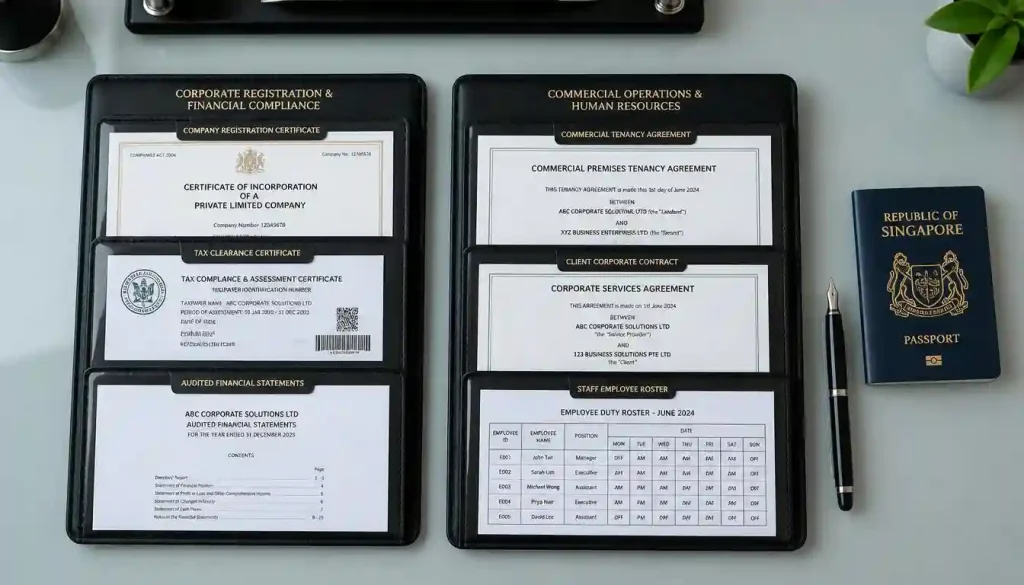
For step-by-step guidance on structuring supplementary family proofs alongside commercial evidence, see our companion reference on UK standard visitor visa document checklist for family.
Organizing a complete document portfolio provides the necessary foundation for a successful application. Next, you must understand caseworker refusal forensics to preemptively counter common assessment traps before lodging your file.
Fatal UK Visitor Visa Refusal Reasons Self Employed Applicants Face
The primary uk visitor visa refusal reasons self employed applicants encounter stem from Immigration Rules Appendix V (Paragraph V 4.2a and V 4.2c), specifically concerning fund origin credibility and economic ties.
Entry clearance officers refuse applications when declared travel budgets drain liquid operational capital or when bank turnover contradicts filed tax earnings.
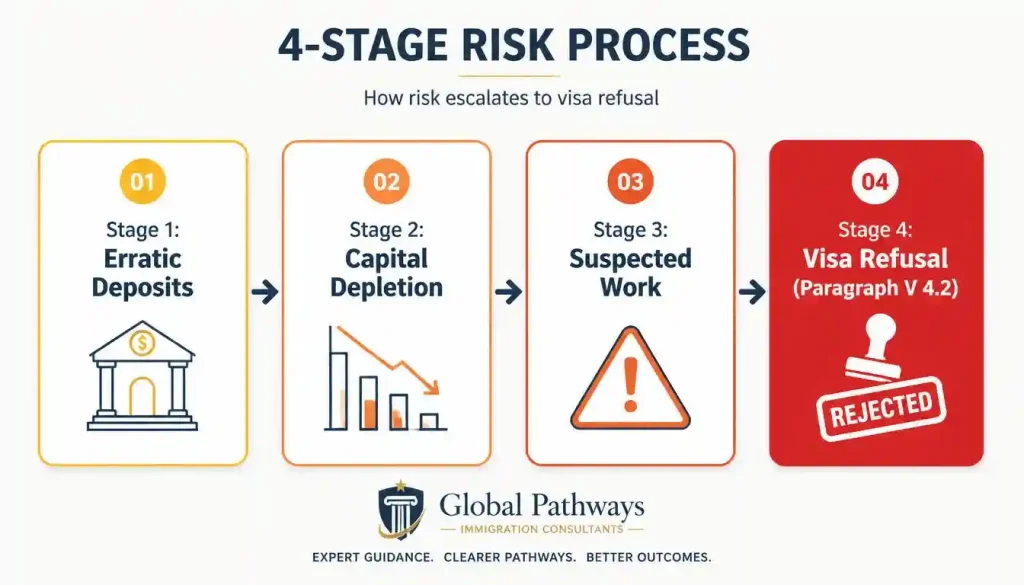
Caseworker Risk Escalation Model
- Stage 1: Erratic Deposits Unexplained lump-sum credits or sudden account balance surges immediately trigger a financial origin audit under Paragraph V 4.2(e).
- Stage 2: Capital Depletion Risk Lacking documented proof of operating capital reserves, caseworkers conclude that travel expenditures will severely jeopardize ongoing commercial solvency.
- Stage 3: Suspected Illegal Working A financially unstable enterprise signals to the entry clearance officer that the applicant intends to seek unauthorized employment within the UK economy.
- Stage 4: Mandatory Refusal With credibility compromised across multiple benchmarks, the caseworker issues a formal refusal notice under Paragraph V 4.2(a), (b), and (c).(Read our guide on how to explain large cash deposits in your UK visa bank statement)
Surprising as it sounds, visa refusals rarely happen because an applicant lacks funds. They usually happen because the financial story simply does not make commercial sense to the caseworker.
Caseworkers scrutinize the proportion of your personal savings committed to the trip against your business overheads. If financing a two-week UK holiday consumes half of your annual net business profits, an officer will conclude the expenditure is commercially irrational and refuse the application under Paragraph V 4.2(a).
Another fatal pitfall is booking unconfirmed, expensive travel arrangements before receiving an entry decision. Applicants often purchase non-refundable flight tickets or pay upfront hotel deposits to prove travel intent.
However, official Home Office guidance explicitly advises against buying non-refundable tickets prior to visa clearance, and doing so offers zero evidentiary benefit during caseworker evaluation.
Strategic Comparison: Speculative vs. Evidence-Led Applications
The following comparative breakdown contrasts the financial exposure and immigration outcome between unverified submissions and audit-compliant filings:
| Application Strategy | Estimated Capital at Risk | Caseworker Refusal Exposure | Practical Evidentiary Outcome |
|---|---|---|---|
| High-Risk Speculative Filing | £1,500 – £3,500+ (Prepaid non-refundable flights, hotel bookings, application fees) | Critical Risk: Refusal under Paragraph V 4.2(a) due to financial strain or unverified cash. | Forfeited booking capital, permanent refusal record on UKVI systems, and mandatory disclosure in future filings. |
| Evidence-Led Audit Filing | £135 (Official UKVI standard 6-month application fee only) | Low Risk: Fully reconciled bank audit trail, certified tax proof, and verifiable return ties. | Protected financial capital, zero cancellation losses, and an auditable paper trail proving genuine intent. |
Official Refusal Letter Excerpt (Paragraph V 4.2 a & c):
“You have declared the total cost of your proposed visit to be £3,000 against a personal savings balance of £4,200. Given that your declared annual business profit is £8,500, I consider this proposed expenditure disproportionate to your financial circumstances.
I am not satisfied that you have sufficient funds to cover your costs without working or accessing public funds, nor that you are a genuine visitor.”_ To learn more, check how to prove genuine visitor intention for UK visa under Paragraph V 4.2.
- The Core Issue: Allocating £3,000 from an annual net profit of £8,500 represents roughly 35% of total annual earnings, directly violating the UKVI 20% to 25% proportionality ceiling. Furthermore, leaving only £1,200 in remaining savings wipes out personal safety margins, triggering automatic refusal under Paragraph V 4.2(a) and (c).
Fatal Assessment Triggers & Preemptive Fixes
- Unreconciled Fund Injections: Depositing borrowed money or unevidenced customer payments shortly before applying is treated as deceptive fund packaging.Fix: Hold personal travel funds in your account for at least 3 to 6 months prior to applying, and document every commercial deposit exceeding your baseline monthly average with signed client invoices.
- Commingling Commercial & Personal Reserves: Paying daily household expenses or holiday budgets directly out of trading accounts without formal drawing entries ruins fiscal credibility.Fix: Maintain an unbroken trail of regular, traceable monthly drawings or dividend disbursements transferred from the commercial ledger into your personal account.
- Failure to Document Business Continuity: Failing to explain who will manage daily trade operations during your trip leads caseworkers to assume your enterprise is either inactive or being abandoned.Fix: Provide a formal operational handover plan, signed delegation memos to key personnel, or scheduled client milestones confirming operations remain uninterrupted in your absence.
For a detailed forensic breakdown of caseworker assessment standards and past rejections, consult the official UKVI guidance on Paragraph V 4.2 refusal rules.
Understanding caseworker scrutiny points allows you to actively defend your portfolio. To neutralize remaining discretionary doubts, pair these safeguards with a precise, professional cover letter reconciling your financial records.
Self Employed Cover Letter for UK Visitor Visa Applications
A high-converting self employed cover letter for uk visitor visa applications functions as an audited financial reconciliation schedule rather than an emotional travel narrative.
Under Immigration Rules Appendix V (Paragraph V 4.2), caseworkers rely on this document to trace bank credits directly to filed tax earnings and verify commercial commitments requiring your return.
Entry clearance officers spend only a few minutes reviewing an application file. They will not search through multiple bank pages to find where an invoice payment landed or how your personal savings accumulated.
A structured cover letter presents your case clearly, mapping corporate earnings to personal drawings and removing ambiguity around large transactions.
The cover letter must clearly define the management safeguards operating while you are away. Explaining who will oversee daily orders, approve team actions, or handle client escalations reassures the caseworker that your company will operate normally without requiring your immediate presence.
Essential Elements of an Audit-Compliant Cover Letter
The table below outlines the core structural components and evidentiary objectives required in an explanation letter for self-employed applicants:
| Structural Component | Mandatory Evidentiary Focus | Caseworker Audit Objective |
|---|---|---|
| Trading Profile & Entity Standing | Registration numbers, tax clearance dates, and shareholding percentages | Confirms legal authority and independent operational existence. |
| Financial Reconciliation Grid | Maps declared trip expenses against annual net profit and personal reserves | Proves the journey cost is commercially proportionate and funded by verified income. |
| Operational Handover Strategy | Designated interim managers and planned operational coverage | Eliminates suspicion of business abandonment or intent to work in the UK. |
| Contractual Return Obligation | Post-travel client deliverables, vendor commitments, and project deadlines | Establishes a concrete commercial anchor compelling departure under Paragraph V 4.2(c). |
Ready-to-Use Self-Employed Cover Letter Blueprint
Use this structured template to reconcile business revenue with personal drawings, establish financial proportionality, and document unambiguous domestic return ties under Appendix V 4.2:
[Your Full Legal Name]
Proprietor / Managing Director
[Business / Trading Name & Full Physical Office Address]
Trade License / Tax Identification Number: [Registration / TIN Number]
To: The Entry Clearance Officer
UK Visas and Immigration (UKVI) | British High Commission
Subject: Standard Visitor Visa Application — Verification of Commercial Standing, Funding & Return Mandates under Appendix V 4.2
Dear Entry Clearance Officer,
I am submitting this letter in support of my application for a UK Standard Visitor Visa to undertake a [Number of Days]-day visit to the United Kingdom, arriving on [Arrival Date] and departing on [Departure Date] for the purpose of [State Exact Purpose, e.g., Exploring Historic Heritage & Tourism].
1. Commercial Status & Legal Incorporation
I am the founder and sole proprietor of [Business Name], an established commercial enterprise operating since [Year/Date]. The business is legally registered under Trade License / Registration No: [Number], with active operational premises situated at [Office/Store Address]. All corporate taxes and municipal trade renewals are up to date, as confirmed by our enclosed tax clearance certificates and trade registration renewals (enclosed in Appendix A).
2. Trip Expenditure & Financial Proportionality
The total anticipated budget for my trip is £[Trip Cost], which will be funded entirely from my personal savings account (Account No: [Last 4 Digits]). This allocation is strictly proportionate to my legitimate annual income and creates no financial strain:
- Verified Annual Business Net Profit: £[Annual Net Income] (Backed by certified accounts and tax filings)
- Average Monthly Personal Drawings: £[Monthly Personal Income]
- Closing Personal Liquid Balance: £[Current Savings Balance]
The estimated trip expense accounts for only [Percentage, e.g., 18%] of my annual verifiable earnings, leaving an unencumbered balance of more than £[Remaining Savings Balance] to maintain routine domestic commitments upon my return.
3. Legitimate Fund Origins & Audit Trail
The funds in my personal bank account reflect steady, routine transfers from my business operating account, corresponding with genuine business turnover. There are no anomalous lump-sum deposits or unverified cash injections preceding this application; all entries correspond to documented commercial transactions outlined in the attached bank ledger (Appendix B).
4. Operational Continuity & Mandatory Return Anchors
During my temporary absence, business affairs will be managed by my trusted Operations Associate / Assistant, [Associate’s Name], ensuring that daily administration continues without disruption. However, my direct physical leadership is mandatory for our upcoming commercial deliverables:
- I am legally required to supervise the execution of client contract [Contract Reference / Project Name], commencing on [Date shortly after return].
- I hold continuous statutory commitments, including commercial lease responsibilities and local staff payroll oversight.
Given my documented financial solvency, clean tax audit trail, and substantial commercial obligations in my home country, I satisfy all requirements under Appendix V 4.2(a), (c), and (e) of the UK Immigration Rules and intend to return immediately upon conclusion of my stay.
Yours faithfully,
[Your Physical Signature]
[Your Full Typed Name]
Proprietor, [Business Name] | [Direct Phone Number] | [Official Email Address]
Strategic Customization Rules
- Reconcile Significant Account Fluctuations: If your personal or corporate account received an unusually large credit within the last 6 months, add a clear sentence in Section 4 referencing the exact invoice number, client contract, and tax entry.
- Avoid Emotional Appeals: Frame your travel around documented dates, booked commitments, and balance sheets rather than general personal statements. Entry clearance decisions rest on verifiable financial and legal evidence.
To align this statement with your overall travel dossier, review our reference on UK visit visa sponsorship letter & financial proof.
With your business documentation organized and financial figures reconciled in the cover letter, complete your review using our final FAQ section and pre-submission audit shield.
FAQs
Can a freelancer apply without a commercial office?
Yes. Physical office premises are not mandatory for freelancers. You must instead provide active freelance platform contracts, digital payment remittances, and official tax assessment acknowledgments covering the preceding 12 months to prove genuine trading.
What is the minimum bank balance required for self-employed applicants?
UKVI specifies no fixed minimum balance. However, caseworkers enforce strict financial proportionality: your personal liquid balance must comfortably exceed 3 times your projected trip cost, while the trip cost should not exceed 25% of your annual net profit.
Do UKVI caseworkers verify business bank statements directly?
Yes. Entry clearance officers routinely verify statements directly with issuing banks and revenue authorities. Submitting altered statements triggers a mandatory 10-year refusal under Paragraph 9.7.1 for deceptive conduct.
How should seasonal or irregular business income be documented?
Submit 12 to 24 months of business bank statements alongside an accountant-certified profit and loss statement. This documents predictable cyclical peaks and prevents caseworkers from mistaking natural cash influxes for artificial deposits.
Can business bank accounts fund personal UK holiday expenses directly?
No. Business funds are legally viewed as working capital rather than personal wealth. You must transfer travel funds into your personal savings account as formal director drawings or documented salary prior to applying.
Pre-Submission Caseworker Audit Checklist
Complete this final practical verification before uploading your documentary package to the visa application portal:
- Entity Active Standing: Confirm corporate registration, municipal operating licenses, and tax IDs are fully active and validated on official public registries.
- Banking Reconciliation: Verify 6 continuous months of corporate and personal statements match reported tax turnover with zero unevidenced lump-sum deposits.
- Proportionality Threshold: Audit your travel budget to guarantee trip costs do not exceed 25% of verified annual net income, leaving disposable reserves of at least 3x trip expenses.
- Documented Return Anchors: Attach executed post-travel commercial contracts, active client project schedules, and commercial lease agreements dated within 30 days of planned return.
- Management Handover Protocol: Include signed delegation memos and operational contingency plans ensuring trading proceeds uninterrupted during absence.
- Certified Chain of Translation: Ensure every regional-language document carries an unbroken certified English translation with the translator’s credentials, contact details, date, and original signature.
- Once your evidentiary portfolio is assembled, follow the step-by-step UK Tourist Visa VFS Global Biometrics Appointment Process.