EB-5 Visa Application Forms and Concurrent Filing Steps
Managing the required EB-5 visa application forms and concurrent filing steps demands a strict legal approach, starting from the moment your investment capital enters escrow.
The EB-5 Reform and Integrity Act (RIA) significantly updated these rules. It introduced domestic concurrent filing, new lockbox protocols, and updated USCIS fee structures.
Before submitting your initial petition, check our complete EB-5 investor visa requirements and process guide to verify your capital benchmarks against official USCIS guidelines.
Choosing the right filing track dictates whether you must wait in your home country or can freely live and work inside the United States during adjudication.
Strategic Advantage: The RIA Onshore Concurrent Filing Privilege
Foreign nationals currently residing in the U.S. on valid non-immigrant visas (such as F-1 STEM OPT, H-1B, L-1, or O-1) can file Form I-526E and Form I-485 at the same time. This allows investors to secure continuous lawful stay, an open-market work permit (EAD), and Advance Parole travel documents within 90 to 180 days.
Core USCIS EB-5 Forms Explained
The EB-5 immigration process is structured around four primary USCIS forms. Each form represents a specific stage of your investment and residency journey.
Form I-526E: Regional Center Investor Petition
This is your foundational petition. It proves your $800,000 (TEA) or $1,050,000 investment is tied to an approved Form I-956F commercial project.
It also establishes a strict paper trail for your investment capital. If you are a standalone direct investor, you must file Form I-526 instead.
Form I-485: Adjustment of Status
Investors physically living inside the United States file this form. It transitions your temporary non-immigrant status into a 2-Year Conditional Green Card.
Form DS-260: Consular Processing
If you are applying from outside the U.S., you will file this electronic application. It is submitted through the Department of State portal to complete your embassy interview abroad.
Form I-829: Removal of Conditions
This is your final petition, filed within the 90-day window before your conditional Green Card expires.
It proves your capital remained invested and successfully created at least 10 qualifying American jobs.
To review the mandatory wealth documentation for your submission, explore our EB-5 eligibility and source of funds forensic checklist.
The 90-Day Intent Rule and Status Protection
Filing concurrently inside the U.S. provides excellent immigration benefits. However, entering the country on a single-intent visa means you must strictly follow Department of State regulations.
The 90-Day Regulatory Window
Foreign nationals on single-intent visas, like B-1/B-2 tourist or F-1 student visas, must not file Form I-485 within 90 days of entering the U.S.
Submitting your adjustment application before this 90-day period ends can trigger a government presumption of visa fraud or “preconceived intent.”
Dual-Intent Visa Exemptions
Holders of dual-intent visas, such as the H-1B or L-1, are completely exempt from this 90-day waiting period.
This means you can file Form I-485 immediately alongside your Form I-526E without risking your current immigration status.
Bridge Status Protection via Pending I-485
Once USCIS issues the receipt notice for your Form I-485, you officially enter a protected period of authorized stay.
This legal protection prevents you from accruing unlawful presence, even if your original visa expires while waiting for a final decision.

Step-by-Step Concurrent Filing Execution Workflow
Filing concurrently inside the United States transforms a long waiting period into immediate domestic stability.
Under the EB-5 Reform and Integrity Act, eligible foreign nationals on active non-immigrant visas can file their investor petition and residency adjustments together.
This includes visas like the F-1 STEM OPT, H-1B, L-1, and O-1. It allows you to process your Green Card without ever departing the country.
To execute this domestic pathway without procedural errors, investors must follow four structured legal phases.
Phase 1: Capital Deployment and Form I-526E
You must first wire the full $800,000 capital and the required administrative fee directly into the project’s escrow account.
Once the transfer is complete, obtain the Regional Center’s Form I-956F receipt or approval notice. You will attach this as the foundational project evidence to your personal petition.
Phase 2: Adjustment Docket Assembly
Next, package your Form I-526E alongside Form I-485 for Adjustment of Status.
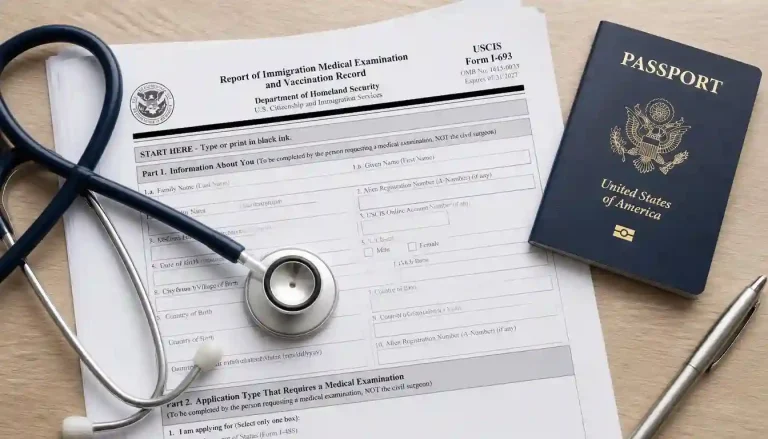
You must also include Form I-765 for an Employment Authorization Document and Form I-131 for your Advance Parole travel permit. Ensure you attach a sealed Form I-693 immigration medical report to prevent future delays.
Phase 3: Biometric Verification and Work Permissions
Within four to eight weeks of filing, you will attend an in-person fingerprint and biometric appointment at your local USCIS Application Support Center.
After this step, unrestricted open-market work permits (EAD) and international travel documents are generally issued within 90 to 180 days.
Phase 4: Conditional Residency to Form I-829 Removal
Upon the approval of both your I-526E and I-485, you will receive your physical 2-Year Conditional Green Card.
Between months 21 and 24 of holding this card, you must file Form I-829. This final step transforms your conditional status into an unconditional 10-year Permanent Resident Card.
To see how project location and TEA set-asides impact these timelines, read our EB-5 visa processing time and priority date guide.
EB-5 Application Forms, Statutory Fees, and Lockbox Routing
Filing an EB-5 petition requires paying substantial fees directly to the Department of Homeland Security. Each form serves a distinct legal purpose and demands strict documentary proof.
You must submit these forms exclusively to designated USCIS lockbox facilities. Sending your petition to standard regional service centers will result in an immediate rejection.
Below is a complete breakdown of the fees, procedural purposes, and filing windows across your entire EB-5 immigration lifecycle:
| Form ID | Core Statutory Purpose | Official USCIS Fee | Filing Window |
|---|---|---|---|
| Form I-526E | Regional Center Immigrant Petition | $11,160 + $1,000 RIA Fee | Initial Filing Phase |
| Form I-485 | Adjustment of Status (AOS) | $1,440 per adult | Concurrent or Post-I-526E |
| Form I-765 | Employment Authorization (EAD) | $520 | Filed concurrently with I-485 |
| Form I-131 | Advance Parole Travel Document | $630 | Filed concurrently with I-485 |
| Form DS-260 | Consular Immigrant Visa (Offshore) | $345 per applicant | Post-I-526E Approval (Abroad) |
| Form I-829 | Removal of Conditions (10-Yr Card) | $9,525 | Months 21–24 of Green Card |
To calculate your complete financial outlay, including legal retainers and family administrative fees, review our EB-5 visa total cost and investment amount guide.
Avoiding Lockbox Rejections and Fee Payment Traps
Procedural errors at the intake stage can cause immediate petition rejections. Making a simple filing mistake will cost you your valuable priority date.
Avoid Credit Card Payments
Banks frequently flag high-value government transactions as fraud. This causes automatic payment declines and immediate petition rejections.
Always pay your USCIS filing fees using separate cashier’s checks or bank money orders. You must provide a separate payment for every single form in the packet.
Submit Upfront Medicals
Submitting your medical exam with your initial Form I-485 is highly recommended. The exam must be completed and sealed by a certified civil surgeon.
Filing this upfront prevents routine Requests for Evidence (RFEs). It also significantly accelerates your Green Card issuance.
Ensure Correct Lockbox Routing
Form I-526E packets must go directly to designated USCIS intake facilities, such as the Dallas Lockbox.
Mailing your application to a general USCIS service center will result in an immediate delivery rejection.
Form I-829 and the 48-Month Automatic Extension
During the 90-day window before your two-year conditional residency expires, you are legally required to file Form I-829.
The 48-Month Extension Letter
Due to long adjudication timelines, USCIS will issue a Form I-797C receipt notice after you file.
This specific document automatically extends the validity of your expired conditional Green Card for exactly 48 months.
Unrestricted Travel and Work Rights
This extension letter serves as absolute legal proof of your permanent residency.
When you pair it with your expired Green Card, you can freely travel internationally. It also fully satisfies U.S. employment verification rules for your employer.
The 10-Year Permanent Green Card
USCIS will eventually review your Form I-829 to verify your job creation and capital sustainment metrics.
Once they confirm you met all requirements, they will issue your unconditional 10-year Permanent Resident Card.
If you are comparing EB-5 filing steps with corporate employment routes, read our complete EB-2 vs EB-3 visa comparison analysis.
Real-World Experience: An H-1B Concurrent Filing Case Study
To understand how these filing steps work in practice, consider a recent scenario involving a software engineer on an H-1B visa. Facing a multi-year employment backlog, they opted for an EB-5 investment in a Rural Targeted Employment Area (TEA).
By filing Form I-526E and Form I-485 concurrently, the investor completely bypassed the standard consular waiting period.
They received their standalone Employment Authorization Document (EAD) in just four months. This allowed them to immediately leave their restrictive H-1B sponsor and launch an independent startup while their main EB-5 petition remained pending.
This case highlights why precise filing is essential. If they had used a credit card (Form G-1450) or missed the sealed medical exam, a lockbox rejection would have delayed their work permit and jeopardized their legal bridge status.
FAQs
Does concurrent filing protect my children from aging out?
Yes. Under the Child Status Protection Act (CSPA), filing Form I-485 freezes your child’s age. If they are unmarried and under 21 at the time of filing, they remain eligible for a Green Card regardless of processing delays.
Can I file concurrently if my country has visa backlogs?
You can only file if your priority date is “current” on the Visa Bulletin. However, investing in reserved TEA projects (like Rural or High Unemployment) often allows investors from backlogged countries to skip the line and file immediately.
Do direct EB-5 investors use the same application forms?
Most forms are the same, but the initial petition differs. Regional Center investors file Form I-526E, while standalone direct investors must file the standard Form I-526.
Is an in-person USCIS interview required for EB-5?
Not always. USCIS frequently waives the in-person interview for EB-5 applicants if your initial source of funds documentation is strong and your background checks are perfectly clear.
Finalizing Your EB-5 Filing Strategy (H2)
Managing the EB-5 visa application forms and concurrent filing steps requires strict attention to legal details.
Taking advantage of domestic concurrent filing is the most efficient way to secure your U.S. residency.
By strictly following lockbox protocols, using cashier’s checks, and submitting upfront medicals, you can easily prevent costly administrative delays.
This careful approach protects your priority date and safely secures your family’s permanent future in the United States.
Official Regulatory Sources & Legal References
- USCIS Form I-526E Petition Guidelines: USCIS Immigrant Petition by Regional Center Investor
- USCIS Form I-485 Adjustment Guidelines: USCIS Application to Register Permanent Residence or Adjust Status
- USCIS Form I-829 Removal Guidelines: USCIS Petition by Investor to Remove Conditions on Permanent Resident Status
- U.S. Department of State Consular Processing: DOS Immigrant Visa Electronic Application (DS-260)