How to Handle Large Cash Deposits in UK Visa Bank Statement: Full Guide & Templates
Knowing exactly how to handle large cash deposits in uk visa bank statement submissions is often the difference between a stamped passport and an outright refusal.
Under Appendix V (Paragraph V 4.2) of the UK Immigration Rules, entry clearance officers must confirm that all funds genuinely belong to you. When an unexplained lump sum suddenly appears right before you apply, caseworkers flag it as borrowed “funds parking.”
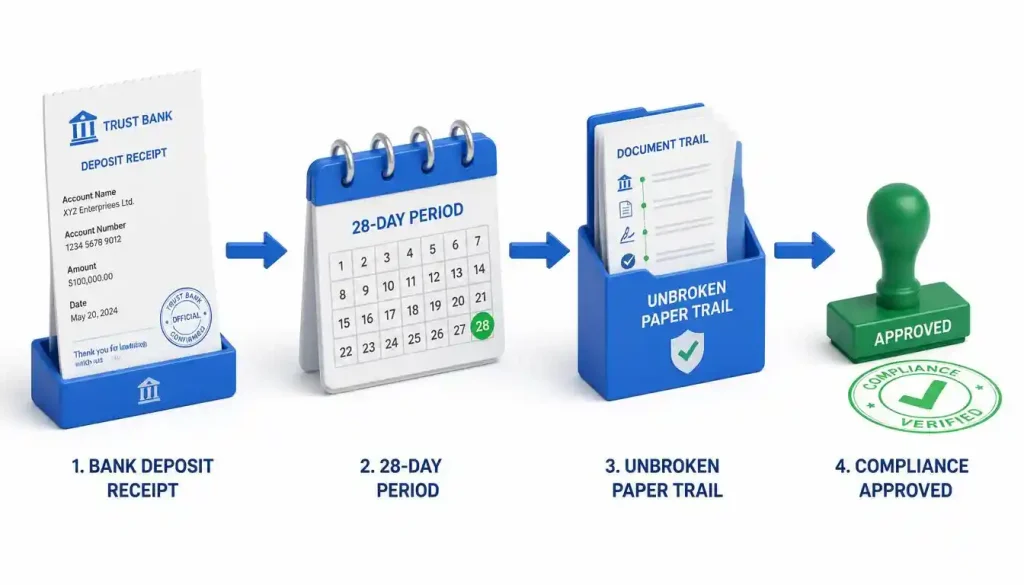
Receiving family gifts, annual bonuses, or asset sale proceeds is completely legal. To avoid refusal, you simply need an unbroken paper trail and a clear cover letter to explain where the money came from.
What a Real Refusal Letter Actually Says
When caseworkers reject an application over banking anomalies, they don’t mince words. Under Paragraph V 4.2 of Appendix V, this is the standard legal wording routinely cited in refusal notices:
Notice what triggered the refusal: it was not the total balance itself, but the disproportion. If you earn £650 a month, spend £300 on living costs, and suddenly £4,200 lands in your checking account, that breaks the natural rhythm of your financial life. Without verifiable third-party paperwork proving the origin of those funds, caseworkers conclude the money is borrowed “show money” and issue an outright refusal under Appendix V.
Deposit Types: What Passes vs. What Gets Flagged
Not every deposit carries the same scrutiny. Some transactions are routine, while others practically guarantee a refusal if submitted without context.
| Transaction Type | Scrutiny Level | What Caseworkers Expect to See |
|---|---|---|
| Transfer between own accounts | Minimal | 6-month statements for both accounts showing corresponding debit and credit entries. |
| Salary bonus or gratuity | Low Risk | Corporate payslip reflecting gross/net payout plus official tax deduction slips. |
| Liquidated Fixed Deposit (FD/DPS) | Low Risk | Bank encashment advice certificate confirming direct proceeds routing into your account. |
| Land or flat sale | Moderate Risk | Registered title conveyance deed, lawyer’s settlement ledger, and capital gains tax receipt. |
| Selling gold or jewelry | Moderate Risk | Registered merchant tax invoice, purity certificate, and direct bank transfer advice. |
| Agricultural cash or farm sales | High Scrutiny | Land title records (Khatian/Porcha), trade licenses, buyer receipts, and harvest memo audit. |
| Gifts from parents or spouse | High Scrutiny | Notarized Deed of Gift, donor’s 6-month bank statements, and civil proof of relationship. |
| Mobile wallets / Agent banking | Very High Risk | Digital wallet statement tied to personal NID/Passport plus stamped agent deposit slips. |
| Over-the-counter physical cash | Critical Risk | Raw cash receipts alone are routinely rejected without an airtight third-party legal trail. |
Give Your Money Time to Breathe: The 28-Day “Cooling Off” Window
A classic mistake is depositing cash on Monday, printing your bank statement on Tuesday, and submitting your visa application on Wednesday—doing this screams artificial staging.
While the 28-day holding rule is an official statutory mandate for UK Student visas, maintaining a 21 to 28-day “cooling-off period” is the single best strategic move for visitor visas. It demonstrates genuine financial stability rather than last-minute panic:
- Natural Account Velocity: During these few weeks, use your account normally—pay utility bills, cover groceries, and settle routine expenses so the funds integrate into your actual financial life.
- Protect the Expense Floor: Ensure your daily living deductions never pull your total balance below the realistic budget declared for your UK holiday.
Before finalizing your numbers, cross-reference our breakdown on UK visitor visa bank balance requirements so your declared trip costs match caseworker assessment tables.
How to Prove Large Cash Deposits in UK Visa Bank Statement (5 Real Cases)
Every financial inflow leaves a different paper trail. Depending on where your funds came from, here is how you build an airtight evidentiary bridge for UKVI caseworkers:
1. Moving Cash Across Your Own Accounts
This happens constantly. You keep everyday living expenses in a checking account, while your actual savings sit quietly in a high-interest DPS, Fixed Deposit, or secondary bank.
When preparing to apply, you pull that capital into your main account so all your travel funds sit under one roof.
To an entry clearance officer reviewing only your primary ledger, that sudden lump sum looks like borrowed money wired by a third party. The fix is straightforward:
- Dual Account Records: Submit 6 full months of certified bank statements for both accounts to show corresponding debit and credit entries.
- Trace the Reference: Clearly mark the transaction date, amount, and reference code showing the transfer originated from your own name.
- Encashment Certificate: If liquidating an FDR or DPS, attach the bank’s official encashment advice voucher alongside the statement.
Once the caseworker confirms the funds moved exclusively between accounts carrying your name, all suspicion of funds parking disappears.
2. Farming, Fisheries, and Family Shop Earnings
In informal or rural economies where farm produce, fish catches, or retail trades operate purely on cash, you will not have monthly corporate pay stubs.
Simply telling an entry clearance officer “I sold crops from my land” leads straight to a refusal under Appendix V. You must prove real economic production behind that cash:
Tax & Deposit Trail: Provide your latest Tax Assessment/Acknowledgement slip declaring this trade income, and pair each wholesale sale slip directly with your bank deposit counterfoil.
Land & Business Title: Attach registered ownership deeds (such as your Khatian or Porcha), along with an active municipal or Union Parishad Trade License.
Trade Invoices & Harvest Memos: Include signed buyer receipts, wholesale market (Arat) memos, and a brief statement detailing your seasonal cash-flow cycles.
3. Liquidating Gold or Family Jewelry
Selling gold ornaments is a traditional and completely legal way to raise travel funds.
The fatal trap, however, is walking out of the jewelry store with an envelope full of cash and depositing it straight into your bank account over the counter. To an entry clearance officer, that sudden cash dump looks identical to borrowed “show money.”
If you plan to fund your trip by liquidating gold, you must handle the entire transaction with strict paper discipline:
- Insist on Non-Cash Settlement: Never accept physical currency. Require the jeweler to pay you through an account-payee cheque or a direct electronic bank transfer (such as BEFTN, RTGS, or NPSB). Your bank statement should clearly reflect the jeweler’s registered business name in the credit narration.
- The Merchant’s Legal Invoice: Get a formal tax invoice printed on the jeweler’s official business letterhead. The receipt must clearly state the merchant’s registered Trade License and Tax Identification Number (TIN/BIN), along with the gross weight, net weight, gold purity (e.g., 21K or 22K), and the prevailing market rate on that day.
- Establish Prior Ownership: Caseworkers often ask an unwritten question: Where did you get that gold in the first place? If you have original purchase vouchers, attach them. If the jewelry was gifted during your wedding or inherited from parents, mention that brief context in your cover letter (e.g., “proceeds from personal wedding jewelry received in 2018”).
Matching the merchant’s printed invoice directly to the electronic credit on your bank statement leaves zero room for a caseworker to label your proceeds as “unverified cash.”
4. Financial Support or Gifts from Family
When parents, a spouse, or direct relatives step in to fund your journey, a simple bank-to-bank electronic transfer will almost certainly trigger a refusal under Appendix V (Paragraph V 4.2).
Entry clearance officers legally treat sudden family transfers as temporary “show money” unless you conclusively prove the financial capacity and genuine intention of the donor. You must submit a coordinated evidentiary bundle covering five critical points:
- Legal Proof of Relationship: Provide government-issued civil records (such as an authentic Birth Certificate, Nikahnama/Marriage Certificate, or Family Registration Certificate). If the document is in a regional language, include an official certified English translation containing the translator’s credentials, signature, and contact details.
- Notarized Deed of Gift / Affidavit: A formal legal declaration on non-judicial stamp paper affirming that the sum transferred is an unconditional, irrevocable gift with zero expectation of repayment or future liability.
- Letter of Sponsorship & ID Proof: A signed Letter of Financial Support from the donor explicitly outlining their willingness to fund your trip, accompanied by a clear copy of their National ID card and data page of their passport.
- Donor’s 6-Month Bank Statements: Six continuous months of certified bank statements from the donor proving they held adequate financial surplus and did not deplete their essential household liquidity or retirement safety net to send you the money.
- The Donor’s Legitimate Source of Funds: Showing bank balance is not enough. You must prove how the donor earned that capital—attach their recent corporate payslips, tax clearance certificates (e.g., Tax Returns/Acknowledgement Slips), or audited business trade licenses.
If you are traveling together with dependents or relying on shared household savings, review our step-by-step UK visa family document checklist to organize civil certificates and financial affidavits without filing errors.
Related Guide: If an unexplained deposit has already triggered a refusal under Paragraph V 4.2, review our legal blueprint on uk standard visitor visa refusal to build an effective appeal or fresh filing.
5. Handling Local Agent Banking & Mobile Financial Services (MFS)
Depositing money through rural agent banking outlets or digital wallets (such as bKash, Nagad, or Rocket) frequently triggers red flags on bank ledgers.
The bank statement rarely records your name for these inflows. Instead, the transaction narration typically displays only a retail outlet code, an agent booth ID, or an automated clearing reference. To an entry clearance officer, this looks like an untraceable cash injection from an unauthorized third party or loan shark.
To turn this into acceptable evidence, you must bridge the entire transactional link:
- The Electronic Trail: Download your official digital wallet statement or agent banking account ledger. Ensure your name, mobile number, and registered National ID (NID) or Passport number appear prominently at the top.
- Match the Transaction Reference: Circle the specific Transaction ID (TrxID) on your MFS/agent statement and cross-match it against the identical narration reference appearing on your main bank statement.
- The Root Cash Source: Remember that proving you transferred the money from a digital wallet only verifies the delivery method—not the actual origin. Always enclose secondary evidence proving where that liquid cash originally came from (e.g., small business sales records, freelance payment memos, or agricultural receipts).
Submitting both statements along with matched TrxIDs proves beyond doubt that the cash moved solely between your own verified accounts.
Get a Branch Confirmation Letter (The Ultimate Safety Net)
Whenever you have a complicated transaction—like property liquidation, an asset sale, or an inheritance payout—don’t rely entirely on a standard statement printout.
In line with official GOV.UK financial evidence guidance, caseworkers must be satisfied that all declared capital is authentic, unencumbered, and fully under your control.
Walk into your bank branch and request an official Fund Verification Letter on original bank letterhead. Ensure the letter states:
- The exact transaction clearance route (such as the RTGS reference, pay order, or clearing cheque number).
- Clear certification that your closing balance is liquid, completely free of liens, and readily accessible for international use.
- The branch manager’s full name, designation, official corporate email, direct telephone extension, and the bank’s round seal.
Caseworkers routinely run independent spot-checks, and having those verifiable contact details on an official letter shuts down third-party doubts instantly.
Pre-Submission Sanity Check
Run through this quick sanity check before heading down to your UK visa VFS biometrics appointment:
- The 30% Threshold: Did any single deposit exceed 30% of your typical monthly earnings? If yes, it requires a dedicated explanatory trail.
- Third-Party Paperwork: Do you have an independent, official third-party document (bank voucher, deed, or settlement memo) for every single irregular inflow?
- Account Retention: Is the deposited money still resting in the account? (Withdrawing capital right after dumping it confirms artificial funds parking).
- Statement Freshness (31-Day Rule): Is your closing bank statement date within 31 days of your online visa application submission date? Older statements are routinely marked invalid.
- Certified Translations: Are all non-English deeds, receipts, and government certificates translated by a certified translator including their full name, credentials, date, and contact details?
- Discretionary Living Buffer: Does your remaining balance comfortably cover all flight, accommodation, and personal trip expenses while still leaving a realistic reserve for your household after you return home?
Cover Letter Template: Laying Out Your Explanations Clearly
Never expect caseworkers to play detective with your paperwork. Put this clear, straightforward letter right at the front of your financial bundle:
FAQs
How long should my money stay in the bank before I apply?
There is no statutory 28-day rule for UK visitor visas, but maintaining a stable, consistent balance for 3 to 6 months builds far greater credibility than funds deposited days before applying.
Can I deposit smaller sums over several weeks to stay under the radar?
Never. Splitting large sums into repeated small cash deposits is viewed as “structuring” or suspected money laundering, triggering an immediate refusal under Paragraph V 4.2.
Can I take out a quick personal bank loan to show the required balance?
No. Using borrowed money to inflate your ledger violates genuine fund rules. Caseworkers assess repayment liabilities against your disposable income and reject applications for unaffordability.
Can I use a fixed deposit instead of keeping everything in cash?
Yes. Fixed deposits and savings certificates are fully acceptable. Simply attach a bank confirmation letter verifying the funds are liquid, unencumbered, and accessible without legal restrictions.
What if I don’t have corporate payslips as a freelancer or trader?
Corporate payslips are not mandatory. Submit official client invoices, payment gateway records (e.g., Payoneer, Wise), income tax acknowledgements, and a concise cover note explaining your trade cycle. A verified paper trail always outweighs a job title.
Official Regulatory References & Sources
- UK Immigration Rules: Appendix V: Visitor (Paragraph V 4.2) — GOV.UK statutory guidelines regarding genuine intentions and financial eligibility.
- UKVI Caseworker Guidance: Visit Guidance (Financial Assessment) — Internal Home Office criteria for evaluating unverified funds and third-party financial support.
- Supporting Documents Guide: Visitor Visa Guide to Supporting Documents — Official evidentiary standards for banking, asset sales, and non-cash fund liquidation.