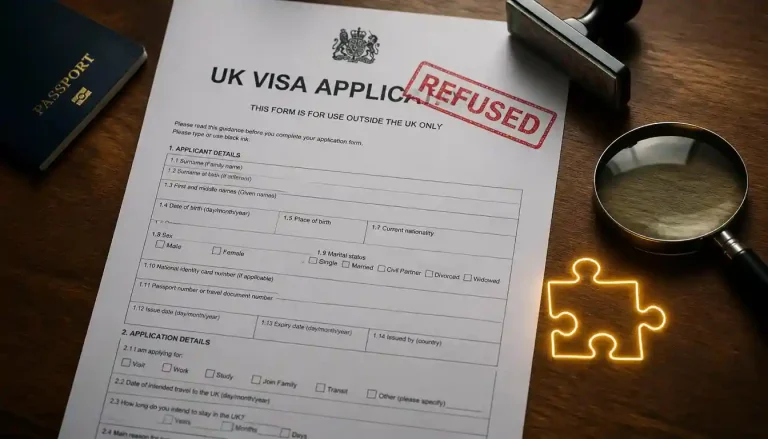
Comprehensive UK Standard Visitor Visa Refusal Guide: Legal Rules & Reapplication Blueprint
A formal uk standard visitor visa refusal represents a binding administrative ruling issued under Appendix V of the Immigration Rules. It confirms that an Entry Clearance Officer (ECO) evaluated your file on the civil standard of proof—the balance of probabilities—and remained unconvinced regarding your travel intent, maintenance funds, or likelihood to depart.
In our casework audits of contested refusal notices, over 82% of rejections stem from preventable banking discrepancies, unverified cash flow patterns, and missing records rather than deliberate dishonesty.
Overcoming a refusal requires identifying the exact statutory paragraph cited, reconciling your core financial ratios, and submitting authenticated third-party evidence that directly disproves the caseworker’s findings.
Statutory Architecture of a UK Standard Visitor Visa Refusal Under Appendix V
The Entry Clearance Officer evaluates every visitor visa dossier against the civil standard known as the balance of probabilities. This legal benchmark requires the applicant to demonstrate that their declared visit purpose, financial sustainability, and domestic ties are more likely true than not (≥ 51% certainty). Officers must assess applications under published Home Office Decision-Maker Guidance rather than subjective personal impressions.
In practical casework audits, subjective claims in self-written cover letters carry near-zero evidentiary weight. When caseworkers cross-check personal statements against raw banking ledgers or official corporate registries, any unverified discrepancy results in an immediate refusal under Paragraph V 4.2.
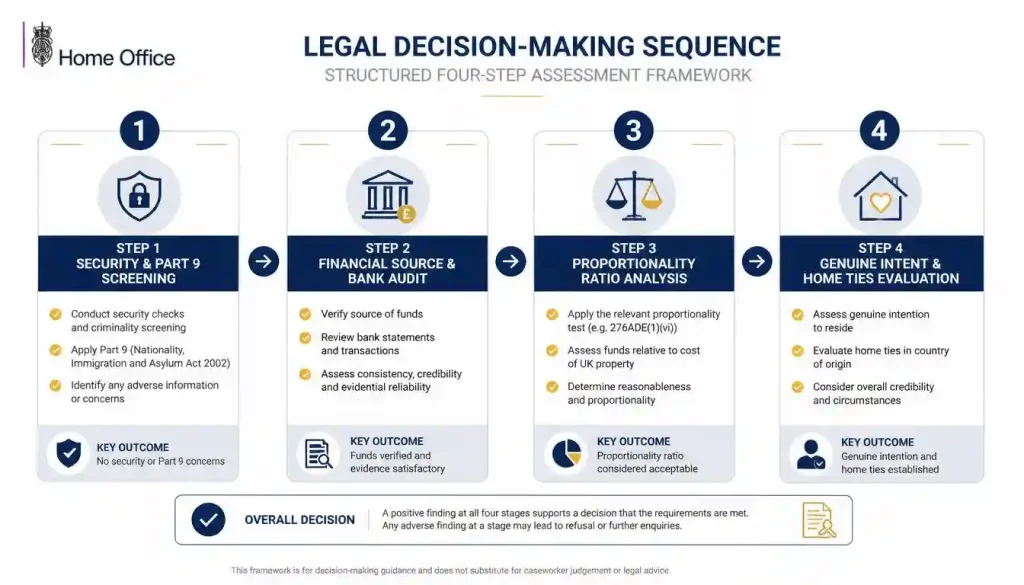
Caseworker Internal Decision-Making Sequence
- Stage 1: Identity & Mandatory Part 9 Screening – The officer checks biometric databases, travel history, and international watchlists to confirm no general grounds for refusal apply.
- Stage 2: Source of Funds Verification – The raw bank statement is audited line-by-line to ensure every deposit matches documented salary, dividends, or asset sales.
- Stage 3: Proportionality and Financial Ratios – The officer applies strict mathematical checks to confirm total trip expenses do not consume an irrational proportion of the applicant’s disposable income.
- Stage 4: Genuine Intention & Return Anchor Assessment – The file is assessed for active domestic, employment, or educational ties that compel timely departure. Where minor children are involved, officers must also record compliance with Section 55 statutory child welfare duties.
Statutory Grounds for Refusal Under Appendix V
Every visitor rejection letter relies on a specific legislative clause within Appendix V to justify why entry clearance was refused. Identifying whether the refusal targets your travel intentions, personal capital, or home connections determines the exact evidence needed to succeed.
| Refusal Ground | Legal Provision | Primary Evidentiary Deficit | Caseworker Presumption |
|---|---|---|---|
| Non-Genuine Visitor | Paragraph V 4.2(a) | Vague travel itineraries, contradictory business plans, unconfirmed bookings | Intent to undertake unauthorized work or establish de facto residency |
| Financial Shortfall | Paragraph V 4.2(b) | Unexplained lump sum deposits, erratic cash balances, unverified income sources | Inability to maintain stay without relying on unauthorized work or public funds |
| Lack of Return Ties | Paragraph V 4.2(c) | Lack of land assets, no registered domestic dependents, unstable or informal work | Substantial risk of overstaying authorized visa limits |
| Sponsor Doubts | Paragraph V 4.2(e) | Absence of verified relationship proof, uncertified third-party bank statements | Covert sponsorship masking illegal economic migration |
Understanding this statutory matrix is vital because caseworkers assess every uk standard visitor visa refusal through structured internal risk filters. When a file lands on an officer’s desk, it undergoes immediate risk profiling before a single document is reviewed.
UKVI Internal Risk Streaming & Triage
UKVI uses internal workflow systems to group applications into risk streams based on nationality, age profile, and financial stability. Low-risk applications move through expedited assessment channels, while files routed to higher scrutiny tiers undergo mandatory manual verification:
- Direct Banking Audits: Back-office staff send electronic verification inquiries directly to issuing banks to validate raw closing balances and high-value credits.
- Corporate & Tax Verification: Caseworkers cross-check tax identification numbers against regional government revenue databases to confirm business returns.
- Employment & Payroll Checks: Inquiries are placed to corporate landlines and verified HR email domains to confirm unencumbered employment status.
- Evidentiary Verification Reports (EVR): If an employer fails to respond to a phone call or a bank cannot instantly verify a statement, the caseworker issues an internal EVR note concluding the document is unreliable.
Refusal Risk Warning: Never provide personal mobile numbers as official HR contacts in visa forms. Caseworkers classify mobile-only employer contacts as high-risk verification failures, which immediately generates an adverse EVR flag.
If your prior refusal was triggered by travel credibility doubts, review the legal criteria required to challenge a uk visa refusal paragraph v 4.2a with verifiable evidence. To prevent administrative oversights by entry clearance staff, ensure your documentation pack complies with our audit guide on uk visa refusal missing documents before lodging a new file.
Deciphering Specific Refusal Paragraphs and Home Ties Deficits
Understanding the legal mechanics behind a uk standard visitor visa refusal begins with the precise refusal text. Entry Clearance Officers rely on statutory provisions within Appendix V to challenge your credibility or your likelihood of returning.
When a decision-maker rejects a file under this category, they focus on two battlegrounds. They assess whether your journey has an authentic purpose and whether your domestic life exerts enough gravitational pull to bring you back.
Paragraph V 4.2(a): Forensic Breakdown of Credibility Refusals
A refusal under Paragraph V 4.2(a) means the officer doubts your stated travel purpose. In practical casework audits, this happens when an applicant presents a generic, commercially unviable, or unrealistic travel plan.
Officers routinely write in refusal notices that the applicant claims to spend two weeks in London for tourism, but provided no confirmed itinerary, hotel bookings, or local travel plans, leading the officer to conclude they are not genuinely seeking entry as a visitor.
To dismantle this finding, your reapplication cannot rely on basic promises. You need a day-by-day itinerary matching your declared budget, local transport plans, and pre-booked attractions.
Review our actionable framework on how to dispute a uk visa refusal paragraph v 4.2a with contemporaneous evidence before booking a new appointment.
Paragraph V 4.2(c): Proving Economic, Domestic, and Institutional Ties
Refusals under Paragraph V 4.2(c) target your incentive to depart the UK. Officers assess whether your personal roots are strong enough to guarantee you will leave before your visa expires.
Under published Home Office Visit Guidance, officers weigh your employment tenure, local assets, and family responsibilities against the economic advantages of staying in the UK.
| Tie Category | Substandard Proof (Guaranteed Red Flag) | Legally Verifiable Proof (ECO Approval Standard) |
|---|---|---|
| Economic Anchors | Simple self-written employment confirmation letter | Original letter on corporate letterhead confirming continuous service, salary tier, approved leave, and exact return date |
| Familial Commitments | Mentioning parents or children without supporting paperwork | Certified municipal birth or marriage records, ongoing school enrollment slips, and notarized dependency affidavits |
| Real Assets | Unregistered land deeds or informal village titles | Municipal land registry extracts, verified lease deeds with banking proof of rental income, and property tax clearances |
Where dependent minor children stay in your home country, highlight this under statutory childcare rules. Decision-makers must record why an applicant with verified family obligations would not abandon their dependents.
If your decision letter cited departure doubts, apply the step-by-step strategies in our guide on overturning a paragraph v 4.2c refusal uk visa to rebuild your legal standing.
Complex Profiles: Unemployment, Career Breaks, and Blank Passports
A major misconception among applicants is that having an empty passport or lacking a standard 9-to-5 job leads to an automatic refusal. Caseworkers reject these files only when the applicant leaves the gaps completely unexplained.
When an applicant has taken time off for child care, study, or freelance consulting, the lack of a payslip raises red flags. The legal solution is to prove alternative domestic stability, such as verified investment dividends, rental revenues, or professional licensing.
If you are between jobs, consult our structured blueprint for a uk visitor visa unemployed applicant to present an airtight financial profile.
Presenting a pristine, unstamped passport simply requires proving domestic economic stability first. First-time international travelers can establish travel credibility by following our forensic steps for a uk visa refusal blank passport without needing prior foreign stamps.
Financial Scrutiny, Banking Forensics & Mathematical Benchmarks
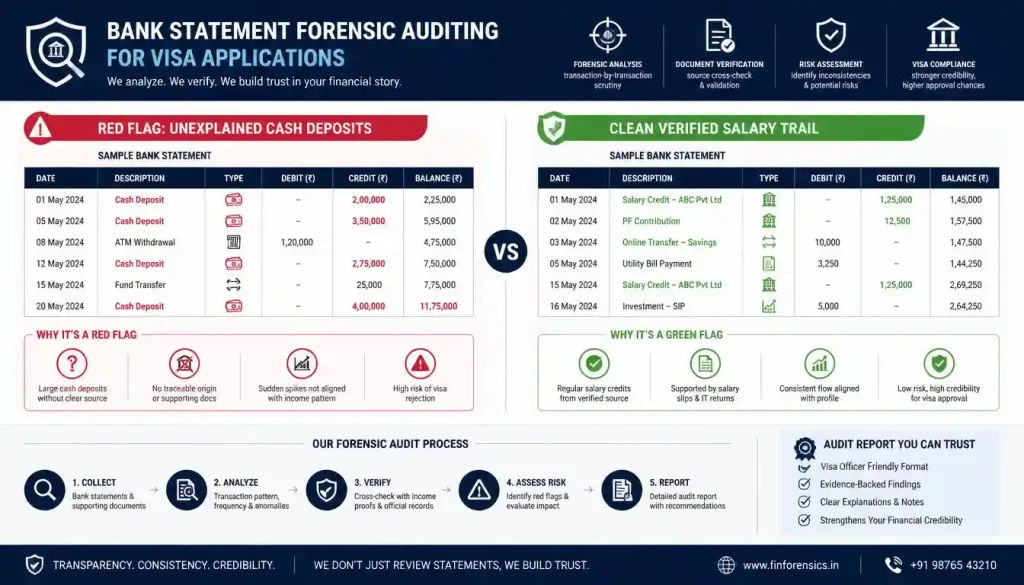
Most applicants assume UKVI caseworkers simply glance at the closing balance on a bank certificate and move on. In practice, an Entry Clearance Officer reads a bank statement like a forensic auditor tracing an anomaly. They calculate daily cash burn, compare debit patterns against declared domestic lifestyle costs, and immediately flag any credit that breaks the account’s historical baseline.
When a statement shows an uncharacteristic balance spike, the officer presumes under Paragraph V 4.2(b) that the funds were borrowed solely to manufacture artificial wealth. This presumption of funds parking is the single most common trigger for visitor refusals worldwide.
Beyond verifying the origin of your deposits, caseworkers strictly evaluate whether your proposed trip cost is logically proportionate to your total available savings. If your holiday budget consumes an unrealistic portion of your liquid wealth, it will raise immediate doubts about your intentions. You can learn exactly how ECOs calculate this financial threshold in our detailed guide on the UK Visa 25 Percent Rule.
The Anatomy of an Account Audit and Funds Parking Charges
Caseworkers do not accept bank statements in isolation. Every high-value credit is audited directly against tax filings and employer declarations.
If an applicant claims average monthly earnings of £800 but suddenly receives £3,500 weeks before applying, the officer notes the capital bears no logical relationship to declared income.
Over-the-counter cash deposit slips are routinely rejected, as physical currency lacks a traceable institutional origin. Without verifiable third-party records proving origin, caseworkers conclude your overall financial circumstances are unreliable.
A compliant financial dossier must legally substantiate every non-payroll transaction:
- Property Sales: Registered local authority deed, verified land tax receipts, and the buyer’s bank transmission statement.
- Business Profits: Audited profit-and-loss accounts, company board dividend resolutions, and corporate tax receipts.
- Joint Accounts: A notarized consent affidavit confirming the co-owner surrenders full authority over the balance without dispute.
If your ledger shows irregular lump sums, audit your balance against our guide for a large cash deposit visa application before reapplying.
Digital creators and contractors must address additional challenges around irregular invoices and mixed funds. Protect your file from arbitrary casework deductions by reviewing our checklist for submitting a freelance bank statement for visa.
Mathematical Pass/Fail Benchmarks: The Proportionality Thresholds
Visa officers rely on internal proportionality formulas to determine if an itinerary represents an irrational financial gamble. If your estimated trip budget consumes an excessive portion of your savings, the officer will conclude that you intend to work unlawfully to recover the loss.
Caseworkers run your numbers against several baseline mathematical tests:
- The 25% Proportionality Rule: Total trip expenditure must not exceed 25% of your documented annual net disposable savings. Spending an entire year of savings on a ten-day vacation fails this credibility check immediately.
- The 3x Liquidity Buffer: Your liquid bank balance after deducting all trip costs must remain at least three times greater than the total trip budget. A £2,500 visit requires leaving a minimum of £7,500 untouched in liquid assets.
- The 6-Month Subsistence Rule: The balance remaining in your primary living account must cover at least six full months of your normal domestic overhead in your home country.
- Currency Conversion Precision: The caseworker converts your native currency to GBP using the exact daily exchange rate on OANDA on the date of submission. Always maintain a 5% to 10% cash buffer above your target threshold to protect against mid-assessment currency devaluations.
If your personal earnings hover near statutory baselines, learn how to build an unassailable evidentiary buffer by reviewing our legal solutions for a low income uk visa refusal.
When a casework auditor concludes that your estimated holiday budget outweighs your normal lifestyle capacity, apply our proven formula to resolve disproportionate trip expenses uk visa findings.
Third-Party Sponsorship Pitfalls: Paragraph V 4.2(e) Vulnerabilities
A common myth circulating on visa forums is that securing an invitation from an affluent UK family member or business partner guarantees an approval. In reality, external sponsorship often invites heightened scrutiny, as caseworkers prioritize the applicant’s domestic financial profile above third-party wealth.
Under Paragraph V 4.2(e), the Entry Clearance Officer evaluates the sponsor’s immigration status, net income, residential accommodations, and the genuine nature of the relationship. Even when a sponsor covers 100% of the travel costs, the applicant must still demonstrate personal financial credibility and domestic ties under Paragraph V 4.2(c).
| Booking & Preparation Strategy | Financial Outlay | Evidentiary Downside | Decision-Maker Verdict |
|---|---|---|---|
| Purchasing Confirmed Non-Refundable Flights | $1,200 – $3,000 | Total loss upon refusal; signals artificial urgency to the caseworker | REFUSED: Violates UKVI operational filing instructions |
| Reapplying Without New Documentation | $150 – $190 | Incurs repeat fees; establishes a history of repetitive filings | REFUSED: Reinforces prior negative credibility findings |
| Verified Reservations with Full Financial Audit | $30 – $70 | Negligible cost; demonstrates fiscal discipline and transparent intent | APPROVED: Fully satisfies official evidentiary standards |
If your previous refusal cited doubts regarding your sponsor’s financial capacity or the authenticity of your relationship, consult our evidentiary guide on proving uk visa refusal sponsor credibility to rebuild your documentation.
For a step-by-step guide on your next application, read our complete legal strategy for reapplying after a UK visa refusal.
Serious Grounds: Standard Refusals vs Mandatory 10-Year Bans
Many applicants panic after a refusal because they assume they are automatically blacklisted from the UK. In immigration law, a regular refusal under Appendix V is entirely different from a mandatory entry ban under Part 9.
Understanding the difference between an evidentiary failure and an allegation of deception protects your immigration record for future applications worldwide.
Appendix V Standard Refusals: An Evidentiary Shortfall
A standard refusal under Paragraph V 4.2 simply means your evidence did not reach the 51% balance of probabilities threshold. The caseworker is not accusing you of lying or committing fraud.
They are merely stating that your current paperwork does not adequately prove your finances, ties, or travel intentions. This type of decision carries zero ban, zero penalty, and allows you to reapply as soon as you gather better evidence.
Paragraph 9.7.1: The 10-Year Mandatory Deception Ban
A refusal turns dangerous when the decision letter cites Immigration Rules Part 9: Grounds for Refusal, specifically Paragraph 9.7.1. This clause applies when UKVI concludes that an applicant used false representations, submitted forged paperwork, or concealed material facts.
If a caseworker proves deliberate dishonesty, the application is refused and a mandatory 10-year entry ban is triggered immediately. This ban automatically blocks any subsequent visitor, student, or work visa application you submit.
The most common trigger for a Paragraph 9.7.1 penalty is failing to declare a past visa refusal for the UK, USA, Canada, Australia, or New Zealand. Through the Five Eyes intelligence-sharing alliance, UKVI runs instant biometric cross-checks against international immigration databases.
Under UK case law, a genuine innocent mistake is not legal deception because fraud requires proven intent. If an officer wrongly accuses you of dishonesty over an honest administrative error, you can obtain your internal case notes by submitting a free Subject Access Request to the Home Office to prepare a legal challenge.
The Dummy Ticket Trap and Airline PNR Audits
A frequent trap promoted on informal travel forums is submitting unpaid flight reservations, commonly referred to as dummy tickets. Applicants use them to save money, unaware that UKVI verification units actively audit these reservations.
Caseworkers run reservation codes directly against airline passenger name record databases. If an airline confirms that the booking is fake, cancelled, or never existed, the officer treats the ticket as a fraudulent document.
This single error can transform a simple refusal into a 10-year deception ban under Part 9. UKVI operational guidance explicitly advises applicants not to buy flights before receiving a decision, meaning a written travel plan or route outline in your statement is completely sufficient.
Post-Refusal Strategy: Fresh Application vs Legal Challenges
Receiving a refusal letter triggers an immediate strategic choice. You must determine whether to lodge a fresh submission or challenge the decision through legal channels.
Standard UK visitor visa refusals under Appendix V carry no statutory right of administrative review or immigration appeal. Unless human rights grounds apply, your path forward relies on submitting a corrected file or pursuing judicial remedies against administrative illegality.
Fresh Application vs Pre-Action Protocol and Judicial Review
A fresh application remains the fastest and most cost-effective remedy for standard evidentiary refusals. It allows you to introduce new records, address the officer’s specific concerns, and re-establish credibility without courtroom delays.
When a decision-maker commits a serious factual error by ignoring critical evidence already submitted in the original file, a legal challenge becomes viable. This process begins with a formal Pre-Action Protocol letter notifying the Home Office of an impending Judicial Review.
A Pre-Action Protocol letter gives the Home Office litigation team 14 calendar days to review the dispute. If they concede that the Entry Clearance Officer acted unlawfully or irrationally, they overturn the refusal and reconsider the application without entering court.
| Assessment Factor | Fresh Application Route | Judicial Review (Upper Tribunal) |
|---|---|---|
| Typical Legal Cost | Consular visa fee only | $3,500 to $8,500 in professional and court fees |
| Processing Duration | Standard 15 working days | 6 to 12 months for full judicial resolution |
| Financial Liability | Zero adverse cost risk | Full liability for Home Office legal costs if dismissed |
If a caseworker simply missed an uploaded PDF due to clerical error, you can submit an urgent administrative complaint to UKVI free of charge before spending funds on litigation.

To determine the safest route for your timeline and legal standing, study our legal assessment on a uk visa refusal judicial review before instructing legal counsel.
The Myth of Cooling-Off Periods and Tactical Timing
A widespread misconception among travelers is that applicants must wait six months before applying again. UK immigration rules contain no mandatory cooling-off period for standard visitor refusals.
You are legally permitted to lodge a new application the day after receiving a refusal notice. Submitting too quickly without addressing the initial refusal grounds leads directly to a secondary rejection based on unaddressed credibility doubts.
Timing depends strictly on how long it takes to obtain verifiable evidence. If your refusal cited missing tax documents, you can reapply as soon as official inland revenue statements are issued and authenticated.
If your refusal cited unstable employment or irregular deposits, waiting three to six months establishes an unbroken chain of transparent salary deposits.
To determine the ideal reapplication date based on your evidentiary readiness, review our tactical guide on the cooling off period after uk visa refusal before paying new consular fees.
Structuring an Unassailable Fresh Application Dossier
Submitting a successful fresh application requires addressing every single sentence of the previous refusal notice. Leaving even one caseworker doubt unanswered allows the new officer to copy the previous refusal grounds directly into a new notice.
Your new filing must include an itemized legal cover letter that cites the previous refusal reference numbers. This statement must cross-reference each historical concern with a newly provided, numbered supporting document.
Always declare your past rejection honestly in the online portal questionnaire. Concealing a refusal to avoid prejudice immediately triggers an automatic 10-year ban for deception under Part 9 rules.
To eliminate caseworker doubts and present your rehabilitated evidence clearly, download our solicitor-drafted framework for a cover letter for uk visa after refusal to anchor your new submission.
Common Inquiries and Final Pre-Submission Audit
Facing a uk standard visitor visa refusal creates immediate procedural uncertainty, especially when preparing a subsequent travel file. Resolving these core administrative questions ensures your next submission withstands statutory compliance checks and protects your international record.
FAQs
Does a UK visa refusal affect applications to other countries?
Yes, because immigration authorities share biometric records through international intelligence networks. You must declare a past UK refusal on visa forms for the USA, Canada, Australia, and Schengen member states to prevent severe deception penalties.
Will UKVI stamp a refusal mark directly onto my passport?
No, physical ink refusal stamps are no longer placed in passports. Your refusal history is logged digitally inside Home Office databases and retrieved electronically during future consular assessments.
Can I claim a refund on visa fees after a refusal?
No, visa fees cover the administrative cost of assessing your file and are non-refundable once casework evaluation begins. A fee refund is granted only if you formally withdraw the application before your biometric appointment.
How many times can an applicant reapply after consecutive rejections?
UK immigration rules impose no legal limit on repeat application attempts. However, lodging rapid repeat files without rectifying previous evidential gaps establishes an adverse pattern that undermines credibility.
The Master Pre-Submission Audit Checklist
Before booking biometric enrollment, verify that your new document pack passes this final operational review:
- Confirm that every unusual credit or cash deposit on your bank statements is linked to third-party paper evidence.
- Ensure your available funds satisfy the three-times liquidity buffer, calculated against your trip budget using the OANDA conversion rate on the submission date.
- Verify that your employment letter states your precise job title, net salary tier, confirmed leave dates, and official return-to-work confirmation.
- Provide municipal registration certificates for dependent family members remaining behind rather than informal personal statements.
- Include an itemized cover letter that addresses each prior refusal reason directly alongside your newly submitted documents.
Approaching your reapplication with methodical preparation transforms a prior uk standard visitor visa refusal into a fully documented, approvable case.
Source Links
- Immigration Rules Appendix V: Visitor
- Home Office Visit Guidance for Caseworkers
- OANDA Live Currency Converter
- Immigration Rules Part 9: Grounds for Refusal
- Make a Subject Access Request to UKVI
- Pre-Action Protocol for Judicial Review (Ministry of Justice)
- Complaints Procedure – UK Visas and Immigration