How to Sponsor Parents for Green Card USA: The Complete 2026 Master Guide
Bringing your mother and father to live with you in America is a deeply rewarding milestone. Whether you are living in the United States or working abroad as an expat in Dubai, London, or Frankfurt, the family reunification process allows you to secure permanent residency for them.
The best part? Under United States immigration law, parents of adult U.S. citizens are classified as Immediate Relatives.
This classification gives your parents a massive advantage. Unlike preference categories that force applicants to wait decades for an open quota, immediate relative visas have no annual numerical caps. A visa number is immediately available as soon as USCIS approves your initial petition.
Core Eligibility Criteria: How to Sponsor Parents for Green Card USA
Before submitting paperwork to U.S. Citizenship and Immigration Services (USCIS), you must confirm that you meet every legal baseline. Missing even one requirement results in an immediate denial.
To sponsor your parents, you must satisfy three non-negotiable legal rules:
- U.S. Citizenship: You must be a native-born or naturalized U.S. citizen. Lawful Permanent Residents (green card holders) cannot file for parents under any circumstance.
- Age Threshold: You must be at least 21 years old at the time of filing.
- U.S. Domicile: You must maintain a primary residence in the United States or demonstrate concrete intent to re-establish domicile when your parents arrive.
If you meet these requirements, you are legally qualified to initiate the US family based green card process on their behalf.
Special Rules for Step-Parents and Adoptive Parents
Immigration law recognizes diverse family structures, but the qualifying standards for non-biological parents are strict.
Sponsoring a Step-Parent
You can sponsor a step-parent only if the marriage between your biological parent and your step-parent took place before your 18th birthday.
If the marriage occurred after you turned 18, USCIS does not recognize the legal parent-child relationship for immigration purposes, even if you share a strong emotional bond.
Crucial Documentary Evidence: Proving the marriage date is not enough. If either your biological parent or your step-parent was married previously, you must submit certified divorce decrees, annulment papers, or death certificates proving that all prior marriages were legally terminated before they married each other. Missing these termination documents is a guaranteed RFE trigger.
Sponsoring an Adoptive Parent
For adoptive parents, the adoption must have been fully finalized before you reached the age of 16.
The Sibling Exception: There is one rare exception: if you and your natural sibling were both adopted by the same parents, the age limit for the older sibling is extended to 18, provided the younger sibling was adopted before age 16.
The 2-Year Custody Rule: Additionally, you must prove that you were in the legal and physical custody of the adoptive parents for at least two full years. This two-year period can accumulate either before or after the formal adoption was finalized.
Warning: Once you successfully sponsor adoptive parents, U.S. immigration law dictates that you permanently and irreversibly forfeit the legal right to ever sponsor your biological parents.
Sponsoring a Father Born Out of Wedlock
If your parents were never legally married, the evidentiary requirements depend heavily on which parent you are sponsoring.
Sponsoring your mother is generally straightforward: it usually requires only your official birth certificate explicitly listing her name.
However, sponsoring an unmarried father requires substantial additional proof to satisfy USCIS. You must prove one of two specific legal conditions: either that you were legally “legitimated” under the laws of your home country before your 18th birthday, OR that a bona fide (genuine) parent-child relationship existed before you turned 21.
How to Prove a Bona Fide Relationship:
USCIS will not just take your word for it. You must provide concrete documentary evidence showing an authentic, ongoing emotional and financial bond during your childhood or youth.
Acceptable Evidence (Pro Tip): To avoid an immediate RFE, include secondary evidence such as:
- Money order receipts, wire transfers, or canceled checks proving he provided financial support.
- Your early school, medical, or religious records specifically signed by your father.
- Old, dated family photographs showing you together during your childhood.
- Notarized affidavits from older relatives or community leaders attesting to his active role in your upbringing.
The Derivative Beneficiary Trap (Can Minor Siblings Come Too?)
A very common question among sponsors is: “If I sponsor my parents, can they bring my younger, unmarried siblings with them as dependents?”
The strict legal answer is no. Because parents of U.S. citizens fall under the “Immediate Relative” category, immigration law prohibits them from bringing derivative beneficiaries. The visa is strictly for the parent.
If you want your siblings to immigrate to the United States, you must file a completely separate Form I-130 for them under the Family First Preference (F4) category. Be aware that this category faces severe visa backlogs. To understand the realistic timeline for brothers and sisters, review our complete guide on the F4 Sibling Green Card Waiting Time.
Consular Processing vs. Adjustment of Status
The filing path you select depends entirely on your parents’ current physical location.
Consular Processing (Parents Residing Abroad)
| Where are your parents right now? | |
|---|---|
| Living Outside the US | Lawfully Inside the US |
|
Consular Processing (File Form I-130 First) |
Adjustment of Status (File Forms I-130 & I-485) |
|
|
If your parents live in their native country or reside overseas, they must go through Consular Processing.
You first submit Form I-130. Once approved, the file transfers to the National Visa Center (NVC). Here, your parents must complete Form DS-260 (Online Immigrant Visa Application) and submit all financial and civil documents.
Ultimately, the case moves to the local U.S. Embassy or Consulate. Your parents attend an interview abroad, receive an immigrant visa stamp, and automatically become permanent residents upon passing through U.S. Customs and Border Protection (CBP).
Delivery Pro Tip: The physical plastic green card is not handed to them at the embassy. You must pay the USCIS Immigrant Fee online before they board their flight. The card will be mailed to your U.S. address only after they successfully land in America.
Adjustment of Status (Parents Lawfully in the US)
If your parents are physically present inside the United States after a lawful entry (such as a B-1/B-2 visitor visa or ESTA), they may be eligible to adjust their status.
In this scenario, you can take advantage of Concurrent Filing by submitting Form I-130 and Form I-485 at the exact same time. Your parents remain in the United States while the paperwork processes without having to return home for an embassy interview.
The Lawful Entry Prerequisite: AOS is strictly reserved for those who were legally inspected by a CBP officer at an airport or border. If a parent crossed the border illegally (Entry Without Inspection), they are generally disqualified from this concurrent path and must return to their home country for Consular Processing.
Can Parents Work or Travel While Waiting for AOS?
One of the biggest advantages of filing for an I-485 Adjustment of Status inside the United States is the ability to file for ancillary benefits concurrently.
Along with the I-130 and I-485, you should simultaneously file Form I-765 (Application for Employment Authorization) and Form I-131 (Application for Travel Document).
- The EAD (Work Permit): Allows your parents to legally work in the U.S. and obtain a Social Security Number while their green card is pending.
- Advance Parole (Travel Permit): Allows them to travel back to their home country for visits without abandoning their green card application.
Warning: Your parents must absolutely not leave the United States until the I-131 Advance Parole document is physically in their hands. Departing prematurely instantly cancels their pending I-485 application.
| Feature | Consular Processing | Adjustment of Status (AOS) |
|---|---|---|
| Parent Physical Location | Abroad (Home Country) | Inside the United States |
| Primary Forms | Form I-130, DS-260 | Form I-130, Form I-485 |
| Travel Restrictions | None during preliminary stages | Cannot exit the U.S. without Advance Parole |
| Interview Location | U.S. Embassy / Consulate | Local USCIS Field Office |
| Work Authorization | Granted upon arrival | Requires separate Form I-765 filing |
Step-by-Step Sponsorship Roadmap
When searching for how to sponsor parents for green card usa, it is crucial to understand that navigating USCIS requires exact chronological order.
Step 1: Submit Form I-130 (Petition for Alien Relative)
The journey begins by filing Form I-130. You must submit an independent petition for each parent. There is no “family petition” option. Filing for both your mother and father requires two completely separate petitions, two distinct filing fees, and two separate sets of supporting evidence.
Online vs. Paper Filing
USCIS strongly encourages petitioners to file Form I-130 online. Creating a USCIS online account allows you to pay the filing fee digitally (which is $50 cheaper than traditional paper filing), upload evidence directly, and track your case status in real-time.
Expert Pro Tip (Avoid the I-130A Mistake)
Many applicants get confused and mistakenly include Form I-130A in their application packet. This supplemental form is strictly required for spousal sponsorships (husband/wife). Do not submit it for your parents; doing so only creates unnecessary confusion for the reviewing officer.
What Happens Next (Form I-797C)
Within 2 to 4 weeks of successfully submitting your petition, you will receive Form I-797C (Notice of Action) in the mail. This is your official receipt notice containing your unique receipt number (e.g., IOE1234567890). Keep this document safe, as you will use this number to track your case progress online.
Step 2: NVC Civil Document Processing (Consular Only)
Following I-130 approval, USCIS transfers the case to the National Visa Center.
Here, you create an online CEAC account, pay the immigrant visa processing fees, submit the DS-260 application, and upload your financial and civil records.
The NVC Police Clearance Trap (Crucial for Expats)
When submitting civil documents to the National Visa Center (NVC), your parents must provide a Police Clearance Certificate (PCC) from their home country.
However, many applicants do not realize they must also provide a PCC from any other country where they have lived for 6 months or more since the age of 16.
For example, if your father worked in Saudi Arabia or Kuwait for a few years in his 30s, he must obtain an official police clearance from that specific country.
Missing foreign police certificates is the single biggest reason the NVC delays scheduling embassy interviews.
Step 3: Complete the Immigration Medical Examination
Every parent must pass an immigration medical exam before visa issuance to confirm they do not carry communicable diseases of public health significance.
- Consular Processing: The exam must be conducted by an embassy-approved Panel Physician (typically scheduled 1 to 2 weeks before the official embassy interview).
- Adjustment of Status (AOS): A USCIS-certified Civil Surgeon must conduct the exam in the U.S. and complete Form I-693 (Report of Immigration Medical Examination and Vaccination Record).
The Sealed Envelope Rule
After the exam, the physician will give your parents the completed Form I-693 inside a sealed envelope. Do not open this envelope under any circumstances. If the seal is broken, tampered with, or altered, USCIS will instantly reject the medical form, forcing you to pay for a completely new exam.
Mandatory Vaccinations (Including COVID-19)
The exam verifies up-to-date immunizations for MMR, Tdap, Hepatitis B, Varicella, and the seasonal flu. Crucial Update: USCIS now strictly requires the COVID-19 vaccine series for all applicants. Ensure your parents have the officially approved doses before their medical appointment to avoid costly delays.
Pro Tip for AOS Applicants: Submit the sealed Form I-693 concurrently with your initial I-485 application package. Filing them together eliminates an automatic medical RFE and significantly speeds up the final approval timeline.
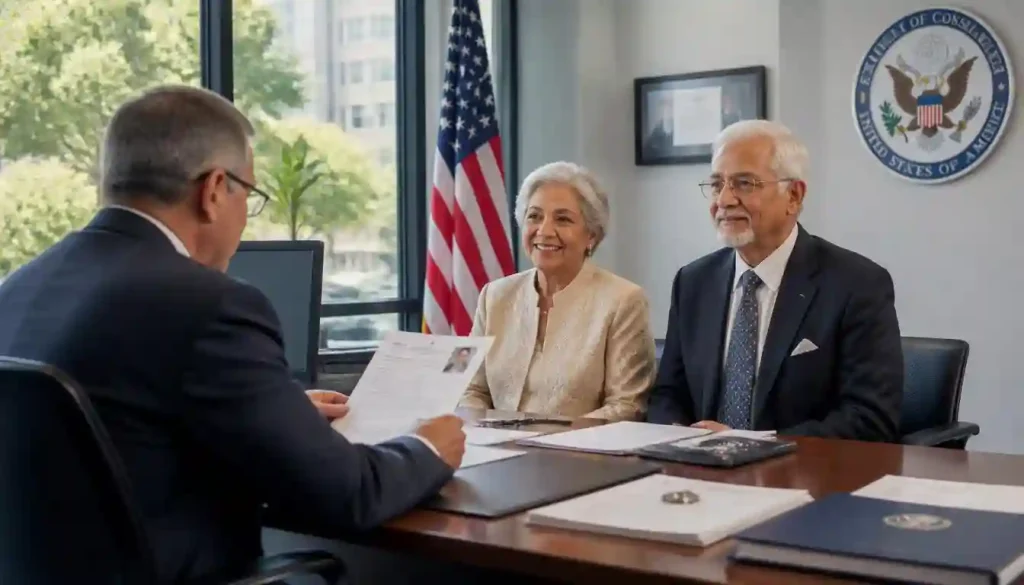
Step 4: The Visa Interview
For applicants abroad, the U.S. Embassy schedules an in-person interview where the consular officer reviews original civil records and confirms the bona fide biological or legal relationship.
For applicants inside the U.S., USCIS often waives parent interviews if the paper evidence is conclusive, though field officers retain full discretion to call applicants in.
Common Consular Interview Questions for Parents
While parent visa interviews are generally less invasive than marriage-based interviews, the consular officer will still rigorously verify your biological relationship and financial stability. Ensure your parents are prepared to answer questions such as:
- “Where exactly does your sponsoring child live in the United States?”
- “What is your child’s profession, and where do they work?”
- “Have you ever violated a U.S. visa or overstayed in the past?”
- “Who is your joint sponsor, and how do you know them?” (If applicable).
Ensure your parents carry physical, original copies of all uploaded civil documents to the interview, along with updated tax transcripts from you (the sponsor) for the most recent filing year.
Step 5: Visa Issuance and U.S. Port of Entry Arrival
Once approved abroad, the U.S. Embassy will place an immigrant visa foil inside your parents’ passports. This visa is typically valid for six months, meaning they must enter the United States before it expires.
The Sealed Envelope Warning
In some cases, the embassy will also provide a sealed envelope containing their civil and medical records. Do not open this envelope under any circumstances. Your parents must hand it unopened to the Customs and Border Protection (CBP) officer at the U.S. airport.
The Temporary I-551 Stamp
When your parents pass through U.S. Customs, the CBP officer will stamp their passports. This stamp serves as a temporary I-551 green card, valid for exactly one year. It immediately grants them the legal right to work and travel internationally while waiting for the actual plastic card.
Finally, ensure you pay the online USCIS Immigrant Fee before they board their flight to America. Once they enter the country, the physical plastic green card will be produced and mailed to your designated U.S. address, usually within 3 to 8 weeks.
2026 Complete Cost Breakdown
Immigrating parents involves statutory government application fees alongside ancillary medical and logistics expenses.
| Filing Component | Form Number | Consular Cost (Per Parent) | AOS Cost (Per Parent) |
|---|---|---|---|
| Petition for Alien Relative | Form I-130 | $675 (Paper) / $625 (Online) | $675 (Paper) / $625 (Online) |
| Adjustment of Status Application | Form I-485 | Not Applicable | $1,440 |
| State Department Immigrant Visa | Form DS-260 | $325 | Not Applicable |
| Affidavit of Support Review | Form I-864 | $120 | $0 |
| USCIS Immigrant Fee | Online | $235 | Not Applicable |
| Immigration Medical Exam | Form I-693 / Panel | ~$250 – $500 | ~$300 – $600 |
| Total Estimated Cost | — | ~$1,605 – $1,855 | ~$2,365 – $2,715 |
(Note: If you sponsor both parents simultaneously, double all listed fees. USCIS does not offer family discounts.)
Financial Sponsorship Requirements: Form I-864
The U.S. government strictly enforces public charge regulations. As the petitioner, you must sign a legally binding contract called Form I-864 (Affidavit of Support).
How to Calculate Your Total Household Size
To find out exactly how much you need to earn, you must first calculate your “household size” using a very simple formula:
- Step 1: Count yourself (The Sponsor) = 1
- Step 2: Add your spouse and dependent children = (Your current family)
- Step 3: Add the parents you are sponsoring = (1 or 2)
- Result = Your Total Household Size
Example Scenario: If you are married with one dependent child (3 people) and you are sponsoring both your mother and father (2 people), your total household size is 5. You must look at the HHS Poverty Guidelines and prove you earn at least 125% of the required income for a family of five.
You must prove that your annualized household income equals or exceeds 125% of the Federal Poverty Guidelines for your household size.
If you are married with one child and sponsoring both parents, your household size is five.
How Long Does Your Financial Liability Last?
When you or a joint sponsor sign Form I-864, you are signing a binding contract with the U.S. government. This financial liability does not expire simply because a certain amount of time passes, nor does it end if you have a falling out with your parents.
Your legal obligation to financially support them only terminates under these specific legal conditions:
- They become naturalized U.S. citizens.
- They work in the United States for 40 qualifying quarters (approximately 10 years) under the Social Security Act.
- They permanently abandon their green card status and depart the United States.
- The sponsored parent passes away.
What If Your Income Is Insufficient?
If your income falls below the required threshold, you have two legal remedies:
- Count Liquid Assets: You can use verifiable assets—cash savings, stocks, bonds, or real estate equity. For parents, total net asset value must equal at least five times the shortfall between your income and the 125% guideline.
- Use a Joint Sponsor: A joint sponsor can be any U.S. citizen or green card holder residing in the United States who meets the 125% income requirement entirely on their own. They file a separate Form I-864 and assume full secondary financial responsibility.
Essential Document Checklist
A disorganized submission invites an avoidable Request for Evidence (RFE). Assemble your application package using this structure, ideally separated by folder tabs and topped with a clear Cover Letter detailing the contents.
Petitioner Identification and Status (The Sponsor)
- Copy of your U.S. Birth Certificate, Certificate of Citizenship, or Naturalization Certificate.
- Copy of your valid, unexpired U.S. Passport.
- Proof of U.S. domicile (lease agreement, mortgage, utility bill, or active U.S. bank statements).
Parents’ Identification (The Beneficiaries)
- Copy of your parents’ valid passports (biographic data page).
- Your parents’ official birth certificates (or NABC with secondary evidence).
- Two (2) identical passport-style photographs of you (the petitioner), and two (2) for each parent. Ensure they meet strict U.S. State Department photo guidelines.
Proof of Parent-Child Relationship
- Your official government birth certificate displaying your parents’ exact full names.
- Parents’ official government marriage certificate (crucial when filing for fathers).
- Certified divorce decrees or death certificates (required if either parent had prior marriages).
- Certified English translations for all non-English civil documents.
Financial Evidence Packet (Form I-864)
- Signed Form I-864 (Affidavit of Support) for each parent.
- IRS Tax Transcripts for the most recent tax year (three prior years recommended).
- Most recent W-2s, 1099s, and the past six months of continuous pay stubs.
- An official employer verification letter confirming active status and annual compensation.
For Adjustment of Status Only (Parents Inside the U.S.)
- Copy of your parents’ Form I-94 (Arrival/Departure Record) proving lawful, inspected entry.
- Copy of their current U.S. visa stamp (e.g., B1/B2 visitor visa).
Processing Timelines and Delays
While visa numbers for immediate relatives are never backlogged, standard administrative processing requires patience.
According to updated I-130 Petition for Alien Relative Timeline metrics, the petition approval stage currently averages between 10 to 15 months at USCIS service centers.
Consular processing through the NVC and foreign embassies requires an additional 4 to 9 months, depending on local consular interview queues.
Total processing time from your initial application to green card delivery ranges between 14 and 24 months.
Can You Expedite the I-130 Processing Time?
Given the 14 to 24-month typical wait time, many citizens desperately wonder if they can speed up the process for their aging parents.
It is important to know that USCIS does not offer Premium Processing (paying an extra fee for faster service) for family-based petitions like the I-130.
However, you can submit an official Expedite Request for free if you meet strict emergency criteria. Valid reasons include a severe, sudden medical emergency (e.g., your parent needs immediate life-saving treatment only available in the U.S.) or urgent humanitarian reasons.
Warning: Simply stating that your parents are “old” or that you miss them will result in an instant denial of the expedite request. You must provide undeniable medical or official documentation to prove the severe emergency.
The Healthcare Reality: Health Insurance and Medicare for Parents
One of the most overlooked aspects of sponsoring elderly parents is the extreme cost of U.S. healthcare. Many sponsors mistakenly assume their parents will immediately qualify for free government healthcare upon arrival.
Can New Immigrant Parents Get Medicare?
Generally, no. To qualify for Medicare, your parents must be at least 65 years old and have lived in the United States continuously as green card holders for at least five years.
Until they meet this 5-year residency requirement, you will need to secure private health insurance for them. Options include purchasing a plan through the Affordable Care Act (ACA) health insurance marketplace (often called Obamacare) or buying comprehensive immigrant visitor insurance. Failure to plan for this can result in catastrophic medical bills that you, as their financial sponsor, will be legally responsible for paying.
The Hidden Global Tax Trap for Immigrant Parents
For U.S. citizens working as expats in tax-free regions like the Middle East (UAE, Qatar, Saudi Arabia), bringing parents to the USA comes with a massive, often unexpected financial consequence: U.S. Worldwide Taxation.
The moment your parents become U.S. Permanent Residents (Green Card holders), they become U.S. tax residents. This means they must report and pay taxes on their global income to the IRS. If your parents have lucrative businesses, foreign rental properties, or substantial pensions in their home country, this income is now subject to U.S. tax laws.
Before filing the I-130 petition, consult with a cross-border CPA to structure your parents’ assets and avoid a devastating tax burden.
Real-Life Case Study: Sponsoring from Abroad
Consider the scenario of Sarah, an American software director working as an expatriate in Dubai, UAE. Sarah wanted to sponsor her parents living in Cairo, Egypt.
Because Sarah earned foreign income tax-exempt under the Foreign Earned Income Exclusion (FEIE), her adjusted gross income on U.S. tax forms appeared as zero. Consequently, her income could not qualify her under the Form I-864 requirements.
To resolve this obstacle, Sarah took two specific legal actions:
First, she enlisted her brother, a physician residing in Texas, as an authorized Joint Sponsor to satisfy the 125% poverty guideline.
Second, because she resided overseas, she took active steps to document her intent to re-establish U.S. domicile. She opened a U.S. bank account, leased a townhouse in Austin, and transferred funds to American institutions.
Sarah filed the I-130 petitions online, designated the U.S. Embassy in Cairo for consular processing, and successfully secured immigrant visas for both parents within 16 months.
Critical Legal Traps and Pro Tips
Immigration adjudication contains strict legal traps. Avoid these common mistakes to protect your parents’ eligibility.
The 90-Day Preconceived Intent Trap
If your parents enter the United States on a non-immigrant visitor visa (B-1/B-2 or ESTA) and file an adjustment of status packet within 90 days, USCIS officers can apply the 90-Day Rule.
Under this standard, immigration officers can presume your parents entered the country under fraudulent intent by misrepresenting their true purpose at the border. Misrepresentation carries a permanent inadmissibility bar under INA 212(a)(6)(C)(i).
The “Day 91” Myth: Many applicants mistakenly believe that filing on day 91 makes them completely immune. This is false. While waiting 90 days lifts the automatic presumption of fraud, USCIS can still deny the green card if they find concrete evidence (such as canceling a return flight the day after arriving, or packing a shipping container of furniture) proving your parents lied to the Customs Officer at the airport. Always consult with an immigration attorney regarding application timing.
Overstay Forgiveness Under INA Section 245(a)
Many children worry that an aging parent who overstayed their authorized stay cannot obtain a green card. Under federal law, unauthorized presence and unauthorized employment are automatically waived for immediate relatives filing for Adjustment of Status inside the United States.
As long as your parent made a lawful, inspected entry through an official port of entry (meaning an immigration officer stamped their passport or issued an I-94), an expired visa will not bar them from a green card through your petition.
The “Entry Without Inspection” (EWI) Warning
This forgiveness strictly applies to visa overstays. If your parent crossed the U.S. border illegally without being inspected by a CBP officer (Entry Without Inspection), they do not qualify for this automatic waiver and cannot adjust their status inside the U.S. They will require a highly complex I-601A provisional waiver and must return to their home country for consular processing.
Certified Translation Uniformity
Every non-English document must feature an official translation certification. The translator must explicitly certify in writing that they are competent to translate from the foreign language into English and confirm that the translation is true, accurate, and complete. Uncertified self-translations are rejected immediately.
The Foreign-Language Copy Rule: You must always submit a clear photocopy of the original foreign-language document alongside its certified English translation. Submitting only the translated English copy without the original language version will trigger an automatic RFE.
The Notarization Myth (Pro Tip): Save your money. USCIS does not require translated documents to be notarized by a notary public. A formally signed certification statement from a competent translator or a professional translation agency is legally sufficient.
Overcoming the #1 RFE Trigger: Birth Certificate Issues
The single most common reason for a Request for Evidence (RFE) in parent sponsorship cases is a defective or missing birth certificate. USCIS requires your birth certificate to clearly list your name and the exact names of both parents.
If your birth was not officially registered at the time of birth (common in many developing nations), or if your parents’ names are spelled differently across various civil documents, USCIS will halt your case.
How to fix it: If a birth certificate is unavailable, you must obtain a formal Non-Availability of Birth Certificate (NABC) from the issuing government authority. Along with the NABC, you must submit secondary evidence, such as early school records, medical records, and at least two sworn affidavits from older relatives (like uncles or aunts) who were present at the time of your birth.
The Ultimate Fallback: Voluntary DNA Testing
In some regions, local civil registries are notoriously unreliable.
If USCIS or the Consular Officer determines that your birth certificate, NABC, and affidavits are still insufficient to definitively prove a biological parent-child relationship, they will issue a Request for Evidence (RFE) suggesting voluntary DNA testing.
If this happens, the testing must be conducted exclusively by a laboratory accredited by the AABB (Association for the Advancement of Blood & Biotherapies).
Never initiate a DNA test on your own before receiving the official USCIS or Embassy authorization letter, as unauthorized tests are strictly rejected.
FAQs
Can my parents visit the U.S. on a B1/B2 visa while the I-130 is pending?
Yes, but entry is not guaranteed. They must convince the border officer their visit is strictly temporary and they will return home for consular processing. Showing strong foreign ties, like property ownership or a job, is mandatory.
How long can my parents stay outside the U.S. after getting their green card?
Green cards require permanent U.S. residency. If your parents stay abroad for more than 12 consecutive months without an approved Reentry Permit, the government may consider their status abandoned and permanently revoke the green card.
Do my parents need to speak English to pass the immigration interview?
No, English proficiency is not a requirement for family-based permanent residency. Embassies conduct interviews in the local language. For USCIS field office interviews in America, they are permitted to bring a fluent, neutral interpreter.
When will my parents receive their Social Security numbers?
If you opted for SSN generation on their DS-260 or I-485 applications, the Social Security Administration will automatically mail the cards to your designated U.S. address within three weeks of their arrival or final approval, completing the final step of how to sponsor parents for green card usa.
Sources & References
- USCIS Official Form I-130 Instructions
- U.S. Department of State: Immigrant Visas for Family-Based Immigrants
- USCIS Affidavit of Support Requirements (Form I-864)
- U.S. Department of Health and Human Services (HHS) Poverty Guidelines