Special Immigrant Juvenile Status Requirements: Complete Legal Guide
Are you an undocumented minor in the US who has faced abuse, neglect, or abandonment by one or both parents? If so, the US government provides a legal lifeline. You can obtain lawful permanent residency (a Green Card) by meeting specific special immigrant juvenile status requirements.
Unlike other visa categories, this process does not require you to leave the country or rely on an abusive parent for sponsorship. However, the exact rules set by the state courts and federal government are strict. Below is the complete, up-to-date guide on how this legal protection works.
What Is Special Immigrant Juvenile Status (SIJS)?
Special Immigrant Juvenile Status (SIJS) is one of the most critical US humanitarian immigration options designed to protect vulnerable children.If a state juvenile court determines that a child needs protection because they were abused, abandoned, or neglected by a parent, that child can apply for SIJS.
Once the United States Citizenship and Immigration Services (USCIS) approves this classification, the child gets a direct pathway to apply for a Green Card. The legal framework for this status is strictly governed by federal laws, specifically INA § 101(a)(27)(J) and 8 CFR § 204.11.
Core Special Immigrant Juvenile Status Requirements
Before starting the sijs application process, you must ensure that you meet both state and federal criteria. Eligibility does not depend on how you entered the US; rather, it depends on your current situation and specific court findings.
| Requirement Category | Exact Legal Condition |
|---|---|
| Age Limit | You must be under 21 years old at the exact time you file Form I-360 with USCIS. Note: Some state juvenile courts only have jurisdiction over minors under 18, which impacts the special immigrant juvenile status age limit at the state level. |
| Marital Status | You must remain unmarried both when you file the petition and when USCIS makes its final decision. |
| Physical Presence | You must be physically present inside the United States. You cannot apply for SIJS from a foreign country. |
| Valid Court Order | You must have a valid order from a US state juvenile court declaring you dependent on the court or placing you in the custody of a state agency or an appointed guardian. |
| Non-Reunification | The state court must legally declare that you cannot safely reunite with one or both of your parents due to abuse, neglect, abandonment, or a similar basis under state law. |
| Best Interests Finding | The court must determine that it is not in your “best interest” to be returned to your home country or the country of your last habitual residence. |
Crucial Legal Protection Against “Aging Out”
One of the most important protections under federal law is that if you properly file your Form I-360 before your 21st birthday, USCIS cannot legally deny your petition simply because you turn 21 while waiting for their decision.
Additionally, regarding the “non-reunification” finding, USCIS makes it clear: the state court does not actually need to have the legal authority to place you in the custody of the unfit or abusive parent to make a valid finding.
Step-by-Step SIJS Application Process
Navigating the sijs application process involves two major stages. You cannot go directly to the federal government; you must secure a legal order from a state court first.
Stage 1: State Juvenile Court
You must petition a state court that has jurisdiction over child custody or dependency (such as a family, probate, or dependency court). Your goal is to obtain a valid court order containing the three mandatory findings: dependency, non-reunification, and your best interests. Remember, state courts cannot grant SIJ status or Green Cards—only USCIS has that authority.
Warning: The Hidden State Court Delay
Do not wait until you are almost 18 or 21 to start this process. State family courts often have massive backlogs. It can take 3 to 6 months just to get a hearing date with a judge. If you “age out” under your specific state’s law before the judge officially signs the order, you lose your SIJS eligibility forever. Always start the process at least a year before your critical birthday if possible.
Stage 2: The USCIS Petition
Once you have the state court order, you must file Form I-360 with USCIS before your 21st birthday. If an immigrant visa number is currently available in the EB-4 category, you can file your Green Card application (Form I-485) at the exact same time. If not, you must file the I-360 first and wait.
Late-Filing Safeguard: If your 21st birthday is approaching fast, USCIS provides an expedite option. You or your legal representative can call 800-375-5283 to request an emergency appointment at a local field office. This allows you to file Form I-360 in person within two weeks of your 21st birthday.
The “One-Parent” Exception: A Critical Detail
Many applicants mistakenly believe they must be abandoned or abused by both parents to qualify for SIJS. This is legally incorrect.
Federal guidelines allow you to qualify even if you are currently living safely with one protective parent.
As long as the state juvenile court determines that reunification with your other parent is impossible due to abuse, neglect, or abandonment, you are still eligible to apply.
Required Forms and Supporting Documents
To avoid delays, you must submit the exact paperwork required by USCIS. You will never be required to contact the parent who abused or abandoned you to gather these documents.
For the I-360 Petition Stage:
- Form I-360: Petition for Special Immigrant.
- Proof of Age: A valid birth certificate, passport, cartilla, or cédula. Include a certified English translation if needed.
- Court Order: The valid state juvenile court order showing the factual basis.
- ORR/HHS Consent: Written consent (only if you are currently in HHS custody).
- Form G-28: Required if an attorney is representing you.
For the Green Card Stage:
- Form I-485: Application to Register Permanent Residence or Adjust Status.
- Form I-693: Report of Medical Examination and Vaccination Record.
- Form I-765: Required only if you are applying for employment authorization.
- Form I-601: Required if you need a waiver of inadmissibility.
SIJS Processing Time and Timeline
Understanding the sijs green card timeline is crucial because the entire journey can take years. USCIS generally decides on the initial SIJ petition (Form I-360) within 180 days (about 6 months) from the official filing date.
However, the Green Card timeline depends heavily on EB-4 visa availability, which is updated monthly via the Department of State’s Visa Bulletin. Certain nationalities face massive backlogs.
Important 2026 Policy Change: For SIJ petitions filed on or after May 10, 2026, USCIS no longer automatically grants “deferred action” determinations. This means applicants stuck in the visa backlog now have less interim protection and limited access to work authorization compared to previous years.
What Happens if Your Case is Denied?
When USCIS approves your Form I-485, you officially become a lawful permanent resident on that exact date. However, if your Green Card application is denied, the law is strict: you cannot formally “appeal” the decision. But you have a legal alternative. You can file a motion to reopen or reconsider your case by submitting Form I-290B.
Common SIJS Application Mistakes to Avoid
Even with a valid court order, simple mistakes can ruin your sijs application process. Always avoid these common pitfalls:
- Aging Out: Failing to secure the state juvenile court order before your 18th or 21st birthday (depending on your state’s specific age cap).
- Getting Married: You must remain unmarried. If you marry before USCIS makes a final decision on your I-360 or I-485, your SIJS eligibility is automatically revoked.
- Leaving the United States: Traveling abroad without an approved “Advance Parole” document can lead to the abandonment of your Green Card application.
- The Travel Trap (Self-Deportation Risk): Never leave the United States while your I-360 or I-485 petition is pending without an officially approved Form I-131 (Advance Parole). If you cross the border without it, USCIS automatically considers your Green Card application “abandoned,” and you could trigger a 10-year ban from returning to the US.
How to Track Your EB-4 Visa Availability
Due to the major policy shifts in 2026 regarding deferred action, tracking your visa status is more critical than ever. SIJ applicants fall under the EB-4 (Employment-Based Fourth Preference) category.
To know when you can actually file your Green Card application, you must monitor the monthly Department of State Visa Bulletin. Find the EB-4 row and check the “Final Action Dates” for your home country. If your priority date is earlier than the date listed, an immigrant visa number is available for you.
SIJS Benefits and Limitations
Securing this classification provides life-changing special immigrant juvenile status benefits, primarily offering a direct path to lawful permanent residence without relying on an abusive parent.
However, the law imposes a permanent limitation. Under INA § 101(a)(27)(J)(iii)(II), a person granted SIJ classification can never petition for the natural or prior adoptive parent whose abuse, neglect, or abandonment formed the basis of the case. Additionally, you must remain unmarried and stay inside the US until USCIS decides your petition.
Generous Inadmissibility Waivers (The Public Charge Exemption)
Unlike many other family-based or employment-based Green Card pathways, SIJS offers incredibly powerful legal waivers.
If you entered the US without inspection (undocumented entry), you are not automatically disqualified.
Most importantly, SIJS applicants are legally exempt from the strict “Public Charge” rule.
This means you will not be denied a Green Card simply because you lack financial resources or might need government assistance.
SIJ Compliance Checklist for Applicants
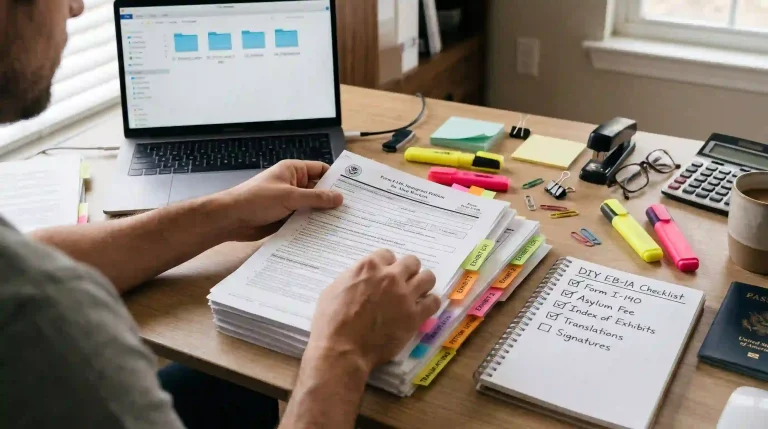
Before mailing your application to USCIS, put your documents on the table and cross-check them. A single missing paper or untranslated document can cause months of delays or a direct denial. Use this comprehensive checklist to ensure your case strictly follows the INA § 101(a)(27)(J) guidelines:
1. Personal Eligibility & Identity
- ✅ Age & Presence: I have official proof that I am under 21 and physically present inside the United States.
- ✅ Marital Status: I am currently unmarried and understand I must remain unmarried until a final decision is made.
- ✅ Foreign IDs Ready: I have my official birth certificate, passport, cartilla, or cédula.
- ✅ Certified Translations: Every single non-English document has a fully certified English translation attached.
2. The Juvenile Court Order
- ✅ The 3 Mandatory Findings: My state court order clearly declares my dependency, non-reunification (due to abuse, neglect, or abandonment), and states it is not in my best interest to return to my home country.
- ✅ Factual Evidence: The court order includes a reasonable factual basis for those three findings.
- ✅ Primary Motive: The paperwork shows I sought court protection primarily for relief from maltreatment, not just to gain an immigration benefit.
- ✅ ORR/HHS Consent (If Applicable): If I am in HHS custody and the order changes my placement, I have the mandatory written consent from the Office of Refugee Resettlement.
3. Federal Forms & Expedite Rules
- ✅ Core Petition: Form I-360 is completely filled out and signed.
- ✅ Legal Representation: Form G-28 is included if an attorney or accredited representative is handling my case.
- ✅ Age-Out Emergency Alert: (Crucial) If I am turning 21 within the next 2 weeks, my representative or I have called 800-375-5283 to request an expedited in-person appointment at a local USCIS field office.
Navigating the 2026 EB-4 Visa Bottlenecks
One of the biggest challenges for SIJ applicants right now is the massive backlog in the EB-4 visa category. Getting your Form I-360 approved is only half the battle. You cannot get your Green Card until a visa number is actually available for your specific priority date.
The May 2026 Policy Shift Impact:
A critical policy change occurred on May 10, 2026. USCIS stopped automatically granting “deferred action” for new SIJ petitions. This means if you file your I-360 now and get stuck in the visa backlog, you will have far less interim protection from deportation and much less access to work authorization while you wait.
Because of this bottleneck, you must rigorously track the monthly Department of State Visa Bulletin. Your “Priority Date” is the exact date USCIS received your Form I-360. You can only file your Green Card application (Form I-485) when the “Final Action Date” for your country on the Visa Bulletin moves past your specific priority date.
SIJS Application Costs and Filing Fees
SIJS application fees can be confusing due to recent federal legal updates. While petitions were historically fee-exempt, current costs involve multiple stages:
- Form I-360 Fee: Historically free. However, the USCIS July 2025 rule (under H.R. 1) established a $250 fee specifically for SIJ applicants (compared to the standard $515 fee).
- State Court Expenses: Varies by jurisdiction for obtaining the initial dependency court order.
- Medical Examination: Separate fees paid directly to a USCIS-authorized civil surgeon for Form I-693.
- Green Card Stage: Mandatory filing fees for Form I-485 once your priority date becomes current.
Pro Tip: Because fee rules and exemptions shift frequently, always double-check the official USCIS Fee Schedule (Form G-1055) on the exact day you file.
FAQs
Can I get a work permit while waiting for my SIJS Green Card?
Yes, but with strict conditions. You can only apply for an Employment Authorization Document (EAD) when you file your Green Card application (Form I-485). Because of the 2026 policy shift, you cannot get a work permit just by having an approved I-360 if you are still stuck in the EB-4 visa backlog.
Does SIJS directly lead to US citizenship?
Not directly, but it provides a clear pathway. SIJS grants you Lawful Permanent Residency (a Green Card). Once you have held your Green Card for five years, you become eligible to apply for US citizenship through naturalization.
Can my siblings be included in my SIJS application?
No. There are no “derivative” beneficiaries in this category. Every sibling must obtain their own separate state juvenile court order and file their own individual Form I-360 petition with USCIS.
Can I apply for SIJS if I am currently in deportation proceedings?
Yes. Even if you are in removal proceedings before an immigration judge, you can pursue SIJS. If USCIS approves your I-360 petition, your attorney can request the immigration judge to terminate the proceedings so you can safely apply for your Green Card.
Source of Information
For official guidelines, policy updates, and federal statutes, please refer to the following government resources:
- USCIS: Special Immigrant Juveniles
- USCIS Policy Manual, Volume 6, Part J
- Policy Manual, Chapter 2: Eligibility Requirements
- Form I-360 Official Details
- USCIS Fee Schedule (Form G-1055)
- Department of State Visa Bulletin
- 8 CFR § 204.11 and INA § 101(a)(27)(J) Legal Code