Complete Form N-600 Application for Certificate of Citizenship: Rules & Requirements
Are you living abroad in places like the UK, Canada, or the Middle East, but your parents are US citizens? You might actually be a US citizen without even realizing it.
However, claiming your rights requires official, legal proof. This is exactly where the form n-600 application for certificate of citizenship becomes your most valuable tool.
Filing this application allows you to secure a physical document proving your legal status. This certificate is absolutely vital for getting a US passport, applying for federal jobs, or securing financial aid for college.
Let’s break down exactly how this process works, what hidden rules you must follow, and how to avoid costly application mistakes.
What is the Form N-600 Application for Certificate of Citizenship?
At its core, the Form N-600 is an official request submitted to the US government. It asks United States Citizenship and Immigration Services (USCIS) to recognize a status you already legally hold.
Unlike going through the standard US citizenship naturalization process, you are not applying to become a new citizen. Instead, you are simply asking for a piece of paper that proves you already are one.
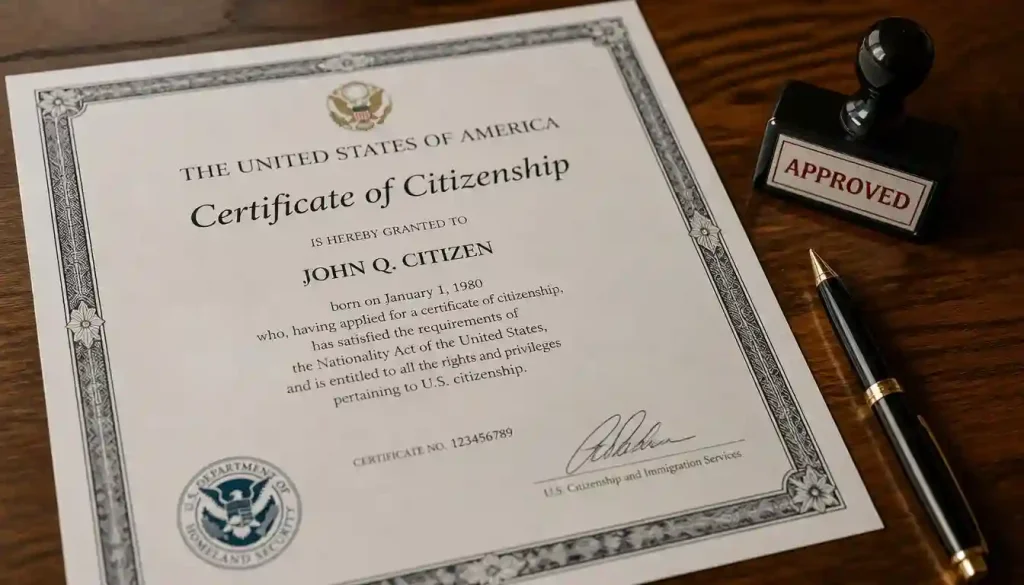
Generally, a foreign-born child claims this legal status in one of two main ways:
- Acquired Citizenship: This happens at the exact moment of birth. For example, if you were born in a Schengen country like Germany or France, but at least one of your parents was a US citizen at the time, you acquire citizenship automatically.
- Derivative Citizenship: This happens after birth. If you were born abroad to non-US parents, but your parents later became citizens, you might derive citizenship from them.
To qualify for derivative citizenship, the child usually needs to hold a permanent resident card (Green Card). They must also live in the US under the physical and legal custody of their naturalized parents.
Who is Eligible to File Form N-600?
Not everyone qualifies for a certificate. In fact, USCIS rejects thousands of applications every year simply because people misunderstand the eligibility rules.
To successfully secure your document, you must meet specific legal conditions based on when and where you were born.
Biological vs. Adopted Children
If you are a biological child born to a US citizen parent in a foreign country—like Canada, Australia, or the UAE—you generally acquire citizenship at birth.
However, your US citizen parent must meet specific “physical presence” requirements. This means they must have lived in the United States for a certain number of years before you were born.
Adopted children are also fully eligible to file the form. But the rules are slightly different. An adopted child must be residing permanently in the United States. Furthermore, they must be in the legal and physical custody of their naturalized US citizen parent.
The Child Citizenship Act of 2000 (CCA) Explained
This specific law changed the game for immigrant families. The Child Citizenship Act of 2000 (CCA) made it much easier for foreign-born children to gain derivative citizenship.
Under the CCA, a child automatically becomes a US citizen if they meet three strict conditions:
- At least one parent is a US citizen (by birth or naturalization).
- The child is currently under 18 years of age.
- The child is living in the US as a lawful permanent resident (holding a valid Green Card).
If you meet all these conditions, you do not need to take a citizenship test. You simply file the N-600 to get your official certificate.
Form N-600 vs. N-400: What’s the Real Difference?
Many expats and immigrants confuse these two forms. Choosing the wrong form will cost you hundreds of dollars in non-refundable USCIS fees.
Here is the simple truth: The N-600 is for people who are already citizens. The N-400 is for permanent residents who want to become citizens.
If you are an adult Green Card holder looking to naturalize, you must file Form N-400. Before doing so, you should carefully review the current Form N-400 Processing Timeline and Fees to understand the costs and wait times.
To make it perfectly clear, check the comparison table below:
Comparison: Form N-600 vs. Form N-400 Requirements
| Feature / Requirement | Form N-600 (Certificate of Citizenship) | Form N-400 (Naturalization) |
|---|---|---|
| Current Legal Status | Already a US Citizen (by birth or parents) | Lawful Permanent Resident (Green Card holder) |
| Purpose of the Form | To get a paper certificate proving status | To apply to become a new US citizen |
| Civics & English Test | Not required | Mandatory (unless exempt) |
| Age Requirement | Can be filed at any age | Must be at least 18 years old |
| Oath of Allegiance | Sometimes required (if over 14) | Mandatory for all applicants |
Step-by-Step Guide: How to Apply for Your Certificate
Filing your paperwork correctly the very first time is critical. A single mistake can lead to months of delays or even an outright denial of your case.
You can choose to file your form n-600 application for certificate of citizenship either online or by mail. For most expats living in the UK, Canada, or the Middle East, filing online through a USCIS account is much faster and safer.
Once USCIS receives your application, they will review your file and send a receipt notice. Later, they will schedule a biometrics appointment to capture your fingerprints and photographs.
Note: If the applicant is over 14 years old, they may be required to take the Oath of Allegiance before the certificate is officially handed over.
Crucial Documents and Evidence Checklist
Gathering solid evidence is the most important part of your application. You must prove your legal relationship to your US citizen parent beyond any doubt.
Make sure to include the following documents in your packet:
- Your Birth Certificate: Must be officially translated into English if issued in a foreign country.
- Parents’ Proof of Citizenship: This can be their US birth certificate, US passport, or official Certificate of Naturalization.
- Parents’ Marriage Certificate: To prove a legal marital relationship at the time of your birth.
- Proof of Physical Presence: Documents showing your parents lived in the US before you were born (like tax records, school transcripts, or rent receipts).
- Proof of Legal Custody: If your parents are divorced, you need court documents showing your US citizen parent has legal and physical custody of you.
Current USCIS Filing Fees and Fee Waivers (Form I-912)
Applying for this certificate is not cheap. Currently, the standard N-600 filing fee is $1,170. This fee is strictly non-refundable, even if your application gets denied.
However, there are exceptions. If you are a member or veteran of any branch of the US Armed Forces, you are entirely exempt from this fee. Additionally, if you have a low household income, you might qualify for a fee waiver by submitting Form I-912.
Pro Tip: USCIS strictly mandates that the $1,170 filing fee is non-refundable. Before creating your USCIS online account to submit the form, double-check your eligibility to avoid losing your money.
USCIS Processing Timelines: How Long Does Form N-600 Take?
One of the most common questions applicants ask is about the waiting period. Unfortunately, the N-600 processing time is not exactly fast.
Currently, USCIS processing times for this specific form range between 5 to 14 months. The exact timeline depends heavily on which local field office handles your case and how accurate your initial application is.
If you are an expat applying from a Schengen country or the Middle East, be prepared for slight delays. International mail routing and coordinating a biometrics appointment at a local US embassy or consulate can naturally extend your waiting period.
Common N-600 Denials (And How to Avoid Them)
USCIS is extremely strict when reviewing derivative citizenship cases. The most common reason for denial is failing to prove the US citizen parent’s physical presence in the United States.
Another major mistake is filing the wrong form entirely. If you were born abroad, are currently living abroad, and regularly reside outside the US, you might actually need Form N-600K instead of the standard N-600.
Also, remember that unlike the naturalization process, N-600 applicants generally do not need to pass a civics test. While adults applying for naturalization must review the US Citizenship Interview: Civics Questions and English Test guide, an N-600 applicant skips this step completely because they are already considered a citizen by law.
FAQs
Do you absolutely need Form N-600 to get a US passport?
No. You can apply directly for a US passport using your parents’ citizenship evidence. However, experts strongly recommend getting the certificate because a passport expires every 10 years, while a Certificate of Citizenship remains valid for your entire lifetime.
What should I do if my Certificate of Citizenship is lost or stolen?
Do not file a new form n-600 application for certificate of citizenship. USCIS strictly allows you to file the N-600 only once in your lifetime. To replace a lost, destroyed, or damaged certificate, you must submit Form N-565 instead.
Will an N-600 denial affect my current Green Card status?
Generally, no. If your application is denied simply because you failed to prove derivative citizenship, you will remain a Lawful Permanent Resident. Your Green Card is not automatically revoked, and you can continue to travel and work legally.
Can I request premium processing to speed up my application?
No, USCIS does not offer premium processing for this specific application. However, if you are experiencing a severe financial emergency, urgent humanitarian reasons, or hold active military status, you can submit an official expedite request through the USCIS Contact Center.
Sources & References
To ensure your application meets all current federal requirements, always verify the latest legal updates directly through these official US government portals:
- Review the latest filing instructions and fee updates via the USCIS Official Guidelines for Form N-600.
- Understand secondary evidence requirements at the U.S. Department of State Citizenship Evidence Rules.
- Read the exact legal framework governing derivative status through the Details on the Child Citizenship Act of 2000.