CR1 Visa Processing Time Middle East: 2026 Timeline and Expedite Guide
Living in Dubai, Riyadh, or Doha as an American expat is an incredible experience. However, the anxiety quickly kicks in when it is time to bring your foreign spouse back to the United States.
You are likely constantly refreshing your email, wondering about the exact cr1 visa processing time middle east. Currently, in 2026, couples applying through Middle Eastern embassies can expect an overall timeline of 14 to 22 months from the initial filing to the final visa stamp.
This specific spousal route is a crucial part of the broader us family based green card process. While the general rules apply worldwide, processing a spousal visa in the Gulf region comes with unique security checks and regional embassy backlogs.
Let us break down exactly how long each stage will take today and what you can do to avoid brutal administrative delays.
Understanding the CR1 Visa Processing Time Middle East
Before counting the days, you must understand exactly what you are applying for. The CR1 (Conditional Resident) visa is designed strictly for couples who have been married for less than two years.
When your foreign spouse successfully enters the USA with a CR1 visa, they instantly become a lawful permanent resident. They can work and travel legally from day one.
Unlike couples already living inside the United States who can simply adjust their status locally, expats in the Middle East must undergo “consular processing.” This means your application travels halfway across the world before approval.
First, your petition is reviewed by USCIS inside America. Next, it moves to the National Visa Center (NVC). Finally, it lands on the desk of a consular officer at a local embassy in the UAE, Saudi Arabia, or Qatar.
Consequently, your total waiting period is heavily influenced by the localized workload of your host country. A scheduling backlog in Doha might look very different from the current interview queue in Abu Dhabi.
Step-by-Step 2026 Timeline for Middle Eastern Expats
Let us cut straight to the chase. You want to know exactly how many months you will be waiting to fly home.
The immigration journey is broken into three distinct phases. Here is the realistic timeline you will face in 2026.
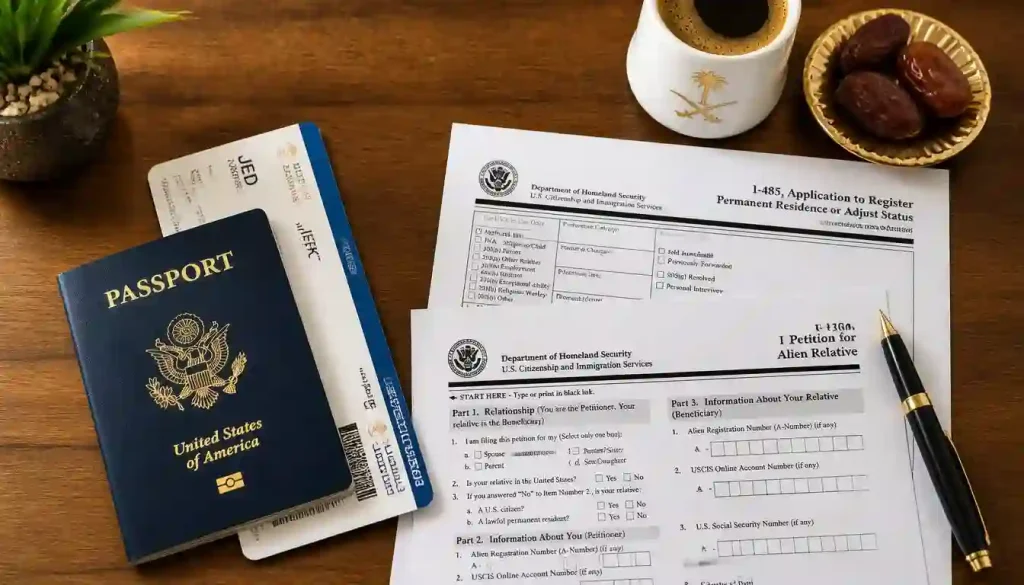
Stage 1: The USCIS Waiting Game (10 to 14 Months)
Everything kicks off when the American sponsor files Form I-130.
At this stage, your location in the Middle East does not matter at all. Your wait time depends entirely on which regional US Service Center (such as Texas or California) processes your paperwork. Currently, this is the longest and most frustrating stretch of the entire process.
Stage 2: NVC Document Qualification (1 to 3 Months)
Once USCIS approves your petition, your file is transferred to the National Visa Center (NVC).
Now, your Middle Eastern residency comes into play. You must submit your financial support forms, civil documents, and local police certificates. Fortunately, securing a clean police clearance in places like Dubai or Qatar is heavily digitized and usually very fast.
As soon as the NVC accepts every uploaded document, your case becomes officially “Documentarily Qualified” (DQ).
Stage 3: Regional Embassy Wait Times (3 to 6+ Months)
This is the final hurdle. After becoming DQ, you must wait for an open interview slot.
However, not all embassies in the Gulf operate at the same speed. Based on recent 2026 scheduling data, here is a quick breakdown of what expats can expect:
| US Embassy Location | Estimated Interview Wait Time | Workload Status |
|---|---|---|
| Abu Dhabi, UAE | 5 to 7 Months | Extremely High Volume |
| Riyadh, Saudi Arabia | 3 to 4 Months | Moderate Volume |
| Doha, Qatar | 2 to 3 Months | Lower Volume (Faster) |
As the table shows, the cr1 visa abu dhabi processing time is notoriously sluggish. Because the UAE hosts a massive international workforce, the US Embassy in Abu Dhabi faces severe backlogs compared to neighboring countries.
Why Are Middle East Embassies Experiencing Delays?
Even after reaching the embassy stage, many couples face unexpected roadblocks. The most dreaded delay in the Middle East is known as “Administrative Processing.”
If the consular officer hands you a Form 221(g) after your interview, your visa is temporarily paused. This happens frequently in the Gulf region due to strict security clearances and deep background checks.
Missing document translations are another common trap. If an Arabic marriage certificate or birth record is not properly translated into English by a certified translator, the embassy will instantly freeze your case.
The Expat “US Domicile” Trap (Form I-864)
If the US citizen sponsor currently lives and works in the Gulf region, consular officers in Abu Dhabi or Riyadh will demand solid proof of US domicile.
You must prove you plan to re-establish your primary residence in the United States before or concurrently with your spouse.
Failing to provide evidence like an active US bank account, a signed lease, or a stateside job offer will trigger an immediate Form 221(g) hold.
The Tax-Free Income Dilemma (FEIE)
Working in the Gulf usually means enjoying tax-free salaries. However, many expats utilize the Foreign Earned Income Exclusion (FEIE) on their US tax returns.
This directly drops their official Adjusted Gross Income (AGI) on IRS transcripts to zero. If your AGI does not meet the federal poverty guidelines, the embassy in Abu Dhabi or Riyadh will reject your financial sponsorship.
To avoid this, you must show significant US-based assets, maintain a stateside income stream, or secure a reliable US joint sponsor before your interview.
To keep your us embassy riyadh cr1 visa timeline on track, double-check every single stamp, seal, and signature before you step into the interview room. Do not give the officer any reason to pause your file.
Proven Ways to Expedite Your CR1 Visa Interview
Nobody wants to wait nearly two years to reunite with their spouse. Fortunately, the US government does allow for expedited processing under very strict conditions.
You cannot speed up the process simply because you miss your partner. However, if you face a severe medical emergency, extreme financial loss, or a sudden US military deployment, you can request an emergency expedite.
To do this, the US citizen sponsor must email the NVC Expedite team with concrete proof. You must attach hospital records, official deployment orders, or formal letters from doctors.
If approved, the NVC will bypass the standard queue and forward your file directly to the Middle Eastern embassy. This strategy can drastically reduce your overall cr1 interview wait time 2026.
FAQs
When should I schedule my immigration medical exam in the Gulf?
Do not book your medical exam until you receive your official interview letter from the embassy in Abu Dhabi, Riyadh, or Doha. Medical results expire after six months, and early tests might force you to pay for a second screening.
How long is a Middle Eastern police clearance valid for NVC?
Generally, police certificates from countries like the UAE or Qatar are valid for up to two years for US immigration. However, if you currently reside there, the NVC typically requires a certificate issued within the last 12 months.
Can my child be included on my CR1 visa application?
No, derivative beneficiaries cannot be included on a CR1 spousal petition. If your foreign spouse has a child, the US citizen sponsor must file a separate, individual Form I-130 (which will become a CR2 visa) for each child concurrently.
Official Sources & References
For the most accurate consulate updates, official forms, and current visa bulletins, always verify information directly through these trusted US government portals:
- US Department of State: The Immigrant Visa Process
- US Embassy & Consulate in the United Arab Emirates
- US Embassy & Consulates in Saudi Arabia