US Marriage Visa Interview Questions and Answers: The Ultimate 2026 Survival Guide
Walking into a US embassy or a local USCIS field office feels incredibly intimidating. If you are an expat working in Dubai, a professional in London, or already living stateside adjusting your status, the pressure is immense. One wrong answer can delay your life together by years.
If you are desperately searching for the exact us marriage visa interview questions and answers to prepare for the big day, you can finally breathe. We have mapped out exactly what the consular officers want to hear, the psychological traps they set, and how to prove your relationship is 100% genuine without sounding rehearsed.
Quick Summary: 2026 Marriage Visa Interview Survival
- The Golden Rule: Never guess an answer. Saying “I do not remember” is legally safer than giving a mismatched guess that triggers fraud suspicion.
- The Stokes Threat: Conflicting stories or lack of financial evidence will instantly trigger a separation interview (Stokes Interview).
- Document Overload: Always bring original legal documents in a well-organized binder, especially joint financials (bank statements, leases), not just photocopies.
Why the US Marriage Visa Interview Causes So Much Anxiety
The immigration system is intentionally designed to be difficult. Whether you are going through consular processing from the Schengen zone or navigating the broader domestic us family based green card process, the core challenge remains identical.
Here is the brutal legal reality: the interviewing officer is legally required to assume your marriage is fake.
Yes, you read that correctly. They do not start from a place of trust. Their primary job is fraud detection. Because of the high volume of sham marriages designed purely for immigration benefits, officers are highly trained to look for micro-expressions, hesitation, and conflicting stories between spouses.
This is why memorizing a generic list of facts is a terrible strategy. If you sound robotic or overly scripted, it instantly raises a red flag. You must approach this conversation like a natural dialogue, not a rigid exam.
For couples who have recently filed their i-485 adjustment of status marriage based application inside the United States, the stakes feel even higher because a denial could trigger immediate deportation proceedings.
The Psychological Game: What the Consular Officer Actually Wants
Before memorizing any questions, you must understand the psychology of a consular officer. They are actively looking for discrepancies. However, here is a massive legal secret most applicants do not realize: officers know that genuine couples argue, forget small details, and experience miscommunications.
Fake couples often have perfectly rehearsed, identical answers for everything. Real couples do not.
If your spouse asks you what you ate for dinner three days ago and you honestly forgot, simply say, “I do not remember.” Do not guess. If you guess “chicken” and your spouse guesses “pizza” in a separate room, the officer will use that discrepancy against you.
For instance, if you are enduring the CR1 Visa Processing Time Middle East, spending a year apart in Dubai or Riyadh while your spouse works in Texas, it is perfectly normal to forget what they wore during your last FaceTime call. Honesty is always your safest weapon.
Pre-Interview Prep: Dress Code and Language Barriers
Preparing for the interview is not just about memorizing questions and answers. Consular officers evaluate your entire presentation, from how you dress to how clearly you can communicate under pressure. Here is how to handle the physical and linguistic challenges of your interview day.
What to Wear and Body Language
Your interview begins the moment you walk into the waiting room. Consular officers judge your body language and attire instantly. Dress in “business casual.” For men, this means a button-down shirt and dress pants (a tie is optional but highly respected).
For women, a professional dress, blouse, or modest trousers. Do not wear jeans, t-shirts, or overly flashy jewelry. Sit up straight, maintain natural eye contact with the officer, and absolutely do not interrupt your spouse while they are answering a question.
The Interpreter Rule: What If You Do Not Speak English?
If you or your spouse are not 100% fluent in English—which is common for expats applying from the Middle East or Schengen zones—do not panic. You are legally allowed to bring a foreign language interpreter.
However, you must follow strict rules. The interpreter must be fluent in both English and your native language, and they will need to sign a formal declaration (Form G-1256) at the USCIS field office. While a friend or family member can legally interpret, hiring an impartial, professional interpreter is highly recommended to prevent the officer from suspecting that someone is “coaching” your answers.
Top US Marriage Visa Interview Questions and Answers (The 2026 Mega List)
Whether you are facing standard green card marriage interview questions domestically, or navigating the cr1 visa interview questions and answers at a foreign embassy in London, Dubai, or Manila, the officer will divide their inquiry into specific categories.
Here is the most exhaustive list of the exact questions they ask, properly categorized, along with lawyer-approved strategies on how to answer them safely.
Category 1: Courtship and Dating History
Officers want to trace the origin of your romance. They are looking for realistic timelines, not fairy tales.
Question 1: How, when, and where did you two exactly first meet?
How to Answer: Never give a one-word answer. Be highly specific. Say, “We met on Tinder in October 2024 while I was visiting Chicago. We chatted for two weeks before having our first coffee date at Starbucks on Main Street.”
Question 2: Who initiated the first date, and what exactly did you do?
How to Answer: Give real details. “He asked me out. We went to an Italian restaurant downtown, and then walked around the city park for two hours.”
Question 3: What did you wear on your first date?
How to Answer: If you do not remember, be honest. “Honestly, that was three years ago, so I don’t remember the exact outfit, but it was winter so I was likely wearing my heavy black coat.”
Question 4: When did you truly realize you were in love?
How to Answer: Share a brief, authentic micro-story. “When I got sick with the flu last winter, he drove an hour in the snow just to bring me soup. That is when I knew.”
Question 5: How long did you date before deciding to get married?
How to Answer: State the exact timeframe clearly. “We dated exclusively for about two and a half years before he proposed.”
Question 6: What do you love most about your spouse?
How to Answer: Avoid generic answers like “He is nice.” Be specific. “I love his sense of humor and how dedicated he is to his family.”
Question 7: Have you met each other’s families? When and where?
How to Answer: “Yes, I met his parents last Thanksgiving at their house in Texas. He met my family on a Zoom call because they live in the UK.”
Question 8: Did you go on any trips together while dating?
How to Answer: List specific locations and dates. “Yes, we took a four-day trip to Miami in July 2025 and stayed at the Hilton.”
Category 2: The Engagement and Wedding Celebration
Sham marriages usually feature rushed, bare-bones weddings. If your ceremony was small, you need a logical explanation.
Question 9: How did you propose, or how were you proposed to?
How to Answer: Describe the setting or the awkward moments. “He proposed during our vacation in Santorini, Greece. He was so nervous he almost dropped the ring.”
Question 10: Did you buy a ring? Where did you purchase it?
How to Answer: “Yes, we bought it together at Zales in the local mall.”
Question 11: What date did you get married, and what day of the week was it?
How to Answer: This is a basic memory test. “We got married on Saturday, May 15, 2026.”
Question 12: Did both of your parents attend the wedding? If not, why?
How to Answer: Honesty is key for expats. “No, my parents live in Dubai and could not secure a B1/B2 visitor visa in time. We FaceTimed them during the ring exchange.”
Question 13: How many guests attended, and where was the reception held?
How to Answer: Be precise. “We had about 45 guests. The reception was at the Marriott Hotel ballroom downtown.”
Question 14: Who were the bridesmaids and groomsmen?
How to Answer: Name them confidently. “My sister Sarah was the Maid of Honor, and his best friend David was the Best Man.”
Question 15: What kind of cake did you have at your wedding?
How to Answer: “It was a three-tier vanilla cake with strawberry filling.”
Question 16: What did you do the day after your wedding?
How to Answer: Stick to the mundane truth. “We were exhausted. We slept in, ate leftover wedding cake for breakfast, and opened gifts.”
Question 17: Did you go on a honeymoon? Where and for how long?
How to Answer: “Yes, we went to Hawaii for seven days and stayed in Maui.”
Category 3: Daily Life and Cohabitation (The Routine)
This is where fraudulent couples stumble. These questions focus on the extreme micro-details of living together.
Question 18: What side of the bed does your spouse typically sleep on?
How to Answer: Answer instantly based on a fixed perspective. “If you are standing at the foot of the bed looking at the pillows, she sleeps on the right side.”
Question 19: Who wakes up first in the morning, and what is your routine?
How to Answer: “He wakes up first at 6:30 AM to walk the dog. I wake up at 7:00 AM and make the coffee.”
Question 20: What did you both eat for breakfast this morning?
How to Answer: Give the exact truth. “We were too nervous to eat much, so we just had black coffee and some toast.”
Question 21: What color is your spouse’s toothbrush?
How to Answer: Do not guess! “We both use a white Philips Sonicare, but his brush head has a blue ring on it.”
Question 22: What brand of toothpaste do you currently use?
How to Answer: “We share a tube of Crest 3D White.”
Question 23: Who usually cooks dinner?
How to Answer: Be practical. “Because of my work schedule, my husband usually cooks during the week.”
Question 24: What is your spouse’s favorite homemade dish?
How to Answer: “His favorite dish to make is grilled salmon with asparagus.”
Question 25: What show did you watch on television last night?
How to Answer: “We binge-watched three episodes of The Office on Netflix.”
Question 26: Who does the grocery shopping, and which store do you use?
How to Answer: “We usually go together on Sunday mornings to the local Walmart or Trader Joe’s.”
Question 27: When is garbage day, and who takes out the trash?
How to Answer: “The city collects trash on Thursday mornings. My husband always takes the bins out to the curb on Wednesday night.”
Question 28: Who does the laundry, and what day is it usually done?
How to Answer: “I usually do the laundry on Saturday afternoons.”
Question 29: What size shoe does your spouse wear?
How to Answer: “He wears a men’s size 10.”
Question 30: Does your spouse have any tattoos or birthmarks?
How to Answer: “Yes, she has a small butterfly tattoo on her right ankle.”
Category 4: The Home Layout (The Stokes Interview Prep)
If you are separated into different rooms, officers will ask detailed questions about your physical house.
Question 31: How many bedrooms are in your house or apartment?
How to Answer: “We live in a two-bedroom apartment.”
Question 32: What size is your bed?
How to Answer: “We sleep on a Queen-sized bed.”
Question 33: How many televisions are in your home, and where are they?
How to Answer: “We have two. One big Samsung TV in the living room and a smaller one in our bedroom.”
Question 34: What color are the curtains or blinds in your bedroom?
How to Answer: “We have white blackout curtains.”
Question 35: Do you have a gas or electric stove?
How to Answer: “It is a standard electric stove with four burners.”
Question 36: What type of flooring is in your kitchen?
How to Answer: “It is white ceramic tile.”
Question 37: Where do you keep your spare toilet paper?
How to Answer: “Under the sink in the master bathroom.”
Question 38: Who is your internet provider, and what is the Wi-Fi password?
How to Answer: “We use Comcast Xfinity, and the password is our dog’s name followed by 2024.”
Category 5: Financial Commingling and Employment
USCIS heavily relies on financial ties to prove a bona fide marriage. They follow the money.
Question 39: Do you have a joint bank account? Which bank?
How to Answer: Name the exact institution. “Yes, we have a joint checking account with Chase Bank.”
Question 40: Who manages the monthly bills, and how is the rent paid?
How to Answer: “I manage the budget, but the rent is automatically deducted from our joint account on the 1st of every month.”
Question 41: Are you listed on each other’s insurance policies?
How to Answer: “Yes, I am the primary beneficiary on his life insurance, and we share a GEICO auto plan.”
Question 42: Did you file your taxes jointly this year?
How to Answer: “Yes, we filed as ‘Married Filing Jointly’ using TurboTax. We brought our transcripts today.”
Question 43: Where does your spouse work, and what is their job title?
How to Answer: Be exact. “He works as a Software Engineer at Microsoft in their downtown office.”
Question 44: What time does your spouse usually leave for work and return?
How to Answer: “He leaves at 7:30 AM and usually gets home around 5:45 PM.”
Question 45: What is your spouse’s approximate annual salary?
How to Answer: “He makes about $85,000 a year before taxes.”
Category 6: Family, Friends, and Special Circumstances
They will test your integration into each other’s wider social circles.
Question 46: What are the names of your spouse’s parents?
How to Answer: “His mother is Mary, and his father is John.”
Question 47: When was the last time you spoke to your in-laws?
How to Answer: “We had a FaceTime call with them last Sunday afternoon.”
Question 48: Does your spouse have any siblings? What are their names?
How to Answer: “Yes, she has one older brother named Michael.”
Question 49: Who are your spouse’s best friends?
How to Answer: “Her closest friends from college are Jessica and Amanda.”
Question 50: How do you communicate while apart? (Crucial for CR1 Visa Applicants)
How to Answer: “Since I am working in Dubai, we use WhatsApp to text daily and we FaceTime every night before bed.”
Filing the initial paperwork and waiting through the I-130 Petition for Alien Relative Timeline is undeniably exhausting. However, establishing a strong daily routine and joint financials from day one makes answering these 50 specific interview questions an absolute breeze.
Lawyer Secrets: The Red Flags That Trigger a Stokes Interview
Even if you memorize every single answer, your body language and application history can still betray you. Consular officers are trained to spot specific “Red Flags” that suggest immigration fraud.
Major red flags include a massive age gap, not sharing a common language, living at different addresses without a logical work-related reason, or marrying immediately after a tourist visa expires (violating the 90-Day Rule). While immediate relatives of US citizens often get overstay forgiveness, the officer will still scrutinize the marriage itself intensely.
What is the Dreaded Stokes Separation Interview
If the USCIS officer notices hesitation, conflicting answers, or a lack of strong joint documentation during your standard interview, they can immediately trigger a “Stokes Interview.” This is an applicant’s worst nightmare.
You and your spouse will be separated into two different rooms. The officer will then ask both of you the exact same highly intrusive micro-questions. If you are subjected to this, they will pull from a specialized stokes interview questions list, diving deep into the layout of your home, your recent arguments, and extremely private daily habits.
The Golden Rule to Survive if You Are Separated
Immigration lawyers give one universal piece of advice for a separation interview: Never, ever guess an answer.
If your spouse asks you what you ate for dinner three days ago and you honestly forgot, simply say, “I do not remember.” If you guess “chicken” and your spouse guesses “pizza” in the other room, USCIS will use that exact discrepancy to deny your application for marriage fraud. Honesty and absolute consistency are your only shields.
The Hidden Interview: Your Social Media Digital Footprint
In 2026, your interview starts long before you walk into the field office. USCIS officers routinely check public social media profiles. This is the ultimate hidden trap.
If you claim to be deeply in love during the interview, but your Facebook relationship status still says “Single,” or you have zero pictures of your spouse on your Instagram, expect aggressive questioning. Ensure your digital footprint logically matches the timeline you submitted on your I-130 and I-485 forms.
Special Note for Expats: Handling Arranged Marriages
If you are applying from regions like the Middle East or South Asia, culturally arranged marriages are incredibly common. Consular officers are fully trained on this. If your marriage was arranged, do not try to invent a fake “dating” history to sound more American. Be completely honest.
Instead of traditional courtship questions, the officer will focus heavily on how your families met, the details of the official family introduction, the dowry or cultural gifts exchanged, and your daily communication after the wedding. Authenticity about your culture is far better than a fabricated romance.
Essential Documents to Bring to Your Interview
While the F4 Sibling Green Card Waiting Time can take well over a decade, marriage-based green cards are processed much faster. However, because they are faster, they require an overwhelming amount of physical evidence.
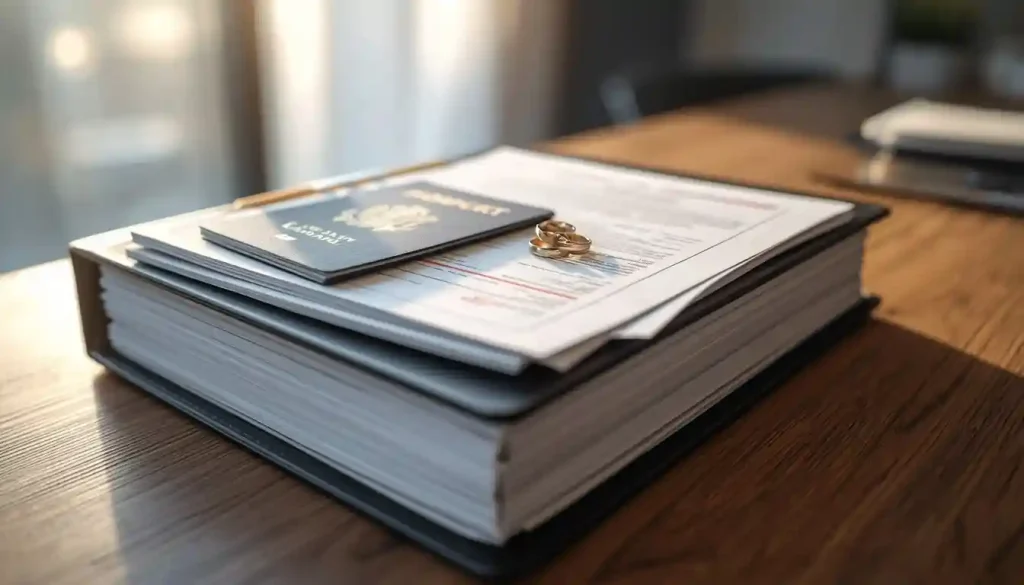
Do not just bring copies; you must bring the original documents in a well-organized binder.
| Document Category | What You Must Bring to the Interview |
|---|---|
| Government Identification | Passports, birth certificates, and state IDs showing the same address. |
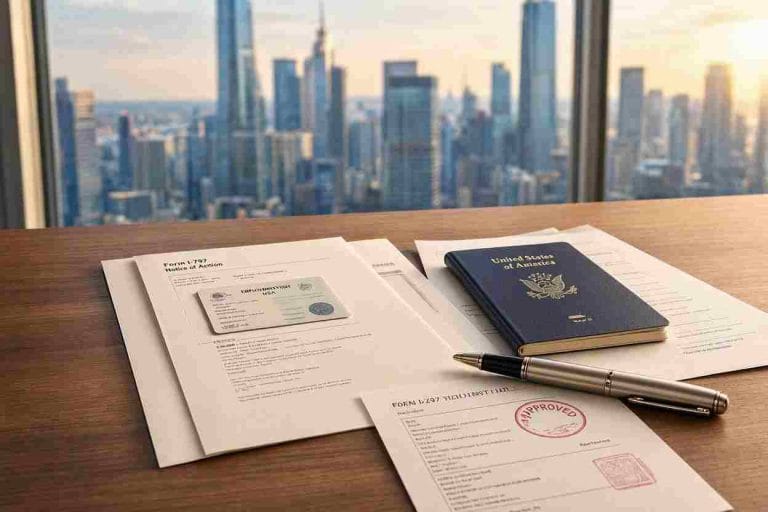
| Legal Status Proof | EAD cards, advance parole documents, and all previous I-797 approval notices. |
| Financial Commingling | Joint bank statements, joint tax return transcripts, and shared utility bills. |
| Cohabitation Evidence | Your shared apartment lease or the mortgage deed with both names listed. |
| Relationship Proof | A photo album spanning your entire relationship, flight itineraries from vacations, and letters from friends. |
| Medical Records | A sealed Form I-693 (Report of Medical Examination and Vaccination Record) if not submitted previously. |
Warning for Expats: The Certified Translation Trap
If any of your original documents—such as a birth certificate from Dubai, a marriage certificate from Europe, or a foreign police clearance—are not in English, you must bring a certified English translation. A simple Google Translate printout or a notarized copy will be instantly rejected.
The translator must provide a formal, signed certification statement confirming their competence to translate. Failing to bring certified translations is the number one reason expat couples are hit with an immediate RFE (Request for Evidence), delaying their green card by several months.
What Happens AFTER the Interview? The Final Verdict
Once the questioning is over, the officer will usually hand you a formal document explaining your case status. There are generally three possible outcomes:
- Approved on the Spot: The officer confirms your marriage is bona fide. If you are going through consular processing abroad, they will keep your passport to stamp the physical visa. If you are adjusting your status domestically, your physical Green Card will arrive in the mail within 2 to 4 weeks.
- Request for Evidence (RFE) or NOID: If the officer is not fully convinced but does not want to deny you immediately, they will issue an RFE (asking for more joint documents) or a Notice of Intent to Deny (NOID). You will have a strict deadline (usually 30 to 87 days) to mail back overwhelming proof of your relationship.
- Scheduled for a Stokes Interview: If major red flags appeared during your session, you will not get an immediate decision. Instead, your case will be paused, and you will be scheduled for a highly intrusive separation interview at a later date.
FAQs
What happens if my spouse and I give different answers during the interview?
Minor memory lapses about dates or meals are normal and expected. However, if you disagree on major facts—like who pays the rent or where you spent last Thanksgiving—the officer may suspect fraud and separate you for deeper questioning.
Do we need to bring an immigration attorney to the USCIS field office?
It is not legally mandatory. However, if you have a significant age gap, prior visa denials, a criminal record, or a lack of joint financial documents, having a lawyer present provides critical protection against unfair questioning.
Can a marriage green card be denied simply for lacking a joint bank account?
Yes, it can. If cultural, religious, or personal reasons prevent you from opening a joint bank account, you must overcompensate by providing alternative concrete proof. This includes joint apartment leases, shared auto insurance, and being listed as beneficiaries on life insurance policies.
Official Sources & References
To ensure you are using the most up-to-date forms, fee structures, and legal guidelines, always verify your application package against these official government portals:
- US Citizenship and Immigration Services (USCIS): Form I-485 Official Page
- US Citizenship and Immigration Services (USCIS): Form I-130 Official Page