
Tourist Visa Interview Questions and Answers: Pass Guide
Giving memorized or conflicting oral explanations at the consular window causes immediate visa refusals under nonimmigrant intent rules. Thoroughly mastering Tourist Visa Interview Questions and Answers allows applicants to present concise, credible testimony that perfectly corroborates their submitted digital applications and eliminates suspected immigrant intent.
Consular adjudicators conduct rapid, high-pressure interviews designed to test credibility in under three minutes. Establishing clear alignment between your verbal answers, source documents, digital footprint records, and domestic obligations turns a nerve-racking consular cross-examination into a straightforward administrative formality.
Core Adjudication Logic of Tourist Visa Interview Questions and Answers
Consular officers evaluate verbal testimony through an evidentiary framework centered on statutory presumptions of immigrant intent, such as Section 214(b) of the United States Immigration and Nationality Act (INA). Preparing the most strategic Tourist Visa Interview Questions and Answers requires understanding that officers are assessing risk indicators rather than merely chatting about travel plans.
Visa adjudicators are trained to spot behavioral hesitations, memorized scripts, and discrepancies between verbal claims and filed electronic records. To navigate this rapid screening successfully, applicants must focus on four primary pillars:
- Verbal-Dossier Congruence: Ensuring every travel date, sponsor name, and salary figure spoken at the counter matches the DS-160, France-Visas, or national portal application.
- The 3-Second Counter Psychology: Delivering a calm, professional initial greeting while the officer reviews your profile notes, establishing immediate credibility before the first question is asked.
- Decisive Purpose Articulation: Stating specific, realistic tourist itineraries without giving vague answers like “exploring opportunities” or “visiting friends indefinitely.”
- Unbroken Economic Anchorage: Demonstrating stable home-country employment, business investments, or professional milestones that require your immediate return.
When building a comprehensive profile using our Tourist Visa Requirements: Global Travel & Approval Guide, excelling at the verbal interview remains the decisive step for countries that require mandatory consular appearances.
Top 10 Consular Questions and Strategic Model Answers
Consular inquiries follow predictable lines of investigation focused on funding sources, travel itineraries, and domestic ties. The following matrix outlines the most common questions, the adjudicator’s hidden assessment criteria, and the optimal strategic response framework.
| Consular Interview Inquiry | Adjudicator’s Hidden Objective | Strategic Response Formula |
| “What is the specific purpose of your trip?” | Tests for disguised business, job-seeking, or open-ended stays | State specific tourist activities, landmarks, and fixed return dates. |
| “Why did you choose this destination at this time?” | Checks personal interest, seasonal logic, and annual leave approval | Connect the trip to personal milestones, seasonal events, or approved work holidays. |
| “Who is funding your international travel expenses?” | Identifies unauthorized sponsors or unverified third-party funds | State self-funding from professional earnings or name direct immediate-family sponsors. |
| “What do you do for a living in your home country?” | Evaluates professional stability and financial continuity | State your exact title, employer name, tenure, and core operational responsibilities. |
| “Do you have family or relatives residing abroad?” | Assesses immigration pull factors and overstay risks | Answer truthfully; disclose immediate legal family without unsolicited elaboration. |
| “How long do you intend to stay overseas?” | Checks against requested leave and realistic tourist itineraries | Give an exact duration that matches your approved employer leave letter. |
| “Who is managing your obligations while you are away?” | Tests operational dependence and business stability | Explain designated workplace handovers, active managers, or academic holiday breaks. |
| “Have you travelled internationally before?” | Checks travel history reliability and compliance patterns | Summarize prior trips, on-time returns, or explain this as your first major international tour. |
| “Why shouldn’t we suspect you will remain abroad?” | Direct challenge on economic, social, and family ties | Cite unmovable local anchors: career trajectory, real estate, and direct family care duties. |
| “What happens to your job while you travel?” | Verifies formal leave authorization versus job resignation | Confirm approved paid vacation and highlight scheduled return-to-work dates. |
Consular posts cross-reference your answers with historical application records in the consular database. If your spoken salary differs from what was submitted in your Tourist Visa Financial Requirements: Bank Proof Guide dossier, officers can mark the response as untruthful and issue an immediate denial.
Digital Footprint Cross-Checks and Counter Psychology
Modern consular screening integrates electronic data verification with real-time behavioral observation. Officers have access to automated security flags, prior visa petitions, and submitted social media identifiers before you speak your first word.
- The 3-Second Opening Protocol: When stepping up to the window, offer a pleasant “Good morning, Officer” and stand upright with your hands resting naturally. Avoid fidgeting or sliding unrequested papers through the slot while the officer reads your electronic case summary.
- Digital Footprint Alignment: Information provided on digital forms—including declared employment history, public professional profiles, and social media handles—must match your verbal narrative. Contradictory statements regarding freelance side gigs or remote work intentions trigger instant scrutiny.
- Managing Relatives with Prior Status Changes: If visiting a relative who previously transitioned from a visitor visa to permanent residency, clarify your independent travel basis immediately: “I am visiting my brother for five days during my approved annual leave, staying in a hotel, and funding the trip entirely through my personal savings.”
Verifying Ties Abroad: Concrete Applicant Scenarios
Adjudicators evaluate social and financial roots to confirm you will return home after your visit. Below are two distinct applicant profiles demonstrating how tailored answers successfully prove nonimmigrant intent.
[Targeted Question] ➔ [Concise Direct Answer] ➔ [Cite Unmovable Anchor] ➔ [Offer Document Only If Asked] ➔ [Visa Approval]
Scenario A: Salaried Corporate Professional
- Consular Question: “Why are you traveling to the United States for only ten days if your flight is so long?”
- Strategic Response: “I have ten days of approved annual leave from my software firm in London, where I manage an enterprise database project launching next month. I am visiting New York to see the major museums and return for our scheduled deployment.”
- Adjudication Impact: Demonstrates high-level professional responsibility, a clear purpose of travel, and a fixed return date tied to career consequences.
Scenario B: Sole Business Owner and Entrepreneur
- Consular Question: “How can your company operate in your absence?”
- Strategic Response: “My retail logistics firm has an on-site operations director managing day-to-day warehouse deliveries. I am taking an eight-day vacation to Paris before returning to oversee our quarterly supply contracts.”
- Adjudication Impact: Establishes business ownership while confirming a functional management structure that enables a short vacation without abandoning business roots.
Interview Methodologies Across Major Embassies
Interview procedures vary depending on national immigration policies. Understanding these differences helps applicants tailor their communication style to specific embassy formats.
| Embassy / Consular Jurisdiction | Primary Interview Format | Key Focus Areas |
| US Department of State (B1/B2) | 2 to 3 minute oral cross-examination | Section 214(b), DS-160 data integrity, verbal credibility |
| Schengen Consulates (Selective) | 10 to 15 minute document verification | Main destination compliance, €30k insurance, itinerary logic |
| UK Visas and Immigration (Credibility) | Video/Phone interview (Selective) | Genuine visitor intentions, source of funds, UK contacts |
| German / Swiss Consulates | Strict verification interview | Employment verification, business ties, exact daily budget |
While European posts emphasize documentary compliance as detailed in our Schengen Tourist Visa Requirements, United States visa windows rely almost entirely on verbal responses, consulting physical paper documents only when resolving factual ambiguities.
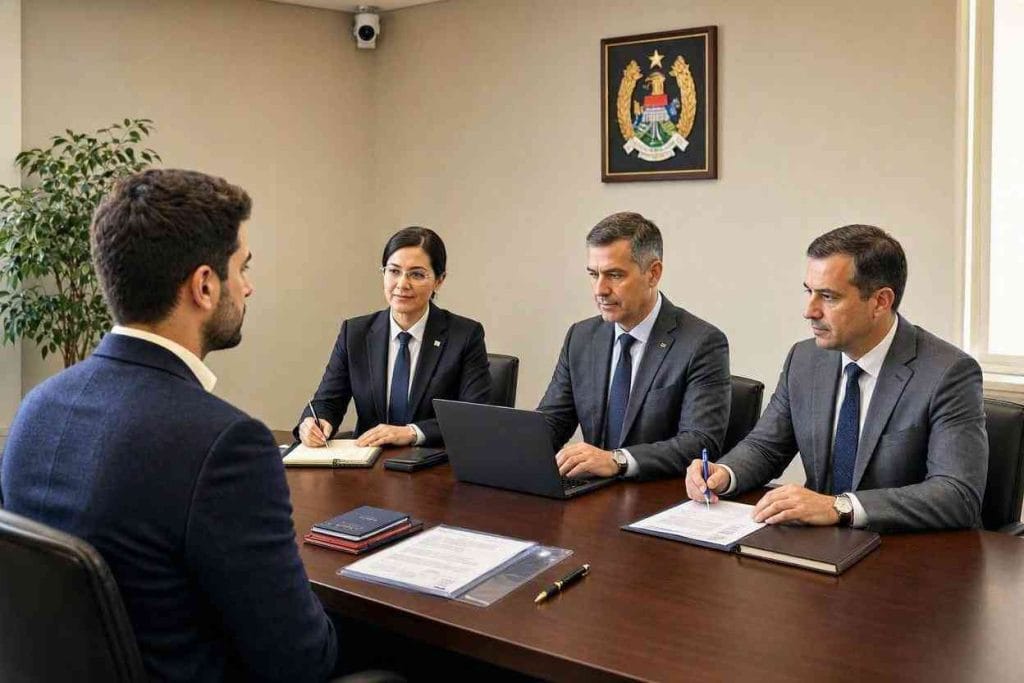
Consular Red-Flag Inquiries and Immediate Fixes
Certain questions are designed to uncover inadmissibility or hidden immigration intent. Handled poorly, these inquiries lead to rapid refusals.
- The Vague Host Trap: When asked, “Where will you stay?”, answering “With some friends around the city” signals a lack of planning. Instead, state: “I have booked the Marriott downtown for five nights, followed by three nights in Boston.”
- The Job-Search Suspicion: When asked, “Do you plan to look for business opportunities?”, never say “Maybe if something comes up.” The correct response is: “No, this trip is purely for leisure. I am fully employed at home and must resume work on the 15th.”
- The Distant Family Trap: If asked about distant acquaintances abroad, do not describe them as your travel sponsors unless they have provided a formal affidavit fulfilling Tourist Visa Invitation Letter Requirements.
From what I’ve seen over the years, trying to guess what the officer wants to hear instead of giving factual, straightforward answers creates visible nervousness that adjudicators interpret as deception.
Body Language Standards for Window Interviews
Consular officers evaluate nonverbal signals alongside verbal statements. Practicing realistic Tourist Visa Interview Questions and Answers alongside strict physical composure reinforces the credibility of your application.
[Steady Eye Contact] ➔ [Clear Voice Projection] ➔ [Hands Resting on Counter] ➔ [No Document Clutter] ➔ [Calm Demeanor]
- Direct Eye Contact: Look directly at the officer through the counter glass. Avoiding eye contact is frequently interpreted as hesitation or evasiveness.
- Organized Document Handling: Keep supporting papers in an indexed accordion folder. Do not push documents through the window slot until the officer explicitly requests them.
- Clear Voice Projection: Speak in a steady, confident voice. Consular halls are noisy, and mumbling forces officers to repeat questions, which increases tension.
- Concise Phrasing: Stop talking once you have answered the question. Volunteering unrequested details often introduces new topics that invite unnecessary scrutiny.
Structuring your answers with the same clarity used when preparing a How to Write a Tourist Visa Cover Letter ensures your spoken narrative remains focused and persuasive.
Key Regional Nuances: US, UK, and Europe
Different consular systems test visitor eligibility through varied administrative formats. Knowing these procedural nuances prevents surprises on interview day.
- US Embassy Procedures (DS-160 Screen): The officer reads your DS-160 on their screen while questioning you. They will rarely inspect physical bank statements, making your spoken words the primary basis of their decision under the USA B1/B2 Visa Requirements.
- UK Credibility Interviews: UKVI selectively interviews applicants to test whether their financial profile matches their lifestyle. These sessions require granular explanations of bank transaction histories.
- Canadian and Australian Inquiries: While primarily paper-based under the Canada Visitor Visa Requirements, procedural fairness letters and phone interviews demand prompt, documented responses to resolve officer concerns.
Overcoming a Prior Refusal at the Window
Facing an interview after an earlier refusal requires a clear, well-reasoned strategy. Adjudicators will review the refusal codes from your previous interview notes before asking their first question.
- Acknowledge Previous Denials Directly: Never hide a past rejection. When asked, state: “My application was refused two years ago under Section 214(b) because I was newly employed and lacked sufficient financial history.”
- Highlight Material Changes in Circumstances: Clearly explain what has changed since your last application: “Since then, I have completed three years of continuous service as senior project lead and doubled my liquid savings.”
- Avoid Challenging the Officer: Never argue that your previous refusal was unfair. Focus entirely on proving your current eligibility with updated, verifiable facts.
Reviewing the legal triggers in Common Tourist Visa Rejection Reasons allows you to address historical application weaknesses before stepping up to the consular counter.
Frequently Asked Questions
What happens if an applicant forgets specific dates mentioned in their application form?
Minor date discrepancies should be corrected calmly at the counter by clarifying the exact travel timeline; conflicting travel schedules can lead officers to doubt the credibility of the entire trip.
Can an applicant request an interpreter for a tourist visa interview?
Yes, most major embassies provide local-language interpreters for visitor visa interviews, and requesting one does not negatively impact the officer’s evaluation of your application.
Should an applicant hand all financial documents to the officer immediately?
No, never push documents through the window slot unrequested; keep papers organized and present specific evidence only when the adjudicating officer explicitly asks to see it.
Why do consular officers refuse applications without reviewing supporting documents?
Officers often make preliminary decisions based on the submitted electronic application and oral credibility, reviewing physical papers only if verbal answers create specific doubts.
How should an applicant answer questions about relatives living abroad without legal status?
Applicants must always answer truthfully about relatives residing abroad, as misrepresenting family connections in electronic systems results in permanent inadmissibility for fraud.
Visa Interview Success Roadmap
Successfully navigating Tourist Visa Interview Questions and Answers requires thorough preparation, perfect alignment with your submitted digital forms, and calm, confident communication. Rather than memorizing long, scripted answers, focus on clearly explaining your travel purpose, employment stability, and verified reasons to return home.
Review your submitted forms, organize your supporting evidence in an indexed folder, and practice answering core questions in one or two clear sentences before your interview date. By presenting honest, concise answers and maintaining a professional demeanor, you can satisfy consular requirements and secure your travel visa.
Official Resources
- US Department of State – Visitor Visa Interview Guidelines
- UK Visas and Immigration – Standard Visitor Overview
- European Commission – Visa Application Procedures