Many international travelers make a huge mistake before planning their trip. They think buying a flight ticket and booking a hotel is enough to get a tourist visa.
In reality, modern tourist visa requirements are much stricter today. You must clearly prove that you have enough money for the trip and strong reasons to return home.
Applying without understanding what visa officers actually look for often leads to instant rejection. This is especially true for strict countries like the US, UK, Canada, and the Schengen area.
To succeed, you need a strong and perfectly documented application. Just showing an informal invitation letter or a basic ticket booking will not work anymore.
How Visa Officers Actually Approve Tourist Visas
Visa officers around the world usually assume that you want to stay in their country permanently. Your main goal is to prove that you will return home before your visa expires.
This strict rule applies whether you are applying for a paper sticker visa or an online eVisa. Every embassy looks closely at a few core things before approving your application.
They want to know exactly why you are visiting, how you will pay for the trip, and what ties you have to your home country. Understanding these elements will make your visa approval much easier.
- Clear Purpose of Travel: You must prove you are visiting purely for tourism, family, or medical reasons. You cannot engage in any unauthorized work during your stay.
- Strong Financial Support: You need to show enough clear funds in your bank account. This money must easily cover your flights, hotels, and any sudden emergencies.
- Deep Home Country Ties: You must show a stable job, property ownership, or close family back home. This proves you have absolutely no reason to stay abroad illegally.
- Clean Travel History: You must strictly follow the rules of your past visas. Always be honest and tell the truth about any previous visa rejections.
(If you are an expat living in the Middle East planning to travel to America, be sure to read our complete guide on US Non-Immigrant Visas for Middle East Expats: The Definitive GCC Guide).
Understanding Different Types of Tourist Visas
Knowing the exact type of visa you need prevents costly mistakes. It saves you from submitting the wrong documents or getting denied boarding at the airport.
Before planning your trip, you must understand how your destination country issues its visas. There are four main ways you can get travel clearance:
- Traditional Sticker Visas: This is a physical stamp placed directly on your passport page. You usually need to visit an embassy or an agency like VFS Global for a face-to-face interview and fingerprints.
- Electronic Visas (eVisas): These are digital travel permits processed completely online. You simply upload your documents on a government website and receive a downloadable PDF visa.
- Electronic Travel Authorizations (eTA / ESTA): These are quick digital clearances for citizens of specific visa-free countries. They are not formal visas, but you must have them to legally cross the border.
- Visa on Arrival (VoA): You get this entry permit right at the airport when you land. You just need to pay a fixed fee and show a confirmed return flight ticket to the immigration officer.
15-Country Global Tourist Visa Guide
Comparing different visa rules helps you plan your trip much better. It allows you to estimate your total budget and understand exactly how long the process will take.
Before you buy flight tickets, you must know if you need an interview or if you can apply online. The table below covers the most important details for the top 15 travel destinations in the world.
We have included the latest government application fees, processing times, and maximum stay limits. This will help you easily navigate the visa system for your dream destination.
| Destination & Category | Standard Visa Fee | Typical Processing Time | Maximum Stay Duration | Interview Required? |
|---|---|---|---|---|
| United States (B1/B2 Visa) | $185 USD | 2 to 8 weeks | Up to 6 months per entry | Mandatory (Ages 14–79) |
| Canada (Visitor Visa / TRV) | $100 CAD + $85 Biometrics | 3 to 12 weeks | Up to 6 months per entry | Rare (Biometrics Required) |
| United Kingdom (Standard Visitor) | £135 GBP | 3 to 6 weeks | 180 days per visit | Rare (Biometrics Required) |
| Schengen Area (Type C Tourist) | €90 EUR | 15 to 45 days | 90 days within 180 days | Mandatory (First-Time Bio) |
| Australia (Visitor Stream 600) | $250 AUD | 2 to 4 weeks | 3, 6, or 12 months | None (Digital Filing) |
| Japan (Temporary Visitor) | Free to ~$25 USD | 5 to 10 working days | 15, 30, or 90 days | Rare |
| New Zealand (Visitor Visa) | $341 NZD | 4 to 8 weeks | Up to 9 months | None (Portal Based) |
| Dubai / UAE (Tourist Entry) | ~$90 to $200 USD | 24 to 72 hours | 30 or 60 days | None (Digital eVisa) |
| Singapore (Entry Visa) | $30 SGD | 3 to 5 working days | Up to 30 days | None (Authorized Agent) |
| Saudi Arabia (Tourist eVisa) | ~$140 USD (Inc. Insurance) | 1 to 24 hours | 90 days per visit | None (Instant eVisa) |
| South Korea (C-3-9 Tourist) | $40 USD | 7 to 14 working days | Up to 90 days | Rare |
| China (L Tourist Visa) | ~$140 USD | 4 to 7 business days | 30 to 90 days per entry | Mandatory (Biometrics) |
| Thailand (Tourist TR / e-Visa) | $40 USD | 5 to 10 working days | Up to 60 days | None (e-Visa Portal) |
| Turkey (e-Visa / Sticker Visa) | $50 USD | Instant to 15 days | 30 to 90 days | Yes for Sticker Visa |
| Malaysia (eVISA Social Visit) | ~$20 to $50 USD | 2 to 5 business days | Up to 30 days | None (eVisa System) |
The Hidden Costs of a Tourist Visa
Many people think the official embassy fee is the only cost for a visa. In reality, there are several hidden charges you must plan for.
For example, visa centers like VFS Global charge their own service fees. You also have to pay for mandatory fingerprinting (biometrics), which is often billed separately.
On top of that, you might pay extra for document translation, notary stamps, premium courier delivery, and mandatory health insurance.
Always keep an extra $100 to $150 USD in your budget to safely cover these sudden hidden costs.
When is the Best Time to Apply?
Applying too late is a huge mistake, but applying too early can also cause problems.
If you apply 6 months before your trip, the visa officer might think your plans are not real. If you apply just 2 weeks before, you might miss your flight due to slow processing.
The golden rule is to apply exactly 2 to 3 months before your planned travel date. This gives the embassy enough time to check your background and return your passport safely.
The 5-Step Tourist Visa Process
Getting a tourist visa follows a simple, step-by-step process. No matter where you want to travel, you will usually go through these five basic stages.
Step 1: Choose the Right Visa First, check the country’s official rules to see if you qualify. Then, pick the exact visa category that matches your travel purpose.
Step 2: Fill Out the Form and Pay Complete your online application form with honest and accurate details. After submitting the form, pay the required government visa fee.
Step 3: Fingerprints and Interview Visit the embassy or a local visa center to give your fingerprints and take a photo. For some countries like the US, you must also pass a short face-to-face interview.
Step 4: Background Check and Processing The visa officers will carefully review your documents and verify your information. They will check your financial status and background history before making a decision.
Step 5: Collect Your Passport Finally, you will receive your passport back from the embassy. Always double-check your visa sticker to ensure your name, dates, and details are 100% correct.
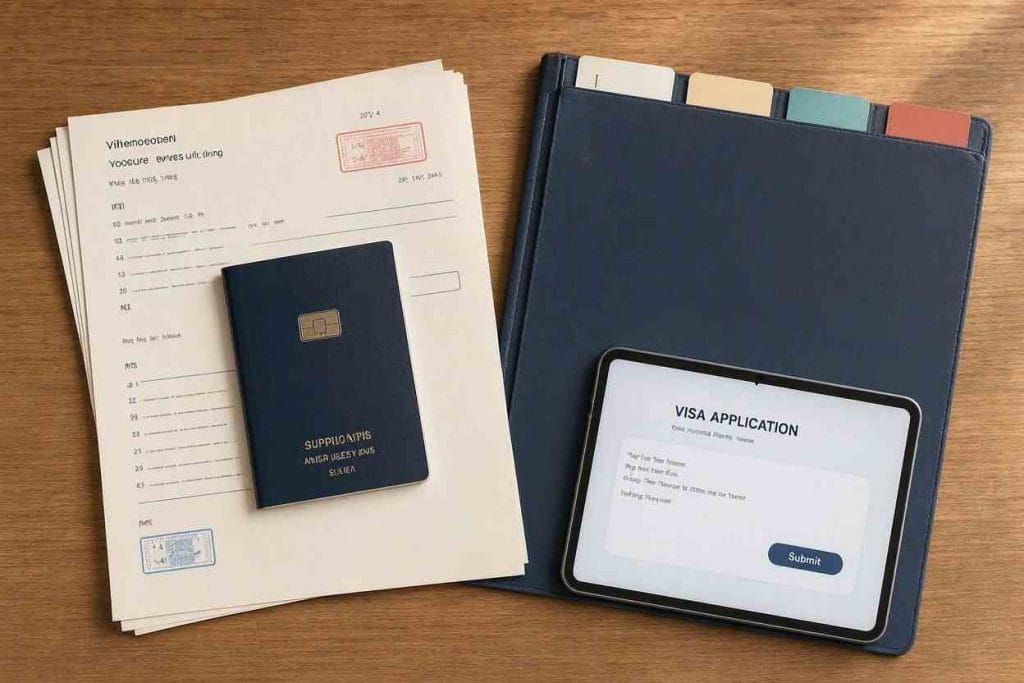
Country-Specific Tourist Visa Requirements
Every country has its own strict rules and exact document checklists. You must understand these specific details to avoid instant rejection.
Below is a simple, easy-to-read breakdown of exactly what you need for the world’s top 15 travel destinations.
1. United States: B1/B2 Visitor Visa
US visa officers legally assume that you want to stay in America permanently. You must prove them wrong during a short 2-to-4 minute face-to-face interview.
They care much more about your stable job, clear income, and family ties than your hotel bookings. You must confidently answer their questions based on your DS-160 online form.
Mandatory Document Checklist:
- DS-160 Confirmation: The printed page showing your final submission barcode.
- Valid Passport: Must be valid for at least 6 months after your planned return date.
- Fee Receipt: Proof that you paid the $185 USD application fee.
- Photograph: One 2×2 inch physical color photo meeting US government rules.
- Financial & Job Proof: 6 months of stamped bank statements, salary slips, tax papers, and a leave letter from your boss.
(For a deeper breakdown of the interview process, check out our complete guide on USA B1/B2 Visa Requirements).
2. Canada: Temporary Resident Visa (TRV)
Canada does not require a face-to-face interview for a tourist visa. Instead, officers make their decision purely based on the digital documents you upload online.
Because you cannot speak to an officer, your paperwork must be absolutely perfect. You must submit strong evidence proving that you will definitely leave Canada when your trip ends.
Mandatory Document Checklist:
- Completed Forms: Fill out and validate the official IMM 5257 and IMM 5645 (Family Information) forms.
- Passport Scans: High-quality color copies of your passport bio-page and all previous visa stamps.
- Financial Proof: 6 months of certified bank statements, salary slips, and tax records.
- Travel Plan: A clear day-by-day travel itinerary and your hotel booking confirmations.
- Home Country Ties: A leave letter from your employer, property ownership papers, or business licenses.
(For step-by-step document assembly rules, read our full guide on Canada Visitor Visa Requirements).
3. United Kingdom: Standard Visitor Visa
The UK visa process focuses heavily on your personal bank accounts and monthly income. Officers will strictly match your regular salary with the estimated cost of your trip.
If they see large, unexplained cash deposits in your bank account, they will instantly reject your visa. Everything must look natural and match your job profile.
Mandatory Document Checklist:
- Online Application: A completed online form and payment proof of the £135 GBP standard visa fee.
- Valid Passport: Your current passport with at least one completely blank page for the visa sticker.
- Bank Statements: 6 consecutive months of official bank statements showing your regular salary coming in.
- Job Letter: An official company letter confirming your current position, salary, and approved holiday dates.
- Trip Details: Your reserved hotel details and a realistic travel plan (do not buy non-refundable flight tickets yet).
(Learn exactly how to organize your bank statements safely in our complete UK Standard Visitor Visa guide).
4. European Schengen Area: Type C Short-Stay Visa
The Schengen visa lets you visit 29 European countries with a single permit. However, you must apply to the embassy of the country where you will spend the most nights.
Do not apply to a different country just to get a faster appointment. This is called “visa shopping” and will cause an instant rejection.
Mandatory Document Checklist:
- Application Form: A fully completed, dated, and signed Schengen application form.
- Passport Rules: Issued within the last 10 years and valid for at least 3 months after your trip ends.
- Photographs: Two recent 35×45 mm passport-sized photos with a plain light background.
- Health Insurance: Mandatory travel insurance covering at least €30,000 for any medical emergencies.
- Trip Proof: Return flights, hotel bookings, a leave letter, and 6 months of bank statements to prove your funds.
(Read the full step-by-step process in our Schengen Tourist Visa Requirements guide).
5. Turkey: Tourist e-Visa & Consular Sticker Visa
Turkey offers a very fast digital e-Visa for many travelers. If you hold a valid visa or residence permit from the US, UK, Ireland, or a Schengen country, you can get an e-Visa online in minutes.
If you do not have these supporting visas, you must apply for a regular sticker visa through a Turkish embassy or visa center.
Mandatory Document Checklist:
- For e-Visa: A passport valid for 6 months and your active supporting visa from an eligible Tier-1 country.
- For Paper Visa: A fully completed visa application form and two 5×5 cm biometric photos.
- Bank Balance: 6 months of clear bank statements showing at least $50 USD for every day of your stay.
- Travel Details: Confirmed return flight tickets, hotel reservations, travel insurance, and a job leave letter.
6. Australia: Visitor Visa (Subclass 600)
Australia has a completely paperless visa process using their online ImmiAccount system. They only want “Genuine Visitors” who have strong reasons to return to their home country.
Officers will closely look at your job, family, and financial status to ensure you will not stay illegally.
Mandatory Document Checklist:
- Passport Scan: A clear color copy of your passport bio-page and all your old visa stamps.
- Home Country Ties: A leave letter from your boss, business licenses, or property papers.
- Proof of Money: 3 to 6 months of bank statements and recent salary slips showing steady income.
- Travel Plan: A simple day-by-day sightseeing plan and your hotel bookings.
(Read our complete step-by-step guide on Australia Visitor Visa Subclass 600).
7. New Zealand: General Visitor Visa
New Zealand processes all tourist visas digitally through their official RealMe portal. The visa officers must be fully convinced that you will not work illegally and will return home on time.
They have strict financial rules about how much money you need to show for your daily expenses.
Mandatory Document Checklist:
- Valid Passport: A clear scan of your passport, valid for at least 3 months after your trip.
- Proof of Funds: Bank statements showing at least $1,000 NZD per month of your stay (or $400 NZD if your hotel is prepaid).
- Return Flight: A confirmed return flight ticket out of New Zealand.
- Home Country Ties: An official leave letter from your employer or business ownership documents.
8. Japan: Temporary Visitor Visa
Japan has strict rules for tourists. While some nationalities can apply online, most travelers must submit paper documents through agencies like VFS Global.
Japanese officers care deeply about two things: your exact daily travel schedule and your official tax papers.
Mandatory Document Checklist:
- Application Form: A fully completed form with a recent 45×35 mm color photo.
- Daily Travel Schedule: A clear day-by-day plan showing where you will go, hotel details, and contact numbers.
- Financial & Tax Records: Official income tax certificates and recent stamped bank statements.
- Employment Proof: A job letter stating your role, salary, and approved holiday dates.
(See our full step-by-step guide on Japan Tourist Visa Requirements).
9. South Korea: C-3-9 Short-Term Tourist Visa
Most travelers need a C-3-9 visa from a Korean visa center to visit South Korea. If your country is visa-free, you still need to apply for a digital K-ETA online.
Officers will check your monthly income very carefully. They want to ensure you have enough money and will not work illegally during your trip.
Mandatory Document Checklist:
- Application Form: Filled out in English with a standard 3.5×4.5 cm color photo.
- Original Passport: Must be valid for at least 6 months with blank visa pages.
- Bank & Tax Papers: 6 months of bank statements showing regular salary deposits, plus tax clearance papers.
- Job Documents: An original company leave letter or your business registration.
- Travel Plan: Your confirmed return flight tickets and hotel bookings.
10. Singapore: Entry Visa
Singapore does not allow you to apply for a tourist visa directly at their embassy. You must apply online through an authorized visa agent or a local sponsor in Singapore.
Mandatory Document Checklist:
- Form 14A: A fully completed and hand-signed visa application form.
- Passport Scan: A clear copy of your passport bio-page, valid for at least 6 months.
- Recent Photo: A 35×45 mm color photo with a pure white background taken in the last 3 months.
- Travel & Sponsor Details: Return flight tickets, hotel bookings, and a Letter of Introduction (Form V39A) if a local is inviting you.
11. China: L Tourist Visa
To visit China for a holiday, you need an L Tourist Visa. You must fill out a detailed online form first.
After that, you must visit a Chinese visa center in person to submit your documents and give your fingerprints.
Mandatory Document Checklist:
- Application Form: Your printed online form showing the confirmation barcode.
- Original Passport: Must be valid for 6 months with at least two blank pages, plus recent photos.
- Travel Bookings: Confirmed return flight tickets and hotel reservations for your entire trip.
- Invitation Letter: If visiting a friend or agency, an official letter with their Chinese ID copy and your travel plan.
12. Thailand: Tourist Visa (TR & e-Visa)
Thailand now offers a very simple online E-Visa system for tourists. A standard single-entry visa allows you to stay for up to 60 days.
If you want to stay longer, you can easily extend it for another 30 days at a local immigration office inside Thailand.
Mandatory Document Checklist:
- Passport Scan: A clear color copy of your passport valid for at least 6 months.
- Proof of Money: Bank statements showing at least 20,000 THB per person (or 40,000 THB for a family).
- Confirmed Travel: Fully paid return flight tickets and paid hotel booking receipts.
- Proof of Residence: An official ID card proving you legally live in the country where you are applying from.
13. Malaysia: eVISA Social Visit
Malaysia offers a fast online eVISA system for many tourists. You can stay for up to 30 days to enjoy a holiday or visit your family and friends.
Mandatory Document Checklist:
- Passport Scan: A high-quality color copy of your passport valid for at least 6 months.
- Digital Photo: A recent 35×50 mm studio-quality photo meeting Malaysian rules.
- Flight & Hotel: Confirmed return flight tickets and your hotel bookings.
- Proof of Money: Recent bank statements showing you have enough money for your trip.
14. United Arab Emirates: Dubai Tourist Visas
You can get a Dubai or UAE tourist visa completely online. These visas allow you to stay for 30 or 60 days.
You cannot apply directly; your visa must be sponsored by an airline (like Emirates), a hotel, or a certified travel agency.
Mandatory Document Checklist:
- Passport Scan: A clear color copy of your passport bio-page valid for 6 months.
- Digital Photo: A standard passport-sized color photo with a white background.
- Travel Plan: Your confirmed return flights and hotel reservations.
- Health Insurance: Mandatory travel insurance to cover any medical emergencies.
(Review specific eligibility details in our Dubai Tourist Visa for Foreign Travelers guide).
15. Saudi Arabia: Tourist eVisa
Saudi Arabia now offers a fast, one-year multiple-entry eVisa online. You can stay for up to 90 days for tourism, events, or performing Umrah (except during Hajj).
If your country is not eligible for the quick eVisa, you must apply in person through a Tasheer visa center.
Mandatory Document Checklist:
- Valid Passport: A color scan of your passport valid for at least 6 months.
- Digital Photo: A square passport-style photo with a clear background.
- Travel Details: Confirmed round-trip flight tickets and hotel bookings.
- Health Insurance: This mandatory medical insurance is automatically included when you pay the eVisa fee online.
Extra Documents You Need Based on Your Job
Your visa requirements change depending on your job and current life stage. Providing the exact documents for your specific situation prevents delays and rejections.
- Salaried Employees: An official leave letter (NOC) from your boss showing your salary, joining date, and approved holidays. You also need 3 to 6 months of salary slips and your recent tax papers.
- Business Owners: Your official business registration, valid trade license, and tax papers. You must also show your company’s bank statements for the last 6 months.
- Freelancers: Your current client contracts, recent invoices, and bank records showing you received international payments. You should also provide your personal tax returns.
- Students: A valid student ID card and an official leave letter from your school or college. You also need a letter from your parents proving they will pay for your trip, along with their bank statements.
- Retirees: Your official retirement certificate and pension payment records. You must also show bank statements proving your regular pension income and other savings.
- Children (Under 18): A birth certificate showing both parents’ names. If traveling alone or with just one parent, you must provide a signed permission letter from both parents and copies of their passports.
Applying for a Visa with Your Family
Applying for a visa with your spouse or children is a little different. You must link all your applications together so the officer knows you are traveling as a group.
Usually, one person acts as the main sponsor who pays for the whole trip. That person must show a much larger bank balance to easily cover flights, hotels, and food for everyone.
You do not need separate bank accounts for your wife or children if they do not work. However, you must attach clear proof of your relationship.
Always include your official marriage certificate and your children’s birth certificates in your document folder.
Passport Rules, Photos, and Fingerprints
Many visas get rejected instantly because of a damaged passport or a bad photograph. Your physical documents must be in perfect condition before the embassy even looks at your application.
- The 6-Month Passport Rule: Your passport must be valid for at least 6 months after your planned return date. It must also have at least two completely blank pages side-by-side.
- Perfect Passport Condition: The visa center will reject your passport if it has water damage, torn pages, or a loose cover. All your personal details must be clearly readable.
- Strict Photo Rules: Your photo must be taken within the last 6 months against a plain white background. You cannot wear sunglasses, hats (except for religious reasons), or use digital filters to edit your face.
- Fingerprints and Scans (Biometrics): You will give your fingerprints and a digital face scan at the visa center. Some biometrics stay valid for a long time, like 5 years for Schengen visas and 10 years for Canada.
How to Prove You Will Return Home (Strong Ties)
The number one reason for tourist visa rejection is failing to prove strong ties to your home country. Visa officers need solid proof that your job, family, and money are anchored back home.
Just telling the officer you will return is never enough. You must show official, legal documents that prove you have no reason to stay abroad illegally.
- A Stable Job: You need an official letter from your boss showing your salary and approved holiday dates. It must state clearly that your job will be waiting for you when you return.
- Business Ownership: If you own a business, provide your official registration and trade license. You must also show your company’s active bank statements and tax papers.
- Property and Assets: Owning property is a huge advantage. Show your registered land titles, house deeds, or property tax papers registered in your exact name.
- Family Commitments: Show legal proof of your close family ties. This includes your marriage certificate or the birth certificates of your children waiting for you at home.
How to Show Your Bank Statements (Proof of Funds)
Visa officers check your bank accounts very closely. They want to ensure you can easily pay for your trip without working illegally or spending all your life savings.
Never deposit a large amount of cash right before printing your bank statements. Officers will think you borrowed the money, which will trigger an instant rejection.
Here are the 4 steps to building a perfect financial profile:
- Show a 6-Month History: Provide a bank statement showing at least 6 months of steady and natural money flow.
- Match Your Salary: Your regular monthly bank deposits must perfectly match your official salary slips.
- Provide Tax Records: Show your official government tax clearance papers to prove your income is legal.
- Show Extra Savings: Include your fixed deposits or other safe investments for extra security.
(For detailed calculation formulas, read our complete guide on Tourist Visa Financial Requirements).
Key Financial Rules to Follow:
- Active Bank Account: Always show the main account where your regular salary or business income is deposited.
- Keep a Safe Budget: Your total trip cost should never be more than 20% to 30% of your total liquid savings.
- Sponsor Documents: If a family member is paying for your trip, you must provide an official sponsor letter along with their bank statements and tax papers.
- Clear Tax History: Submit your tax returns from the last two to three years to prove exactly how you earned your wealth.
Flight Tickets and Hotel Bookings
Many travelers wonder if they should buy expensive, non-refundable flight tickets before getting their visa. Consulates actually advise you not to do this.
- Flight Reservations: Just get a temporary flight reservation that has a valid PNR number. You do not need a fully paid ticket yet.
- Hotel Bookings: Always use reliable booking websites to make free-cancellation hotel reservations. This proves where you will stay without risking your money.
- Do Not Waste Money: Buying a non-refundable ticket will not help your visa get approved. Officers care about your ties to your home country, not your expensive flight tickets.
How to Write a Perfect Visa Cover Letter
A good cover letter acts as a quick summary of your whole visa application. It is extremely important for strict countries like Canada, the UK, and the Schengen area.
Keep your letter professional, honest, and short—usually one or two pages. You must clearly state your travel dates, where you will stay, your job details, and exactly who is paying for the trip.
Make sure your cover letter includes these four key sections:
- Trip Summary: State exactly why you are traveling, your flight dates, and the cities you will visit.
- Job & Money Details: Clearly write your monthly income, current bank balance, and the source of your funds.
- Daily Travel Plan: Add a simple table showing your daily sightseeing spots and hotel details.
- Document List: A numbered list of every single document you attached to your application folder.
(To download easy templates, explore our guide on How to Write a Tourist Visa Cover Letter).
Rules for Invitation and Sponsorship Letters
If you are visiting family or friends abroad, an invitation letter helps prove where you will stay. However, an invitation does not mean you can skip showing your own bank statements.
You must still prove you have enough money. Your host’s letter must include their legal ID, proof of their address, and clearly state who is paying for your daily costs.
(Learn exactly what your host needs to write in our Tourist Visa Invitation Letter Requirements guide).
How to Pass the Consular Visa Interview
For countries like the US, a face-to-face interview is the most important part of getting your visa. The interview usually lasts only two to five minutes.
Officers decide very quickly based on your confidence and how clearly you speak. Never argue, give long confusing answers, or sound like you memorized a script.
- Keep It Short: Only answer the exact question the officer asks. Do not give long, unnecessary stories.
- Match Your Documents: Ensure your spoken travel dates and financial details perfectly match the online form you submitted.
- Always Be Honest: Never lie about past visa rejections. Embassies share security records, so they already know your true travel history.
- Organize Your File: Keep your bank statements, job letters, and property papers neatly arranged so you can hand them over instantly if asked.
(Practice with real sample dialogues in our Tourist Visa Interview Questions and Answers guide).
What to Do If Your Visa Gets Rejected
If your tourist visa gets denied, do not panic. You must carefully read the official rejection letter to understand exactly what went wrong.
- Understand the Reason: Embassies will always give you a specific reason for rejection. Most of the time, it happens if you fail to prove that you will return home.
- Filing an Appeal: Some countries let you appeal the decision if you think the officer made a mistake. For Schengen visas, you usually have 30 days to write an appeal letter.
- When to Reapply: Never apply again immediately with the exact same documents. You must wait until your situation improves, like saving more money or getting a better job.
(To know exactly why visas get denied, read our complete guide on Common Tourist Visa Rejection Reasons).
Warning: Never Use Fake Documents
Embassies around the world use highly advanced security systems. They share databases worldwide to easily catch fake information and hidden travel histories.
- The Cost of Lying: If you submit a fake bank statement or fake job letter, you will face severe punishment. You could get banned from entering countries like the US or Canada for 5 years, or even permanently.
- Beware of Fake Agents: No travel agent or broker can ever guarantee a visa approval. Only the official visa officers inside the embassy have the power to approve your visa.
Frequently Asked Questions
Can I change my tourist visa to a work visa after arriving?
No. In most countries like the US, UK, and Canada, you are strictly not allowed to work on a tourist visa. You cannot simply convert it to a work permit while staying there.
How much bank balance is required for a tourist visa?
There is no exact fixed amount. However, you should show enough money to comfortably spend $100 to $200 USD per day during your trip, plus extra backup savings for emergencies.
Does an invitation letter guarantee my visa approval?
No, it does not. An invitation letter only proves where you will stay. You still must prove that you have enough money and strong ties to your home country.
What should I do immediately if my tourist visa is rejected?
Read the official rejection letter carefully to understand the exact reason. Do not reapply immediately unless you have new documents to prove your financial or job situation has improved.
Is travel health insurance mandatory for a tourist visa?
It is 100% mandatory for the Schengen area and Saudi Arabia. For countries like the US and Canada, it is not mandatory but highly recommended to avoid massive hospital bills if you get sick.
Final Tips for a Successful Visa Application
Getting a tourist visa is easy if you plan carefully and provide honest documents. Visa officers care much more about your stable job and bank savings than your expensive hotel bookings.
Before you apply, double-check your bank statements, tax records, and job letters to ensure they are 100% accurate. Never use fake agents, and always apply directly through official government websites.
Source of Information
To ensure 100% accuracy, we collected the visa rules and fees directly from these official government portals:
- US Department of State Travel Portal
- Immigration, Refugees and Citizenship Canada (IRCC) Portal
- GOV.UK Standard Visitor Portal
- European Commission Migration and Home Affairs Portal
- Australian Department of Home Affairs Portal
- Immigration New Zealand Portal
- Immigration & Checkpoints Authority (ICA) Singapore