Applying for a Canada Visitor Visa (TRV) without knowing the latest IRCC rules is a big mistake. Many applicants get a refusal letter simply because they failed to prove they will return home.
Unlike other countries, Canada rarely takes face-to-face visa interviews. IRCC officers will decide your fate based only on the digital documents you upload online.
To get your visa approved, you must show clear bank statements, a real travel plan, and strong reasons to go back to your home country.
Core Canada Visitor Visa Requirements
Canadian visa officers strictly follow the rules of IRPR Section 179. By default, they assume you want to stay in Canada illegally. It is your job to prove them wrong.
You must convince the officer that you will leave the country before your visa expires. To pass this first test, every applicant must meet four basic rules:
- Valid Passport: You need a real, machine-readable passport. It must remain valid well past your planned return date.
- Clean Police & Medical Record: You must not have any criminal history. Also, you cannot have a serious medical issue that would cost the Canadian healthcare system.
- Strong Home Ties: You must give the officer a solid reason to trust you. You can do this by showing proof of a stable job, an active business, or property in your home country.
- Clear Travel Plan: Do not just say you want to visit. You must provide a day-by-day travel itinerary, hotel bookings, or an invitation letter from a Canadian host.
Canada is much stricter than most other countries. As we discussed in our guide on Tourist Visa Requirements: Global Travel & Approval Guide, a small gap in your paperwork can lead to an instant refusal because you will not get an interview to explain yourself.
Single vs Multiple-Entry Visa: The New IRCC Rules
Canada recently made a massive change to its visitor visa policy. They no longer give out 10-year multiple-entry visas automatically to everyone.
Under the new rules, IRCC officers look at every single application closely. They now have the power to decide exactly how long your visa will last based on your travel reason.
If you are just going for a quick vacation or a one-time business meeting, they might only give you a visa for those exact dates. To get a long-term visa, you must clearly prove that you need to visit Canada often.
| Visa Type | Who Gets This Visa? | How Long Is It Valid? |
|---|---|---|
| Single-Entry TRV | People attending a one-time event, like a wedding, medical visit, or a short conference. | Only covers your exact travel dates plus a few extra buffer days. |
| Limited Multiple-Entry | Travelers with a need to visit a few times and moderate bank savings. | Usually valid for 1 to 3 years, depending on your exact travel plan. |
| Full Multiple-Entry | Frequent travelers with very strong home ties and excellent finances. | Valid up to your passport expiry date (maximum 10 years). |
Mandatory Documents for a Canada Visitor Visa
Canada processes visitor visas completely online instead of taking face-to-face interviews. If you submit messy or unverified documents, your visa will be refused instantly without any warning.
| Document Type | Required Proof | Why IRCC Needs It |
|---|---|---|
| Identity & Family | Valid passport, national ID card, and marriage certificate. | To prove your real identity and close family ties. |
| Financial Proof | 6 months of stamped bank statements, tax returns, and pay slips. | To show you have enough clear money without sudden deposits. |
| Job Verification | Official employer letter, approved leave paper, and job contracts. | To show you have a stable job and must return to it. |
| Travel Plan | Day-by-day travel plan, hotel bookings, and flight details. | To confirm your trip makes sense for your vacation time. |
| Home Country Ties | Land registry deeds, business papers, or commercial leases. | To prove you have strong assets and reasons to go back home. |
The Secret Weapon: A Strong Letter of Explanation (LOE)
Since there is no in-person interview, a Letter of Explanation is your only voice. It is a simple one or two-page letter written directly to the visa officer.
Use this letter to explain anything unusual in your file. If you received a large bonus at work, sold land, or took an extended leave, explain it clearly here.
A well-written letter connects all your documents together. It removes doubts before the officer even has a chance to question your motives.
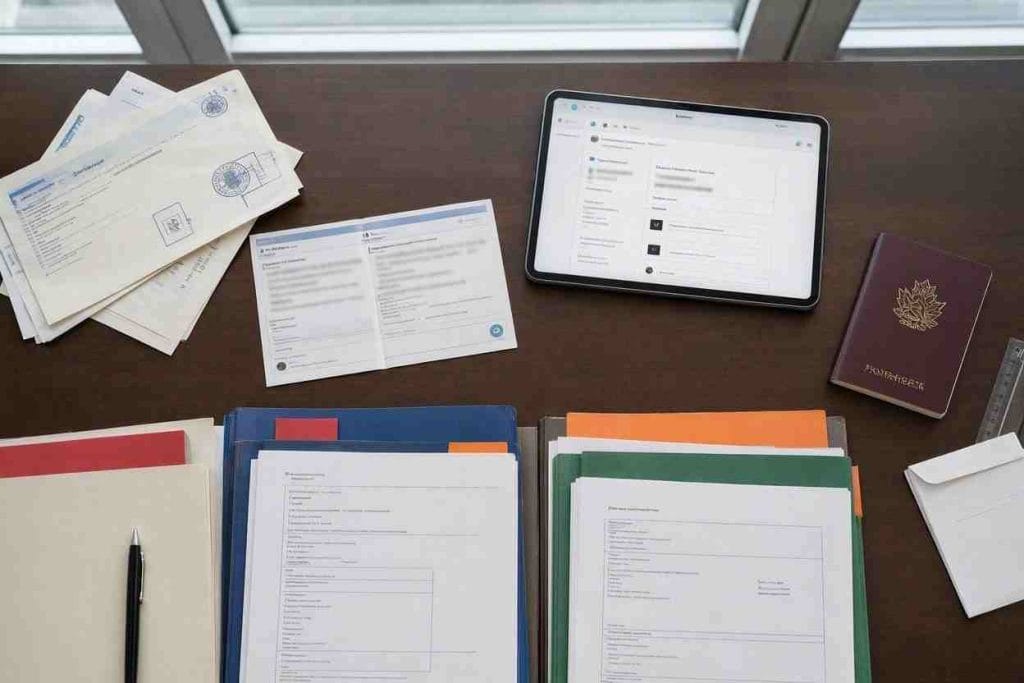
Visa officers closely check your bank statements for any recent large deposits. Sudden, unexplained money added to your account right before applying will make them highly suspicious.
Applying Online: IRCC Portal vs GCKey
You can apply for your visa using the newer IRCC Portal or the older GCKey system. Both platforms send your paperwork to the same visa officers, but they work very differently.
Here is the simple step-by-step process of how your application moves forward:
- Step 1: Submit your application online (via IRCC Portal or GCKey).
- Step 2: Give your biometrics (fingerprints and photo) at VFS Global.
- Step 3: Wait for the visa officer to review your file.
- Step 4: Receive your Passport Request (PPR) for the visa stamp.
The new IRCC Portal is much easier to use. It asks you simple questions and automatically creates upload slots based on your specific travel reason.
The older GCKey system is a bit more complicated. It requires you to download, fill out, and validate standard PDF forms (like the IMM 5257) by hand on your computer.
After applying, you must give your biometrics within a strict 30-day window. Always track your appointment through the official verification portal to avoid any delays.
No matter which system you choose, your PDF files must stay under the 2 MB to 4 MB limit. Merge your papers neatly and add a table of contents so the officer can read them easily.
Proof of Funds: How Much Money Do You Need?
Proving you have enough money is one of the most critical parts of your application. Visa officers want to see that you can easily pay for your entire trip without needing to work illegally in Canada.
| Family Size | Recommended Minimum Funds | Required Proof |
|---|---|---|
| Single Applicant (1 to 2 Weeks) | $3,500 – $5,000 CAD | 6-month stamped bank statements and recent income tax returns. |
| Couple (Spouse / Partner) | $6,000 – $8,500 CAD | Joint bank records and job verification letters for both. |
| Family of Three (With a Child) | $9,000 – $12,000 CAD | Liquid savings, fixed deposits, and proof of approved school leave. |
| Sponsored Travel | $3,500 CAD (Host) + Personal Ties | Host’s Notice of Assessment (NOA) plus your own home bank balance. |
Relying only on an invitation letter from a Canadian host is a major reason applications get rejected. Even if your host promises to pay for your stay and food, officers still focus on your personal savings.
The visa officer must be completely convinced that you have your own financial independence and strong financial roots in your home country.
Understanding Dual Intent: Can You Apply for Both?
Dual intent means applying for a visitor visa while also having an active permanent residency profile (like Express Entry). The good news is that Canadian immigration law officially allows you to do both at the same time.
To get your visitor visa approved under dual intent, you must understand these three simple rules:
- Future Goals vs. Present Visit: Wanting to live in Canada permanently in the future does not stop you from visiting as a tourist today.
- Following the Rules: You must prove that if your permanent residency gets delayed or denied, you will still leave Canada before your visitor visa expires.
- A Clear Reason to Visit: Your trip must have a real purpose, like a quick vacation or a family reunion. You cannot use a visitor visa just as a shortcut to stay in Canada permanently.
Always be 100% honest in your paperwork. Visa officers will check your history very closely across all platforms.
If you hide an active Express Entry profile or a past visa refusal, they will treat it as a serious lie. Hiding facts can result in a mandatory five-year ban from entering Canada.
Step-by-Step Visa Process and Fee Guide
Applying for a Temporary Resident Visa (TRV) happens in a few simple steps. It starts when you create your online account and ends when you submit your physical passport for stamping.
Here is a clear breakdown of the application steps, government fees, and expected processing times:
| Application Step | Official Fee | Accepted Payment Method | Processing Time |
|---|---|---|---|
| Visitor Visa (TRV) Fee | $100 CAD per person | Online credit or debit card | 2 to 8 weeks (depends on your country) |
| Biometrics Collection | $85 CAD ($170 max per family) | Paid online with your application | Must be done within a 30-day window |
| Passport Submission (VFS) | Local VFS service charge | Local currency, bank draft, or online | 5 to 10 business days |
| Visa Extension (In Canada) | $100 CAD (Visitor Record) | Online via IRCC Portal / GCKey | Apply 30 days before your stamp expires |
After you apply online and give your fingerprints at an authorized Visa Application Centre (VAC), your file moves to the background check stage.
If you match your documents perfectly with the Canada Visitor Visa Requirements, you can easily avoid unexpected delays during this review.
When Does Processing Time Actually Start?
Many applicants make the mistake of counting days from the moment they pay online. That is not how IRCC works.
Your official processing time only begins after you submit your biometrics (fingerprints and photo) at the visa center.
Book your biometrics appointment as early as possible. Any delay in giving your fingerprints directly delays the start of your background check.
Always check the national processing backlogs through the official IRCC Processing Times Portal. This helps you understand the current wait times so you can submit your paperwork well in advance of your planned trip.
Common Reasons for Visa Refusals (And How to Fix Them)
Most Canada visitor visa refusals come with a standard letter checking a few generic boxes. To reapply successfully, you need to understand what those checked boxes actually mean.
- Vague Travel Plans: Do not just say you want to explore Canada. If you fail to show booked local tours, hotel reservations, or a clear day-by-day plan, officers will see your trip as high-risk.
- Weak Family Ties at Home: If your spouse and children are traveling with you, who is left behind? If you leave no close family in your home country, officers will doubt your reasons to return.
- Unstable Job History: Working a brand-new job or getting paid in cash is a big red flag. If your salary cannot be verified through official bank deposits or tax returns, your profile becomes very weak.
- Unrealistic Travel Costs: If a two-week trip to Canada costs more than half of your yearly salary, it will look highly suspicious. Your travel budget must make logical sense for your income level.
If your visa gets refused, never guess the reason and reapply blindly.
Always order your official ATIP (Access to Information and Privacy) case notes first. These notes will show you the exact internal comments left by the refusing officer so you can fix the exact problem in your next application.
Arriving in Canada: CBSA Border Rules
Having a visa stamp in your passport does not guarantee you can enter Canada. The final decision is always made by a Canada Border Services Agency (CBSA) officer at the airport.
Here is what you need to know when you face the border officer:
- Border Questions: The officer will check your identity and scan your fingerprints. They will also ask where you are going, how long you plan to stay, and how much money you have.
- Allowed Stay Time: Most visitors can stay for up to six months. However, the border officer has the power to give you less time by stamping a specific exit date in your passport.
- Strict No-Work Rule: As a visitor, you are strictly not allowed to do any kind of work or receive money from Canadian businesses during your trip.
When you land at major airports like Toronto, Vancouver, or Montreal, you must prove you meet all the Canada Visitor Visa Requirements right there.
Always pack printed copies of your return flight ticket, hotel bookings, bank statements, and host invitation letters in your carry-on bag. Never put these important papers in your checked luggage!
FAQs
Does having a US visa make it easier to get a Canada visitor visa?
Yes. If you have held a US visa in the past 10 years or currently hold a valid one, you might qualify for the CAN+ program. This speeds up your processing time and usually requires fewer financial documents.
How soon can I reapply if my Canada tourist visa gets rejected?
There is no official waiting period. You can apply again the very next day. However, you should never reapply until you order your ATIP case notes and fix the exact reasons for your refusal.
Can I show Fixed Deposits (FD) or Mutual Funds instead of a liquid bank balance?
Yes, you can. However, cash in your regular savings account is always the safest option. If you show FDs or investments, you must prove that you can cash them out immediately without heavy penalties.
What should I do if my visa processing crosses the official timeline?
Do not panic if your application takes longer than the standard processing time shown on the IRCC website. You can submit an official IRCC Webform to respectfully ask about the status of your file.