
Australia Visitor Visa Subclass 600: How to Avoid Refusals and Get Approved Easily
Did you know that a sudden, unexplained bank deposit can instantly ruin your visa chances? Even a basic, poorly written leave letter from your boss can trigger an automated refusal from Australia’s Department of Home Affairs.
To safely secure your Australia Visitor Visa Subclass 600, you must build a rock-solid application. You need clear proof showing that you are just visiting for a short time and will definitely return home.
Visa officers check your application using strict rules under Section 65 of the Migration Act 1958. They use this specific law to decide if you are a genuine traveler or a high-risk applicant.
To avoid a costly visa rejection, you must clearly show your strong ties to your home country. You also need to organize your digital document uploads perfectly and complete your biometric fingerprints on time.
Legal Rules to Get Your Australia Visitor Visa Subclass 600
Under Schedule 2 of the Migration Regulations 1994, Australia strictly evaluates all temporary visitors. To get your visa approved, you must pass the “genuine visitor test” (Clause 600.211).
This simply means you have to convince the visa officer that you have strong, unbreakable reasons to return home. When your digital application lands on a caseworker’s desk, they judge it based on five strict rules:
- The Genuine Visitor Test (Clause 600.211): Do you have a stable job, an active business, or family duties back home? Officers check these details to ensure you will leave Australia on time.
- Country Risk Levels: If your passport is from a low-risk country (Level 1), the computer might auto-grant your visa in 48 to 72 hours. But for Level 2 or 3 countries, a human will check your file, taking 20 to 45 business days.
- Proof of Sufficient Funds: You must show clean, available cash in your own bank account. As a standard rule, officers expect you to have about 200 to 250 AUD per day to cover your hotel, food, and daily travel costs.
- Health Checks (PIC 4005/4007): Are you planning to stay for more than 6 months, or are you over 75 years old? If yes, you must get a chest X-ray or blood test using an official HAP ID from an approved clinic.
- A Realistic Travel Plan: Your day-by-day travel itinerary must make logical sense. It should perfectly match your bank balance and the exact dates your boss approved for your office leave.
Meeting these basic rules keeps your file out of the rejection pile. Make sure your paperwork also matches our complete Tourist Visa Requirements: Global Travel & Approval Guide to avoid unwanted delays.
Choosing the Right Subclass 600 Stream for Your Trip
The Subclass 600 visa is not a one-size-fits-all category. It is actually divided into several specific “streams” based on where you are currently located and your exact reason for traveling.
| Visa Stream | Who is it for? | Where to Apply | Must-Have Documents |
|---|---|---|---|
| Tourist (Offshore) | Holidaymakers and general tourists | Outside Australia | 6-month bank statements, boss’s leave letter, travel plan |
| Tourist (Onshore) | Travelers extending a current trip | Inside Australia | Proof of money and a highly compelling reason to stay longer |
| Sponsored Family | People funded by an Aussie relative | Outside Australia | Form 1149 and an optional $5,000–$15,000 security bond |
| Business Visitor | Short corporate meetings or conferences | Outside Australia | Company invitation, event pass, employer support letter |
| Frequent Traveller | Regular visitors from selected countries | Outside Australia | 10-year validity declaration and biometric confirmation |
From my years of experience, picking the wrong visa stream is a huge mistake. For example, do not apply for a standard tourist visa if an Australian relative is actually funding your entire trip.
Making this simple mistake confuses the case officers immediately. It causes long processing delays and triggers requests for conflicting documents that you might not even have.
Essential Document Checklist vs. Common Submission Mistakes
Every single document you upload to the Department of Home Affairs must be absolutely perfect. Always provide clear, high-resolution color scans of your original certificates.
| Required Document | Common Mistakes to Avoid | What the Embassy Wants to See |
|---|---|---|
| Financial Records | Just a 1-page balance certificate or sudden large deposits | 6 months of bank-stamped statements showing clear cash flow |
| Employment Proof | Unsigned emails or missing company details | An official NOC on company letterhead showing your salary and approved leave |
| Business Assets | Unverified or basic local trade papers | Company registration, real tax filings, and audited balance sheets |
| Family Ties | Just claiming you have a family without any real proof | Certified marriage certificates and children’s birth certificates |
| Accommodation | Fake, unpaid, or easily cancellable hotel vouchers | Real hotel confirmations or a formal agreement from your local host |
What if your original documents are in your local language? You cannot just upload them directly to the portal.
As a strict rule, any non-English document must be translated into English. Make sure this translation is done by an official NAATI-accredited translator or a certified translation agency.
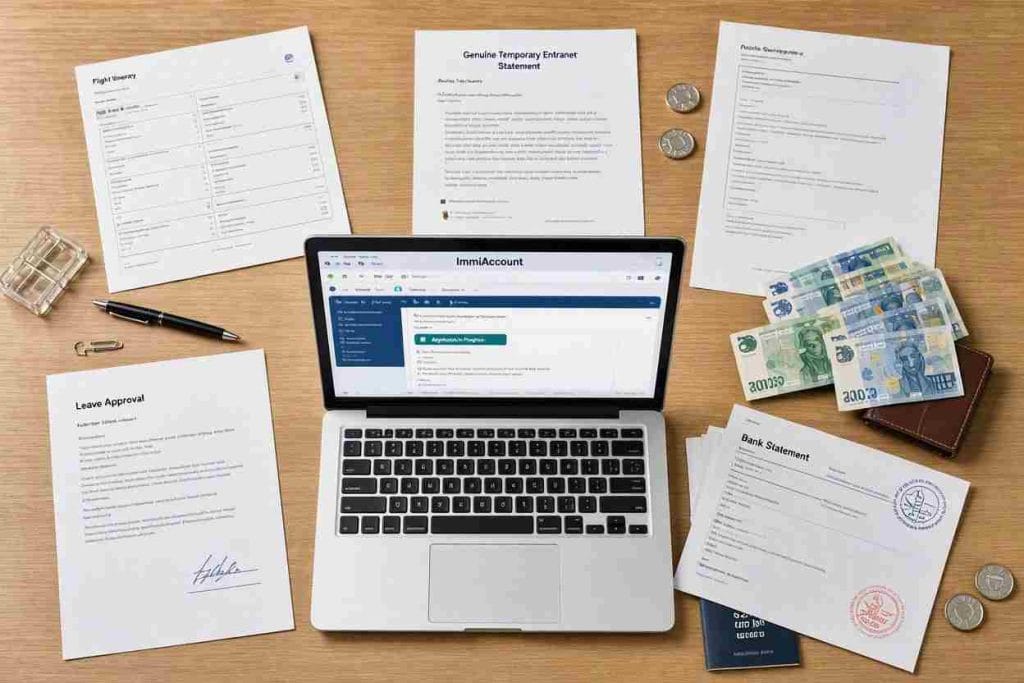
Proving Your Strong Home Country Ties (Clause 600.211)
The “Genuine Visitor” rule is the most important part of your entire visa application. Under Clause 600.211, officers want absolute proof that you have a settled life back home and will not overstay in Australia.
To win their trust, you need to show strong personal, financial, and family connections. Think of this as a simple journey: Job & Business ➔ Property & Money ➔ Family Needs ➔ Guaranteed Return.
- Your Financial Ties: Show them a solid, long-term job contract, an active business, or your property papers. The officer needs to see that your physical presence is required back home to manage your money.
- Your Family Duties: Do you have dependent children, elderly parents, or a spouse staying behind? These are very powerful emotional reasons that will naturally force you to return on time.
- Study and Community: Are you a university student? Provide your upcoming semester dates to show you must go back to finish classes. If you hold a local community role, mention it clearly.
- Your Past Travel Record: Have you previously traveled to strict places like the UK, Canada, or the Schengen area? A clean travel history makes Australian officers trust you much faster.
To tie all these powerful points together, you must write a beautifully organized cover letter. Following a good guide on How to Write a Tourist Visa Cover Letter helps you present your personal story perfectly to the case officer.
How Much Does It Cost and How Long Will It Take?
When planning your budget, remember that the standard application fee for an offshore Tourist Visa is usually 195 AUD. However, this is just the base government fee.
You must also keep some extra money ready for other required steps. You will need to pay separately for your biometric fingerprints, medical tests (if asked), and official document translations.
So, how long will you have to wait for an answer? Every application is completely different. A simple application with perfect documents might get approved in just a few days.
But if the embassy is busy, or if they need to call your boss to verify your job, it can easily take 20 to 30 days. To be completely safe, you should submit your application at least 4 to 6 weeks before your planned flight.
Navigating the ImmiAccount Lodgement Process
Australia no longer accepts paper visa applications. You must process everything online through their official ImmiAccount system. Here is how to complete the process smoothly:
- Step 1: Set Up Account & Form 1419: First, create a secure profile on the ImmiAccount portal. Then, carefully fill out the digital Form 1419. Make sure every single detail exactly matches your passport.
- Step 2: Upload Documents Safely: You can upload up to 60 documents, but each file must be strictly under 5 MB. Sort them into the right sections, like “Identity” or “Financial Proof.”
- A Quick Tip on Document Scans: Clear, original color scans are best because they do not need notarization. However, if you upload black-and-white copies, a Notary Public must certify them first.
- Step 3: Pay the Visa Fee: You will pay your visa fee directly inside the portal. Keep in mind that standard bank surcharges will apply depending on how you pay.
- Understanding Surcharges: Expect a 1.40% extra fee for Visa or Mastercard, 1.99% for PayPal, and 2.81% for Diners Club. Paying this instantly generates your official receipt and TRN number.
- Step 4: Health Checks & Fingerprints: Next, download your eMedical letter to get your unique HAP ID for any required clinic checkups.
- The 14-Day Biometric Rule: Finally, you have a strict 14-day window to submit your fingerprints. Book an appointment quickly at an approved VFS Global center to complete this step.
Made a Mistake on Your Form? Do Not Panic
It is very common to realize you made a typo or uploaded the wrong document after you have already paid the visa fee. If this happens, never try to hide it.
Australia is extremely strict about false or misleading information. If the officer thinks you lied, they can ban you from applying again for up to 3 years.
Instead, there is a very simple fix. Just download Form 1023 (Notification of Incorrect Answer) from the official website. Fill it out correctly, explain your simple mistake, and upload it directly into your ImmiAccount. Honesty will always protect your application from being refused.
Case Study: How a Freelancer Secured a 12-Month Visa
Freelancers, contractors, and remote workers often face a tough time with visa applications. Since they do not have standard monthly salary slips, visa officers check their files with extra suspicion.
Consider the story of an independent software consultant. He applied for a short 6-week holiday in Australia. However, his income came from random international wire transfers.
Without regular pay slips, his application was at a high risk of being refused over financial stability concerns. To prove his income was legitimate and he had strong ties to his home country, he used a smart strategy.
- Audited Tax Records: He hired a certified accountant to review his last two years of income. He then submitted an audited balance sheet alongside official tax notices.
- Active Client Contracts: He uploaded five ongoing work contracts. Crucially, he showed that his project deadlines were scheduled after his planned return date, proving he had to go back to finish the job.
- Clear Bank Statements: He provided 6 months of bank-stamped operational statements, perfectly following our Tourist Visa Financial Requirements: Bank Proof Guide.
- Property and Office Ties: Finally, he attached the official title deeds for his house and the lease agreement for his commercial office.
Because he provided such clear proof of his business and home ties, the embassy not only approved his 6-week trip but actually granted him a 12-month visa!
What These Documents Actually Proved
Here is a quick breakdown of how these specific documents perfectly answered the visa officer’s questions:
| What Needed Proving | The Documents Submitted | Why the Visa Officer Loved It |
|---|---|---|
| Clean Tax History | Audited 2-year tax assessments | It proved his money was legal and completely removed any doubts about his cash flow. |
| Work Deadlines | Active client project schedules | It showed a strict professional duty to return home to finish the ongoing work. |
| Local Assets | Office lease and home property papers | It proved he had valuable physical assets safely holding him to his home city. |
By showing these clear tax records and ongoing client projects, the applicant easily proved his trip was just a temporary holiday.
Because his proof was so strong, the officer confidently approved his Australia Visitor Visa Subclass 600 and even rewarded him with multiple-entry privileges!
Important Visa Conditions You Must Follow
When your visa is finally approved, it comes with a few strict rules attached to your electronic record. Breaking any of these rules can get your visa canceled instantly under Section 116 of the Migration Act.
| Condition Code | What It Means | The Simple Rule |
|---|---|---|
| Condition 8101 | No Work Allowed | You cannot do any kind of paid job while you are in Australia. |
| Condition 8201 | Maximum 3 Months Study | You cannot take a course or train for more than 3 months in a row. |
| Condition 8501 | Keep Health Insurance | You must have valid international health insurance during your whole trip. |
| Condition 8503 | “No Further Stay” | You cannot apply for a different visa while you are still inside Australia. |
| Condition 8558 | 12 Months Limit | You cannot stay in Australia for more than 12 months in total over an 18-month period. |
Pay extra attention to Condition 8503, especially if you plan to stay for a long time.
If your grant notice has this code, you absolutely cannot apply for another visa without leaving the country first.
The only exception is if you face a major, unexpected emergency and get a special waiver (Form 1447) based on compassionate grounds.
How Australia’s Visa System Compares to Other Countries
If you are a frequent traveler, you might wonder how Australia’s visa process compares to other major countries like the US, UK, or Canada.
The great news is that Australia’s system is entirely digital. It saves you the stress of standing in long embassy lines! Here is a quick, simple comparison:
| Feature | Australia (Subclass 600) | USA (B1/B2) | Canada (Visitor) | UK (Standard Visitor) |
|---|---|---|---|---|
| How to Apply | 100% Online (ImmiAccount) | Online Form + Embassy Interview | 100% Online (IRCC Portal) | Online Form + Document Upload |
| Is an Interview Required? | Rarely (Sometimes just a phone call) | Yes, an in-person interview is mandatory | No (Only fingerprints needed) | No (Only fingerprints needed) |
| What You Actually Get | Digital record (No sticker in passport!) | A physical sticker in your passport | A physical sticker in your passport | A physical sticker in your passport |
| Bank Statements Needed | 3 to 6 months of clear records | Reviewed mostly during the interview | 4 to 6 months of clear records | 6 months of verified records |
As you can see, the biggest advantage of the Australian system is the digital visa. You do not need to submit your physical passport anywhere. Everything is linked electronically!
If you are preparing your files, just focus on keeping your bank statements and employment letters perfectly organized.
What to Do If Your Visa Is Refused
If your Australia Visitor Visa Subclass 600 is refused, do not panic. The Department will send you a formal “Decision Record.” This letter explains exactly why your application failed under Section 65 of the Migration Act.
The best way to fix a visa refusal is to follow a simple four-step plan: Read the Refusal Letter ➔ Find the Missing Proof ➔ Decide to Appeal or Reapply ➔ Submit a Perfect New File.
- Can You Appeal to the ART? If you applied for a normal tourist visa from outside Australia, you cannot appeal. However, if an Australian relative sponsored you, your sponsor has the legal right to appeal to the Administrative Review Tribunal (ART). Just remember, they must do this within a strict deadline.
- Fixing Money Issues: Did the officer refuse you for having low funds? Next time, you must provide stronger proof. Include audited tax returns, explain any sudden large deposits, and show that you have steady cash savings.
- Proving Home Ties (Clause 600.211): If the officer felt you might not return home, you must submit stronger proof. Attach registered property deeds, a clear leave letter from your boss, and documents showing you have family waiting for you.
- Getting Sponsored Properly: If your family in Australia is sponsoring your trip, their documents must be flawless. They must provide complete proof of their legal Australian status and income to support you.
- Handling Surprise Phone Calls: Sometimes, an immigration officer will unexpectedly call you or your boss to verify details. Make sure that whatever you say on the phone exactly matches the information in your application forms!
FAQs
Should I buy my flight tickets before my visa is approved?
No. The Department of Home Affairs explicitly advises against booking non-refundable flights before receiving your visa. A planned travel itinerary or a simple flight reservation is perfectly fine for your application.
Can I include my family members in one single application?
No. Every single person traveling with you must have their own separate visa application. This includes babies and young children. However, you can group all your family’s applications together inside your ImmiAccount so the officer processes them at the same time.
Can a friend formally sponsor me for the Sponsored Family stream?
No. A friend can write you a nice invitation letter for a standard Tourist visa. However, to apply under the official “Sponsored Family” stream, your sponsor must be an eligible Australian citizen or permanent resident relative.
What happens if my passport expires before my visa is approved?
Your Australian visa is purely digital and electronically linked to your specific passport number. If you get a new passport while waiting, you must immediately update your new passport details using Form 929 inside your ImmiAccount.
Does a multiple-entry visa mean I can basically live in Australia?
Absolutely not. Even if you have a multiple-entry visa, you cannot use it to live in Australia by making frequent, back-to-back trips. If border officers suspect you are secretly living there rather than visiting temporarily, they will cancel your visa directly at the airport.
Next Steps for Your Visa Application
Getting your Australia Visitor Visa Subclass 600 approved simply comes down to careful preparation. Focus heavily on providing clear bank statements, a genuine office leave letter, and a realistic travel plan.
Always double-check your document scans so they are perfectly clear and easy to read. Also, remember to translate any non-English papers through a certified professional translator.
By following these simple steps, you will easily prove that you are a genuine visitor. This keeps your file out of the rejection pile and gives your application the absolute best chance of approval. Safe travels!
Sources & References
To ensure absolute accuracy and maintain editorial trust, the legal frameworks and visa rules detailed in this article are verified directly from official Australian government portals:
- Australian Department of Home Affairs – Subclass 600 Visitor Visa
- ImmiAccount Online Portal – Application Lodgement
- Administrative Review Tribunal (ART) – Migration Merits Review
- Federal Register of Legislation – Migration Regulations 1994
- VFS Global – Australian Biometric Collection Services