UK Standard Visitor Visa Application Guide: Step-by-Step
A UK Standard Visitor Visa allows you to travel across the UK for tourism, family visits, short study, or business meetings for up to 6 months. To secure approval, you simply need to prove three things to UKVI: that your visit is genuine, that you have enough legal savings to fund the trip without working, and that your job or family ties will bring you back home.
This step-by-step UK standard visitor visa application guide walks you through the official process under Appendix V rules.
The standard 6-month visa costs £135, and decisions typically take 3 weeks (15 working days) after your biometric appointment. With global refusal rates hovering between 15% and 20% due to paperwork and bank statement mistakes, this guide helps you prepare a transparent, refusal-proof application from start to finish.
What Is the UK Standard Visitor Visa?
The UK Standard Visitor Visa represents a consolidated immigration category created by the Home Office to simplify temporary entry.
Prior to its establishment, travelers navigated a fragmented landscape of distinct routes like Family Visitor, General Visitor, Child Visitor, and Business Visitor visas. Today, all these purposes fall under a single legal umbrella.
Holding a standard visitor visa allows overseas nationals to enter and remain in the United Kingdom—encompassing England, Scotland, Wales, and Northern Ireland—for periods of up to 6 months (180 consecutive days) per trip.
However, possessing entry clearance does not grant unlimited liberty. The Immigration Rules strictly define what you can and cannot do on British soil.
Permitted Activities
- Traveling throughout the UK for holidaying, sightseeing, and independent cultural tourism.
- Visiting immediate and extended family members, relatives, spouses, or personal acquaintances.
- Attending non-commercial business activities, including contract negotiations, corporate boardroom meetings, professional conferences, academic symposiums, and formal job interviews.
- Participating in short, non-accredited courses of study, vocational workshops, or recreational training programs lasting up to 30 calendar days.
- Attending pre-arranged private medical consultations or undergoing outpatient health assessments (subject to strict financial and clinical pre-authorizations).
- Taking part in amateur sporting tournaments or cultural performance showcases where no appearance fee or performance salary is disbursed.
- Undertaking incidental remote work directly tied to an existing overseas employment post, such as responding to office emails, tracking ongoing corporate communications, or attending virtual meetings, provided the applicant does not service the UK domestic market.
Prohibited Activities
- Taking up paid or unpaid employment for any UK-registered commercial entity, business, or individual employer.
- Establishing a business, setting up permanent commercial offices, or operating as an independent self-employed contractor within the UK.
- Accessing UK public funds, welfare benefits, state disability allowances, housing credits, or non-emergency National Health Service (NHS) hospital care without paying statutory fees.
- Using sequential, frequent, or back-to-back visits to effectively make the United Kingdom your primary residence or main place of domestic life.
- Entering into a civil marriage, registering an official partnership, or serving civil notices of intended marriage (all of which strictly require a distinct Marriage Visitor Visa).
Visa Types, Validity, and Official Fees
The Home Office structures standard visitor visas into four distinct validity tiers. While long-term variations offer multi-year operational convenience, the maximum permissible stay remains strictly capped at 180 consecutive days per individual visit.
| Visa Validity Period | Standard Home Office Fee | Maximum Stay per Trip | Target Applicant Profile |
|---|---|---|---|
| 6-Month Standard Visa | £135 | Up to 180 days | First-time tourists, holidaymakers, one-off events |
| 2-Year Long-Term Visa | £506 | 6 months per entry | Regular tourists, frequent corporate business travelers |
| 5-Year Long-Term Visa | £903 | 6 months per entry | Established international travelers with continuous UK ties |
| 10-Year Long-Term Visa | £1,128 | 6 months per entry | High-net-worth visitors with long-term UK family commitments |
Choosing a longer validity duration does not allow an applicant to reside continuously in the UK across multiple years. Rather, it eliminates the administrative hassle of repeatedly submitting fresh applications, paying appointment charges, and attending biometric centers for each separate journey.
Selecting the Right Validity Tier
The 6-Month Standard Visitor Visa serves as the universal baseline for the majority of overseas travelers. First-time applicants are strongly advised to apply for this entry category, as caseworkers expect applicants to demonstrate compliance on a standard entry before requesting multi-year permissions.
The 2-Year Long-Term Visit Visa offers economic and practical value for regular tourists, recurring business attendees, or parents visiting children enrolled in UK degree programs. It provides multiple-entry flexibility over 24 months without requiring repeated embassy filings.
The 5-Year and 10-Year Long-Term Visas are designed for seasoned international travelers with established UK family commitments or ongoing corporate obligations. Applications for these extended durations face heightened scrutiny. You must prove a credible, ongoing requirement to visit the UK over the entire validity duration and demonstrate uncompromised financial ties to your home country.
Importantly, long-term visas carry a strict non-residence condition. Border Force officers examine your historical travel frequency to ensure you do not use repeated short-term visits to effectively make the United Kingdom your primary residence.
Understanding the Genuine Visitor Test (Appendix V)
Every UK visa application is evaluated through the legal lens of the Genuine Visitor Requirement codified under Paragraph V 4.2 of Appendix V.
Entry clearance caseworkers operate under a balance of probabilities standard. They do not simply confirm whether an applicant possesses physical funds or paid employment; they determine whether the applicant’s overall life profile makes their stated travel intentions credible.
The caseworker must be fully satisfied that you will not overstay, that you will not engage in prohibited activities, and that you have compelling incentives to return home.
If the officer suspects that your life in your home country lacks economic stability or personal anchors, they will infer an intention to remain unlawfully in the UK.
Establishing compliance with Paragraph V 4.2 requires substantiating three primary elements:
- Verifiable Intention to Depart: Demonstrating that your employment position, ongoing commercial operations, owned real estate, or dependent family structures make remaining in the UK counterproductive to your personal interests.
- Economic Proportionality: Proving that the financial commitment required for your visit represents a sensible, proportionate allocation of your disposable capital rather than an unrealistic depletion of your total life savings.
- Plausibility of Proposed Travel: Ensuring that your proposed itinerary, travel duration, and daily activities logically correspond with your approved workplace leave window and historical travel profile.
UK Standard Visitor Visa Application Guide: 6-Step Process
The path from form filling to passport collection follows an ordered sequence:
Step 1: Online Application Completion on GOV.UK
Begin your journey exclusively on the official GOV.UK digital portal. You will create an authenticated user profile, select your visa duration tier, and input extensive background records.
The online form demands absolute transparency regarding your personal identifiers, passport records, ten-year travel history, domestic employment, net income, and itemized household expenditures.
Ensure that every numeric figure inputted into the digital declaration precisely matches your bank records. Even minor numerical inconsistencies are treated by UKVI caseworkers as serious credibility concerns.
Step 2: Visa Fee and Priority Service Payment
Once your online questions are completed, you proceed to the integrated statutory fee portal. Payments must be processed using an internationally enabled credit or debit card.
During this stage, you will decide whether to proceed with standard processing or opt for Priority or Super Priority services, where available.
Upon successful card authorization, the GOV.UK portal issues your official payment receipt and generates your unique GWF reference number. This reference serves as your primary tracking identity across all operational systems.
Step 3: Document Upload via Partner Portal (VFS/TLS)
After payment confirmation, the system automatically redirects your digital profile to the commercial partner managing visa logistics in your territory—predominantly VFS Global or TLScontact.
Here, you will register your commercial account and proceed to the document upload stage. You have the choice to self-upload digital scans prior to your appointment or purchase assisted scanning at the center.
Self-uploading remains the preferred route. Ensure every document is converted into clear A4 PDF files under 5MB each, organized neatly under corresponding document headings, and free from password restrictions.
Step 4: Biometrics Enrollment and Identity Verification
Book and attend your in-person biometric appointment at your regional Visa Application Centre (VAC).
On appointment day, bring your physical passport, printed appointment confirmation receipt, and digital document upload checklist.
Inside the facility, staff capture your digital facial photograph adhering to ICAO biometric standards and execute an ink-free, ten-digit digital fingerprint scan. Your physical passport is retained for vignette stamping unless you purchase the Keep My Passport service.
Step 5: Home Office Caseworker Evaluation
Once biometric enrollment is logged, your electronic application bundle is routed directly to the UKVI Decision Making Centre (DMC).
Entry clearance caseworkers examine your financial records, verify payroll deposits, inspect employer authorizations, and conduct intelligence checks against international databases.
Standard processing targets an outcome within 15 working days. During peak summer or winter travel periods, evaluation cycles may extend depending on operational caseloads.
Step 6: Passport Collection and Vignette Validation
Upon completion of the caseworker review, UKVI issues an automated dispatch notification indicating that your application has been processed.
You will retrieve your passport directly from the VAC by presenting your original submission receipt, or await secure delivery via tracked courier service.
If successful, carefully inspect the printed physical visa vignette affixed to your passport. Verify that your full name spelling, passport number, visa category, and operational validity dates are accurate.
Financial Scrutiny: The 3x Disposable Income Rule
Financial capability represents the most common ground for refusal under Paragraph V 4.2(e).
A frequent misconception among applicants is that having a large sum of money sitting in an account guarantees approval. In practice, UKVI caseworkers do not evaluate wealth simply by looking at the final closing balance.
Instead, caseworkers evaluate financial health through the lens of discretionary disposable income. They routinely apply what immigration experts term the 3x Disposable Income Rule to test if your trip is sustainable.
The Realistic Budget Calculation Formula
A trip is considered economically proportionate if its total estimated cost does not exceed two to three times your uncommitted net monthly savings:
Step 1: Net Monthly Salary − Total Monthly Living Expenses = Monthly Disposable Surplus
Step 2: Safe Trip Budget Threshold ≤ Monthly Disposable Surplus × 3

Real-Life Budget Scenario
Consider an applicant presenting the following personal balance sheet:
- Monthly Net Take-Home Salary: £3,000
- Declared Monthly Household Expenses (Rent, Food, Utilities, Loans): £2,000
- Uncommitted Net Monthly Surplus: £1,000
- Proposed Budget for a 10-Day UK Holiday: £2,200
Caseworker Verdict: Spending £2,200 represents approximately 2.2 months of savings. This shows that the applicant is allocating a reasonable portion of their disposable earnings toward leisure travel without exhausting their personal finances.
Conversely, if the same applicant with a £1,000 monthly surplus declares a trip budget of £6,000, the caseworker will observe that funding this short trip consumes six full months of total savings.
On a balance of probabilities, caseworkers view such disproportionate expenditures as implausible for a genuine tourist, leading directly to refusal under Paragraph V 4.2(e).
Detailed Guidelines for Supporting Evidence and Key Sub-Topics
A successful application requires building a complete, cohesive portfolio of evidence where every document supports your overall travel narrative.
Below are detailed operational strategies for the key elements of your application:
1. Bank Balance and Expat Solvency Proof
Securing entry clearance as an expatriate working outside your country of origin requires careful documentation. Caseworkers evaluate expatriate applicants through a specialized lens, cross-referencing residency legality against commercial stability.
If you reside in hubs like Dubai, Riyadh, Doha, or Singapore, presenting bank statements showing significant liquid assets is only half the requirement. Your financial history must explicitly show recurring salary deposits originating directly from your licensed employer, matching the remuneration declared on your contract.
Furthermore, caseworkers verify whether your foreign residency status provides sufficient long-term stability. If your work permit expires shortly after your proposed travel dates, officers often conclude that your incentive to return is compromised.
Maintaining an uncommitted cash cushion equal to twice your declared trip budget ensures your application meets UKVI expectations. You can explore exact balance calculations and country-specific considerations in our dedicated guide on UK visitor visa bank balance requirements for expats.
2. Handling Large or Irregular Bank Deposits
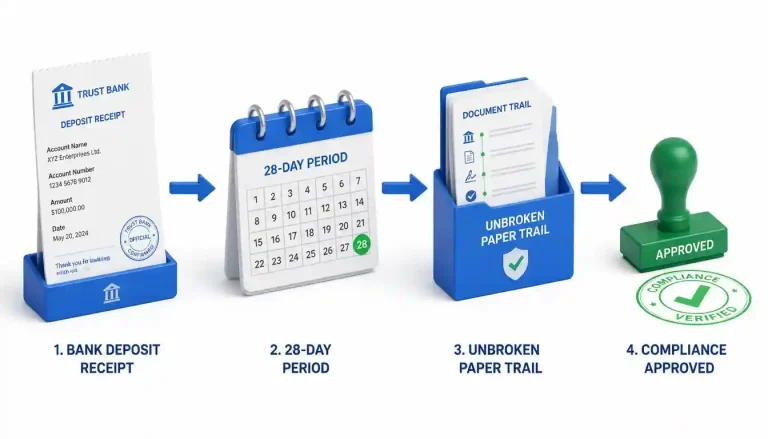
Unexplained bank deposits represent one of the fastest paths to refusal under Paragraph V 4.2(e). UKVI caseworkers are trained to identify “funds parking”—the practice of depositing borrowed cash into an account shortly before printing statements to manufacture paper wealth.
If an unusual, irregular credit appears on your 6-month bank statement that deviates from your regular payroll cycle, caseworkers will discount that money unless its origin is thoroughly documented.
To navigate this issue, applicants must provide a complete paper trail proving the legitimate source of any substantial deposit. If the credit stems from an annual bonus, supply your formal corporate bonus letter and corresponding tax slip.
If it originates from a property liquidation or matured fixed-deposit certificate, submit the registered sale agreement, deed transfer, and bank receipts. Accompany these documents with a detailed explanation in your cover letter.
Review the precise documentation frameworks needed to substantiate unexpected inflows in our guide on how to explain large cash deposits in UK visa bank statement.
3. Employment Confirmation and Leave Approvals
For salaried professionals, your employment status serves as your primary anchor proving economic stability and an ongoing obligation to return home.
A standard employment contract or basic offer letter is insufficient, as it confirms past hiring rather than active, authorized leave. Caseworkers require contemporary, verifiable documentation confirming that your workplace expects your return on an agreed date.
You must secure a formal No Objection Certificate (NOC) printed on official corporate letterhead, signed by an authorized Human Resources manager or director.
The document must explicitly state your date of joining, current job title, net monthly remuneration, and specific authorized leave dates matching your travel itinerary. The letter must also confirm that your position remains permanent upon your return.
Pairing this certificate with your three to six most recent official pay slips builds a solid evidentiary foundation. Access compliant templates and layout requirements in our UK tourist visa employment letter and NOC format sample.
4. Self-Employed and Business Owner Documentation
Entrepreneurs, sole proprietors, independent contractors, and corporate shareholders face distinct scrutiny from entry clearance officers.
Because business owners determine their own working hours and compensation, simple self-drafted letters confirming leave carry little evidential weight. Caseworkers focus on establishing that the business is an actively trading, legally registered entity that requires your physical presence.
To substantiate a self-employed profile, you must submit your official company incorporation certificates, commercial trade licenses, registered partnership deeds, and recent filings from national corporate registries.
You must also supply audited balance sheets, corporate profit-and-loss statements, business tax clearance records, and the last six months of company bank statements.
If your personal living expenses are drawn directly from company profits, provide corporate board resolutions authorizing dividend distributions. Review the complete document assembly strategy in our guide on UK standard visitor visa self employed document requirements.
5. Managing Sponsorship and Financial Guarantees
When an applicant’s journey is funded, hosted, or underwritten by a third party—such as a UK-based family member or friend—informal email invitations carry zero legal standing.
The caseworker must be satisfied that the sponsor possesses both the genuine intention and verified financial capacity to support the visitor without relying on public assistance.
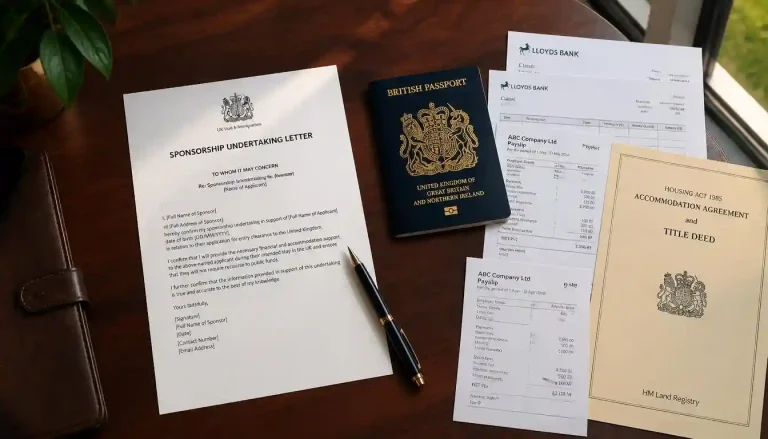
A compliant sponsorship package requires a formal, signed sponsorship undertaking letter outlining the precise nature of the relationship, the reason for hospitality, and a commitment to cover maintenance or accommodation costs.
The guarantor must provide primary documentary evidence, including certified proof of British citizenship or valid UK leave to remain, six months of UK bank statements, recent pay slips, and verified proof of housing, such as a land registry deed or tenancy agreement confirming adequate room.
Explore the legal requirements for drafting compliant guarantees in our walkthrough on UK visit visa sponsorship letter and financial proof requirements.
6. Document Checklists for Family and Group Travel
Coordinating standard visitor visa applications for a family group requires organizing individual files while maintaining a cohesive group narrative.
A common mistake is assuming that a strong application from the primary earner automatically guarantees approval for dependents. In reality, every single applicant, including young infants, receives an independent legal evaluation under Appendix V.
Each family member must have their own completed GOV.UK application form, paid biometric enrollment slot, and dedicated document bundle.
The application must clearly establish legal relationships and economic dependency through authenticated marriage certificates, official birth records, and formal dependency declarations.
If one parent is traveling with a minor child without the other parent, explicit written legal consent, certified identity copies, and custody agreements are mandatory to prevent child abduction concerns. Access our complete preparation guide in the UK standard visitor visa document checklist for family.
7. Flight Itineraries and Accommodation Arrangements
A frequent point of confusion among applicants is whether to purchase confirmed travel tickets prior to submitting an application.
The Home Office explicitly advises applicants against purchasing non-refundable long-haul flight tickets or pre-paying hotel reservations before holding an approved visa. Doing so exposes the traveler to unnecessary financial risk without improving approval chances.
Caseworkers look for a clear, realistic travel plan rather than prepaid booking receipts. You should provide a verifiable flight itinerary showing realistic transit routes and dates matching your leave approvals.
For accommodation, provide cancellable hotel bookings or an official invitation from your UK host confirming residential arrangements.
Review safe methods for building compliant travel plans in our analysis of UK visitor visa flight itinerary and hotel booking requirements.
8. Processing Times and Priority Service Tiers
Standard processing for a standard visitor visa averages 15 working days (3 calendar weeks) from the date of your biometric enrollment.
However, seasonal travel peaks, localized processing surges, and staffing allocations at UKVI Decision Making Centres can extend standard turnaround times to four to six weeks.
Applicants with urgent travel commitments can utilize commercial priority options at participating Visa Application Centres. The Priority Visa service aims to deliver an outcome within five working days for an additional statutory charge of £500.
The Super Priority service provides next-working-day decisions for an added fee of £1,000. These priority pathways expedite caseworker review times, but do not alter the evidentiary standards required for approval.
Check current operational turnaround times in our breakdown of UK visitor visa processing time and priority service fees.
9. Technical Protocols for In-Person Biometric Enrollment
The in-person biometric appointment is a mandatory procedural gate for every applicant.
This stage confirms identity through biometric verification, capturing facial images and fingerprint data that are cross-referenced across international security databases. Failing to follow biometric protocols can cause immediate administrative rejections or appointment cancellations.
Applicants must arrive at the Visa Application Centre 15 minutes before their scheduled appointment, carrying their current original passport, printed appointment letter, and checklist.
Ensure your fingertips are clear of any temporary markings, henna designs, cuts, or abrasions, as these can interfere with digital fingerprint scanners.
Dress in business-casual attire suitable for an official passport photo, ensuring your forehead, eyes, and facial contours remain fully visible. Walk through the complete center security procedure in our guide to the UK tourist visa VFS Global biometrics appointment process.
10. Proving Ties to Your Home Country (The Non-Return Test)
The foundation of the Genuine Visitor Test under Paragraph V 4.2 rests on your ability to prove strong ties to your country of residence.
Caseworkers evaluate whether your personal, professional, and economic roots provide compelling reasons to return home following your trip. Demonstrating strong ties requires presenting concrete, verifiable evidence of ongoing obligations.
Economic anchors include long-term employment contracts, active business management duties, and registered ownership of real estate or commercial property.
Personal and domestic ties include immediate family dependents—such as a spouse, school-aged children, or dependent parents—who remain in your home country during your travel.
By showing that remaining in the UK would significantly disrupt your career, family life, and assets, you directly satisfy the caseworker’s departure requirements. Master these evidence frameworks in our detailed guide on how to prove genuine visitor intention for UK visa.
Core Document Audit Checklist
Before uploading your supporting documents, conduct a comprehensive audit using this structured checklist:
| Document Category | Primary Documents Required | Verification Standards |
|---|---|---|
| Identity & Travel | Original Passport + Travel History | 6 months validity, blank double visa page, past entry stamps |
| Financial Proof | 6 Months Official Bank Statements | Duly stamped by bank, displaying running payroll credits |
| Employment/Income | NOC Letter, 3–6 Months Payslips, Tax Returns | On formal corporate letterhead, signed by HR or Director |
| Accommodation | Provisional Hotel Bookings or Host Undertaking | Dates perfectly aligned with leave letter and online form |
| Home Ties | Property Deeds, Tenancy, Family Records | Proves continuous social, domestic, and legal obligations |
How to Structure an Actionable Cover Letter
A well-structured cover letter acts as an executive roadmap for the entry clearance caseworker, tying your supporting documents together into a clear, cohesive narrative.
To maximize clarity, organize your cover letter around these five essential paragraphs:
- Purpose of Visit and Travel Dates: Clearly state your full legal name, passport number, planned dates of travel, destinations within the UK, and your primary reason for visiting (tourism, family visit, or business meetings).
- Employment Background and Leave Authorizations: Outline your current professional role, employer name, length of employment, monthly compensation, and confirm the specific dates of authorized leave approved by your workplace.
- Financial Summary and Budget Breakdown: Detail your estimated trip expenses (flights, accommodation, daily transit, food, and sightseeing) and demonstrate that your savings comfortably cover this budget without exhausting your disposable income.
- Accommodation and Daily Logistical Arrangements: State where you plan to stay throughout your trip with hotel names or host addresses, noting clearly that provisional bookings have been made pending visa approval.
- Binding Ties and Mandatory Return Obligations: Detail your concrete personal, domestic, and economic ties to your country of residence—such as ongoing employment, business ownership, real estate, or dependent family members—that require your prompt return.
Top UK Visa Refusal Traps to Avoid
Reviewing common refusal patterns helps you identify and resolve potential issues in your application before submission:
- Discrepancy Between Declared and Banked Income: Declaring a net monthly earnings figure on the online form that does not match the actual payroll credits reflected in your bank statements.
- Unrealistic Leave Durations: Applying for an extended multi-week stay when your employer has only granted a short vacation window.
- Failure to Declare Prior Refusals: Concealing past visa rejections from the UK, USA, Canada, Schengen Area, or Australia. Caseworkers share biometric immigration intelligence across international databases, and omissions are treated as deception.
Mandatory 10-Year Bans under Part 9
Submitting forged employment documents, altered bank statements, or inaccurate personal information triggers immediate refusal under Part 9: Grounds for Refusal (Section 9.7.1).
This results in a mandatory, unappealable 10-year ban across all UK immigration routes. Ensuring absolute honesty across all declarations is essential.
FAQs
Can I work remotely from the UK on a tourist visa?
ANS: Yes, but only for incidental tasks like replying to emails or taking occasional overseas work calls. Your main purpose must remain tourism, and you cannot work for the UK domestic market.
How much bank balance is recommended for a 2-week trip?
ANS: The Home Office sets no fixed minimum amount. Generally, having £2,000 to £3,000 in uncommitted liquid funds is safe for a 10 to 14-day trip, excluding pre-arranged flights and hotels.
When should I apply before my travel date?
ANS: You can apply up to 3 months (90 days) in advance. The ideal window to submit your application is 6 to 8 weeks before departure to avoid seasonal backlogs.
Does a UK host invitation letter guarantee a visa?
ANS: No. An invitation letter only confirms your planned accommodation and host details. Approval depends entirely on your own finances, home ties, and personal eligibility.
Final Pre-Submission Action Plan
- Verify that your monthly earnings and household living expenses match your 6-month bank statements.
- Draft a clear cover letter summarizing your itinerary, accommodation details, and personal ties to your country of residence.
- Secure your signed employment NOC or compile complete self-employment tax records.
- Upload high-resolution PDF scans of your evidence into the commercial partner portal (VFS Global or TLScontact).
- Attend your biometric enrollment appointment on schedule with your appointment confirmation receipt and passport.
Official UK Immigration Resources
- GOV.UK Immigration Rules (Appendix V for Visitors): Official statutory framework and legal requirements governing visitor entry clearance.
- GOV.UK Visa and Immigration Fees Schedule: Official Home Office statutory fee tables for standard entry and priority services.
- Apply for a Standard Visitor Visa Portal (GOV.UK): The verified official application gateway for international applicants.
- VFS Global UK Visa Processing Services: Official commercial partner for biometric scheduling and digital document uploading across Asia and the Middle East.
- TLScontact UK Visa Application Centers: Official appointment scheduling partner for Europe and Africa regions.