France 5 Year Multiple Entry Schengen Visa Requirements (Latest Information)
Securing a long-term European visa often feels like decoding an embassy secret. If you are tired of gathering stacks of paperwork, paying visa fees every few months, and chasing scarce appointment slots, a long-validity visa changes everything.
The france 5 year multiple entry schengen visa requirements are tailored specifically for frequent flyers, business travelers, and regular family visitors who need unrestricted access to 29 European countries.
Here is the real truth: getting a 5-year sticker is not a lucky draw, nor is it a box you simply check on a form.
French consulates work on a strict, evidence-based progression system. Before you start drafting your paperwork or learning how to fill schengen visa application form for multiple entry, you need to understand how consular officers actually evaluate your profile.
Quick Facts for 5-Year France Visa
- Processing Time: 15 to 20 standard days.
- Bank Balance: Minimum 65 Euros per day of your first trip.
- Eligibility: Must have lawfully used a 2-year multiple-entry visa first.
- Insurance: Only needed for the first planned trip, not for 5 years.
Understanding the France Multiple Entry Visa Cascade Rules
Under Article 24(2) of the European Union Visa Code (Regulation EC No 810/2009, updated in 2020), consulates must issue Multiple-Entry Visas (MEVs) through an objective framework known as the “Cascade System”.
France applies these cascade rules strictly. You cannot leap directly from a first-time visa to a 5-year multi-entry visa simply by requesting it. Instead, you earn longer validity by building a verified track record of compliance.
The 3 Stages of the EU Cascade System
| Stage | Mandatory Requirement | Visa Issued |
|---|---|---|
| Stage 1 | Obtained and lawfully used 2 Schengen short-stay visas within the previous 3 years. | 1-Year MEV |
| Stage 2 | Obtained and lawfully used a 1-year MEV within the previous 2 years. | 2-Year MEV |
| Stage 3 | Obtained and lawfully used a 2-year MEV within the previous 3 years. | 5-Year MEV |
What Does Lawfully Used Actually Mean?
Many travelers assume having past visas stamped in their passport is enough. Consulates look much deeper:
Physical Entry and Exit: You must have actually entered and left the Schengen zone within the authorized validity. An unused visa does not count toward the cascade.
The 90/180-Day Rule: You must never exceed 90 days of stay within any rolling 180-day window. Overstaying by even 24 hours destroys your cascade progression permanently.
| The Rule Parameter | What It Actually Means | Practical Example |
|---|---|---|
| 90 Days Maximum Stay | The total number of days you can legally stay inside the Schengen zone. | If you stay 30 days in France and 60 days in Germany, your 90 days are finished. |
| 180-Day Rolling Window | It is not a fixed calendar year. The window counts backward 180 days from your current date. | Whenever you enter Europe, look back 180 days. Have you spent 90 days there already? If yes, you cannot enter. |
| Resetting the Clock | You must stay completely outside the Schengen area for a continuous 90 days to reset a full 90-day allowance. | After staying exactly 90 days, you must leave and cannot return for the next 90 days. |
Primary Destination Compliance: If France issued your previous visa, your main purpose of travel or first entry should reflect France. Consulates check exit stamps and entry records (especially with the EU Entry/Exit System – EES).
In real-world terms, qualifying for a 5-year French visa under standard rules requires a proven sequence: two short-stay visas, then one 1-year visa, then one 2-year visa. Once you complete this cycle, you hold the legal standing to request a full 5-year multiple-entry visa.
Can You Skip Stages and Get a 5-Year Visa Directly?
Under standard EU rules, you cannot skip the queue—you must hold the 1-year and 2-year visas first.
However, there is an official legal exception under Article 24(2c) of the EU Visa Code.
Consular officers have discretionary power to grant a 5-year visa directly if you have a proven, compelling need to travel frequently and an impeccable socio-economic profile.
This exception typically applies to:
- High-level corporate executives with ongoing European business interests
- International sports figures and performing artists
- Frequent academic researchers attending European conferences
While this exception exists, it is granted sparingly. Unless you have an extraordinary profile, sticking to the standard cascade steps is your safest route to approval.
France 5 Year Multiple Entry Schengen Visa Requirements & Checklist
A common misconception among travelers is looking for a separate 5-year visa application form. There is none. You apply using the standard Schengen Short-Stay Visa (Type C) application, which France officially categorizes as a Circulation Visa (Visa de circulation).
The secret lies entirely in how you assemble your supporting file and how you fill the online portal. While a first-time applicant only needs to justify a single itinerary, your file must prove two things simultaneously: absolute immigration compliance in the past, and an undeniable need for repeated travel in the future.
When filling out the application on the France-Visas portal, never write 5 years or 1825 days in the duration of stay box. Always enter the exact duration of your first intended trip (such as 10 or 15 days) and select Multiple Entries. Your cover letter and verified cascade record are what legally trigger the consular officer to grant the 5-year circulation validity.
Essential Document Checklist for a 5-Year MEV
| Document Category | What Consular Officers Look For | Critical Success Factor |
|---|---|---|
| Past Visas & Travel History | Copies of all previous Schengen visas (specifically the 1-year and 2-year MEVs). | Clear entry/exit stamps proving compliance with the 90/180-day rule. |
| Proof of Recurring Travel | Business contracts, supplier meetings, corporate board invitations, or family ties in France. | Concrete dates or recurring events across consecutive years. |
| Home Country Anchors | Permanent employment contract, company registration, property deeds, family dependents. | Approved leave letters showing ongoing tenure and guaranteed career continuity. |
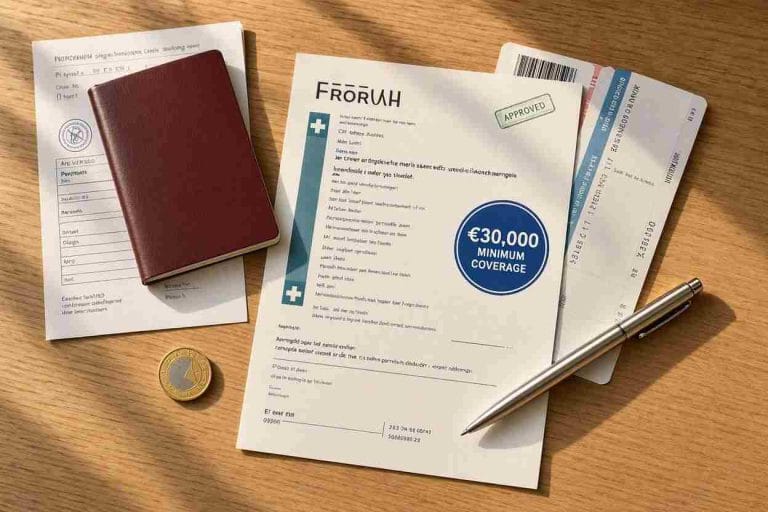
| Travel Health Insurance | Minimum €30,000 emergency medical and repatriation coverage across all 29 Schengen states. | Only required for the first planned trip. |
Do Unused or Cancelled Visas Count Toward the Cascade?
A common question applicants ask is: “I have two previous Schengen stickers in my passport, but I canceled the trips. Do they count?”
The legal answer is no.
The EU cascade strictly mandates that visas must be lawfully used:
- You must have physical entry and exit stamps showing you actually visited Europe.
- If a visa was issued but never used, the consulate treats your travel history as blank for that period.
- Additionally, Type A (Airport Transit Visas) and LTV (Limited Territorial Validity Visas) do not contribute to your cascade progression. Only standard Type C short-stay visas count.
The Reality About Travel Insurance (Do You Need 5 Years?)
One of the biggest concerns applicants have is the cost of insurance: “Do I have to buy an expensive 5-year insurance policy upfront?”
The short answer is no.
The EU Visa Code does not require you to pre-purchase health coverage for 5 years.
For your visa submission:
- You only need comprehensive insurance covering the exact dates of your first upcoming trip.
- Alternatively, frequent travelers often submit an Annual Multi-Trip Policy, which demonstrates professionalism.
- By signing the Schengen application form, you legally acknowledge that you will purchase compliant insurance for every subsequent entry into Europe.
How to Write a Winning Cover Letter for a 5-Year MEV
Your cover letter is where you connect the dots for the visa officer. Without a clear statement explaining your progression under the cascade rule, the officer may simply default to granting a single-entry visa.
1. Address and Request Line
Address the specific French Embassy or Consulate handling your jurisdiction. State your request in the opening sentence without ambiguity:
“I respectfully request a five-year multiple-entry Schengen visa to support my frequent and recurring travel obligations in France and the wider Schengen territory over the coming years.”
2. Cascade Progression Summary
“Over the past three years, I have held and lawfully utilized two consecutive Schengen visas, including a 2-year multiple-entry visa issued by the French Consulate (Visa No: XXXXXX, valid from DD/MM/YYYY to DD/MM/YYYY). All prior visits strictly complied with the 90/180-day stay limit, as verified by the enclosed entry/exit stamps.”
3. Justification for Future Recurring Trips
Vague statements like “I enjoy holidaying in Paris” will lead to a downgraded visa. Give concrete reasons:
- Business: Mention recurring quarterly meetings, annual trade expos, or ongoing client consultations (attach official invitations).
- Family: Detail periodic visits to children, spouses, or aging relatives living legally in France.
4. Strong Economic Ties
Reiterate your career position, business operations, or family obligations in your home country to confirm that your primary residence remains unchanged.
Financial Proof and Insider Legal Insights
When applying for a 5-year multiple-entry visa, your finances will be under a microscope. Consular officers are not just looking for a large bank balance; they are looking for financial stability and credibility.
How Much Money Do You Actually Need?
France follows a strict daily reference amount (known as the Annex 25 guidelines). To prove you can financially support yourself, your bank account must comfortably cover your upcoming trip based on these specific rates:
- €65 per day: If you have a confirmed and fully booked hotel reservation.
- €32.50 per day: If you are staying with family or friends and have an official host certificate (Attestation d’accueil).
- €120 per day: If you have not booked any accommodation yet.
The Bank Statement Trap: Many applicants make the critical mistake of depositing a huge lump sum of money into their account right before applying. This is a massive red flag. Consulates strictly look at your last 3 to 6 months of bank statements to see a steady, reliable pattern of income. A consistent monthly salary credit is much more powerful than a sudden, unexplained deposit.
3 Insider Secrets Consulates Rarely Tell You
Even if you meet all the cascade rules, consular officers use a few unwritten guidelines to decide whether to grant a 1-year, 2-year, or a full 5-year visa.
1. The Passport Validity Cap You might flawlessly meet the requirements for a 5-year MEV, but your visa validity is permanently tied to your passport. The consulate is legally bound to cap your visa so that it expires at least 3 months before your passport does. Real-world tip: If your passport expires in two years, renew it before applying for a 5-year visa.
2. The Pattern of Purpose Officers highly favor applicants with a “logical repeated purpose.” Going to Paris once for a holiday is normal. Going 5 times in two years just for “sightseeing” might look suspicious. However, traveling frequently for quarterly corporate meetings, industry trade shows, or visiting an immediate family member shows a highly credible and consistent travel pattern.
3. Zero Tolerance for Minor Violations A clean compliance record is non-negotiable. If you ever overstayed by a single day, worked without authorization, or spent the majority of your previous Schengen trip in a different country than the one that issued your visa, your 5-year request will likely be downgraded to a single-entry visa.
How Much Does a 5-Year Schengen Visa Cost in Reality?
Many people think a 5-year visa requires a special, expensive consular fee. Officially, the application fee for a 5-year multiple-entry visa is exactly the same as a short-stay Type C visa: 90 Euros for adults.
However, that is only half the truth.
Because of the strict Cascade System, you cannot just pay 90 Euros once and get a 5-year visa on your first try. You have to “earn” it by applying multiple times over several years. Here is the real cost breakdown of achieving a 5-year visa:
- The Cumulative Embassy Fees To qualify for a 5-year visa, you must first apply for short-stay visas, then a 1-year MEV (90 Euros), followed by a 2-year MEV (90 Euros), and finally the 5-year MEV application (90 Euros). Your actual investment in embassy fees over the years is at least 270 to 360 Euros.
- VFS Global / TLScontact Service Fees The embassy does not accept direct applications. Every time you apply, you must pay an outsourcing service fee, which is generally between 30 to 40 Euros per application.
- The Hidden Preparation Costs For every single application step in the cascade, you will also spend money on:
- Travel Health Insurance: Mandatory for the first trip of every application.
- Document Preparation: Translation and notarization of business documents, deeds, or marriage certificates.
- Logistics: Courier fees for passport return or premium lounge services.
So, while the final application costs only 90 Euros, the real financial requirement for securing a 5-year Schengen visa is a long-term investment across multiple trips and applications.
How to Get 5 Year Schengen Visa: Application Process
Securing a long-validity visa requires flawless execution on the official platform. Even a small misstep on the portal can cause the visa center to categorize your file incorrectly.
1. Register on the France-Visas Official Portal
All French visa applications must start through the official France-Visas platform. Create your account and complete the visa wizard.
When asked for the duration of stay, remember that you are applying for a Short-Stay Schengen Visa (Uniform Type C). You cannot directly type “5 Years” as your requested days—instead, select “Multiple Entries” and enter the duration of your first intended trip (e.g., 10 or 15 days). Your cover letter and prior cascade record are what trigger the consulate to grant the 5-year validity.
2. Lock In Your Visa Appointment Early
Once you complete and validate your online application form, generate your registration receipt. You will be directed to book a biometrics appointment through the designated outsourcing partner in your country (such as VFS Global or TLScontact).
Slots fill up extremely fast, especially during peak holiday seasons. Make sure to book your appointment at least 4 to 6 weeks before your planned date of departure.
If you are exploring other European travel options alongside France, you can check our comprehensive guides on popular tourist visas and embassy requirements to plan your itineraries properly.
Why Do Some Applicants Get Downgraded to a 6-Month or 1-Year Visa?
Meeting the cascade criteria gives you the right to be considered for a 5-year visa, but it does not guarantee one. Consulates frequently downgrade applications to a 6-month or 1-year visa due to subtle profile weaknesses:
- Vague Justification: Applying for 5 years with only a basic 4-day tourist itinerary in Paris. Without proof of recurring future travel, the officer has no incentive to issue long validity.
- Weak Economic Anchors: Freelance or temporary employment where income fluctuates drastically month-to-month.
- Inconsistent Past Travel: Holding a French visa previously but spending 90% of your time in Spain or Germany without a valid itinerary explanation.
- Passport Expiry: If your passport expires within the next 18 to 24 months, the consulate cannot issue a 5-year sticker and will cap the visa duration according to your passport’s expiration date.
FAQs
What happens if my 5-year Schengen visa is valid, but my passport expires?
You do not lose your visa. You can travel by carrying both passports together: your old expired passport (which holds the valid 5-year visa sticker) and your new valid passport. Just ensure your personal details match perfectly on both documents.
Must I enter France first on every single trip over the 5 years?
No. For your very first trip after getting the visa, France must be your primary destination. However, for any subsequent trips over the next five years, you are completely free to enter and exit through any of the 29 Schengen countries, even without visiting France.
How do I accurately calculate the 90/180-day rule to avoid accidental overstays?
The 180-day window is not a fixed calendar year; it is a “rolling” window. This means it counts backward from whatever day you are currently inside the Schengen zone. To avoid risking a permanent entry ban, always use the official EU Schengen Calculator online to track your exact days.
Can I use my 5-year multiple-entry visa to work remotely as a digital nomad?
Absolutely not. A Type C short-stay visa strictly prohibits any form of paid employment or long-term remote work settling within the Schengen area. While checking occasional business emails is fine, living there as a digital nomad requires a specific National Long-Stay Visa (Type D) or a dedicated Digital Nomad Visa.
Author’s Final Advice from Experience
Getting a 5-year visa from France is completely a game of patience and proper documentation. From my experience managing travel queries, the biggest reason people fail to get long-term visas is rushing the process. Do not apply for a 5-year validity if you have not completed the 1-year and 2-year cascade steps.
Build your profile slowly, show a genuine need to visit Europe frequently, and let your clean travel history do the talking. Make sure your bank statements reflect steady income, not sudden deposits.
If you have any specific questions about your travel history, passport validity, or bank statements, drop a comment below. I will personally review your query and help you figure out your next steps.
Official Sources & Legal References
To ensure 100% accuracy, the information in this guide is sourced directly from the official European Commission and French Consular directives. For further verification, you can explore the official legal frameworks below:
- EU Visa Code (Regulation EC No 810/2009): The primary legal basis detailing Article 24 and the exact MEV cascade rules.
- European Commission MEV Directives: Official implementing act showing the precise steps for 1-year, 2-year, and 5-year visa issuance.
- France-Visas Official Portal: The singular mandated platform for initiating short-stay and circulation visa applications for France.
- France Diplomatie Guidelines: Consular steps, embassy procedures, and financial subsistence guidelines (Annex 25).