CR2 Visa Processing Time for Stepchild of US Citizen: The Complete Legal Guide
Navigating the U.S. immigration system for a blended family requires extreme precision. If you are a U.S. citizen petitioning for your stepchild, the exact cr2 visa processing time for stepchild of us citizen is currently 10 to 14 months from start to finish.
This timeline fluctuates heavily based on which USCIS service center processes your Form I-130 and the local U.S. embassy’s backlog. Stepchild visas also come with unique legal considerations that biological child visas do not.
Below is a detailed breakdown of the exact processing timeline, strategies to expedite your case, and the critical rules you need to follow to ensure a smooth approval.
Quick Summary (TL;DR)
- Zero Waiting Lines: Stepchildren of U.S. citizens are “Immediate Relatives,” meaning they are exempt from annual visa caps and do not have to wait in the Visa Bulletin backlog.
- The Age Limit: To qualify for a CR2 or IR2 visa, the marriage between the U.S. citizen and the biological parent must legally occur before the child’s 18th birthday.
- Airport Procedures: The CR2 visa printed in the passport becomes a temporary 1-year Green Card the moment it is stamped at the U.S. border, allowing immediate school enrollment and SSN application.
Understanding the Visa Bulletin and F2A Category
Many families panic when checking the monthly Visa Bulletin, worrying about priority dates and long waiting lines. Fortunately, for U.S. citizens, a stepchild is classified as an “Immediate Relative.”
This means there is zero waiting line for a visa number. The processing time is purely the administrative time it takes for USCIS and NVC to process the paperwork.
However, a critical issue arises if the stepparent is a Lawful Permanent Resident (Green Card Holder). In this scenario, the stepchild is not an Immediate Relative. They fall under the F2A visa category and must wait in the Visa Bulletin backlog, which can add years to the process.
If the Green Card holder becomes a naturalized U.S. citizen while the stepchild’s I-130 is still pending, the visa category does not change automatically.
To fix this, the parent must immediately contact USCIS or the NVC. You must upload the new Naturalization Certificate and formally request an upgrade to the Immediate Relative category to bypass the backlog.
The Absolute Rule: Marriage Before the 18th Birthday
Before calculating processing times, you must pass the most heavily scrutinized rule in stepchild immigration. To qualify for a CR2 or IR2 visa, the marriage between the U.S. citizen and the biological parent strictly must occur before the child’s 18th birthday.
If the marriage takes place on the day of the child’s 18th birthday or any time after, the application will fail. The child legally does not qualify as a stepchild for immigration purposes.
A common point of confusion for parents is the difference between the marriage age and the filing age. You do not have to file the Form I-130 petition before the stepchild turns 18.
As long as the marriage took place in time, you have a window to apply. You can legally file the petition when the stepchild is 19 or 20 years old, provided USCIS receives it before their 21st birthday (which freezes their age under the Child Status Protection Act).
Stepchild vs. Adopted Child: Key Legal Differences
Many applicants face outright denials because they confuse stepchild regulations with adopted child laws. Some U.S. citizen stepparents mistakenly believe they must legally adopt the stepchild in their home country to sponsor them.
If you formally adopt a child after age 16 and check the “Adopted Child” box on Form I-130, the visa will be permanently denied. You should always file strictly as a “Stepchild” based on the marriage certificate alone.
Here is a clear breakdown of the differences:
| Legal Requirement | Stepchild (CR2 / IR2) | Adopted Child (IR3 / IR4) |
|---|---|---|
| Age Limit | Parents’ marriage must occur before the child turns 18. | Legal adoption must be finalized before the child turns 16. |
| Custody Rule | Zero cohabitation required. The stepparent never has to live with the child. | Requires 2 full years of legal and physical custody. |
| Parental Rights | The other biological parent keeps their legal rights. | The other biological parent’s rights must be completely terminated. |
Additionally, a common and costly mistake is assuming a stepchild can be added as a “derivative” to the biological parent’s CR1 or IR1 spouse petition.
Immediate relatives do not have derivative rights. You must file a completely separate Form I-130 and pay a separate USCIS filing fee for the stepchild.
CR2 Visa Processing Time for Stepchild of US Citizen Cases and Timeline
If you meet the marriage date requirement, here is the exact breakdown of the NVC processing time for CR2 visa and the preceding USCIS stages.
The entire administrative journey is broken down into three distinct steps:
USCIS Processing (11 to 14 Months)
After filing the I-130 petition, your wait time depends entirely on which USCIS Service Center is assigned to your case. Processing times vary widely between the Texas, Potomac, and Nebraska centers.
To get a deeper understanding of how this works, you can check our detailed guide on The Exact I-130 Petition for Alien Relative Timeline (And Expedite Secrets), which breaks down the step-by-step processing stages and secret expedite methods.
NVC Processing (1 to 3 Months)
Once approved, the case moves to the National Visa Center (NVC). Here, you pay fees, file the DS-260, and upload supporting documents. Your ultimate goal is receiving the “Documentarily Qualified” (DQ) email, which stops the NVC processing clock.
Embassy Interview Queue (1 to 4 Months)
After becoming DQ’d, the NVC waits for your local U.S. embassy to open an appointment slot. Keep in mind that high-volume embassies may take over six months just to schedule the interview.
If you are facing a severe medical emergency or active-duty military deployment, you can request an NVC Expedite by emailing NVCExpedite@state.gov with official proof.
However, you cannot email the NVC if your I-130 is still pending at USCIS. Furthermore, if the embassy approves your expedite, the NVC CEAC online portal will instantly freeze. You must physically carry all original documents, forms, and fees directly to the embassy on interview day.
Critical Legal Considerations for Stepchild Visas
A single paperwork error can cause months of delays or trigger an administrative refusal at the U.S. embassy. To guarantee a smooth approval, you must carefully navigate several procedural requirements.
Securing Non-Migrating Parent Consent (Hague Law)
U.S. embassies strictly enforce international child abduction laws under the Hague Convention. The consular officer will refuse the CR2 visa if you lack absolute legal permission from the other biological parent.
A basic notarized “No Objection Certificate” is often rejected. The consent letter must explicitly state permission for “permanent relocation and immigration to the United States” and include the name of the U.S. citizen stepparent.
If the other parent is uncooperative or missing, you must obtain a formal Court Order granting Sole Legal Custody. This order must specifically include the right to remove the child from the country’s jurisdiction.
Stepchildren Born Out-of-Wedlock
If the biological father marries a U.S. citizen, and the stepchild was born out of wedlock, submitting a birth certificate alone is not enough. Under INA 101(b)(1)(D), the father must provide solid legal proof that a “bona fide parent-child relationship” existed before the child turned 18.
This requires documenting emotional and financial ties over the years, such as money transfers, school or medical records listing the father, and family photos. Failing to prove this ongoing relationship will result in an automatic visa denial.
The Form I-130A Exemption and Prior Divorces
When filing for a foreign spouse, the U.S. citizen must submit Form I-130A. However, many applicants mistakenly submit this form for the stepchild as well, which clutters the packet and triggers delays. Form I-130A is strictly for spouses.
Instead, USCIS scrutiny shifts entirely to the validity of the parents’ marriage. You must provide the legal termination (Divorce Decree or Death Certificate) of the biological parent’s previous marriage.
If you only submit the new marriage certificate without proving the previous marriage legally ended, the stepchild’s petition will receive a Request for Evidence (RFE) or an outright denial.
Overstays and the Under-18 Exemption
If the stepchild previously visited the U.S. and overstayed, parents often fear the CR2 visa will be denied. Leaving the U.S. after accruing unlawful presence normally triggers a 3-year or 10-year ban.
However, U.S. immigration law has a specific exemption for minors. Any unlawful presence accrued before the child turns 18 does not count toward these bans.
You must always disclose past overstays honestly on the DS-260 application. Hiding it will trigger a permanent lifetime ban for misrepresentation that no age exemption can fix.
Entering on a Tourist Visa (The 90-Day Rule)
Many parents try to skip the embassy wait by bringing the stepchild to the U.S. on a B-2 tourist visa and filing for Adjustment of Status. Entering the U.S. with the secret intention to stay permanently is considered visa fraud.
If you file for the green card or enroll the child in a U.S. public school within 90 days of entering, USCIS automatically presumes you misrepresented your intentions at the border. This can lead to a permanent ban.
While a stepchild can legally adjust status if circumstances naturally changed after a genuine visit, lying at the airport will destroy the case.
Converting CR2 to IR2 at the Border
If the U.S. citizen and biological parent have been married for less than two years, the child receives a CR2 (2-year conditional green card). If married for more than two years, they receive an IR2 (10-year green card).
This 2-year mark is calculated on the day the stepchild enters the U.S. border, not the interview date. If the 2-year anniversary is approaching, you can delay travel to enter after the anniversary to secure the 10-year card.
Just ensure you travel before the visa expires (exactly 6 months from the medical exam). At the airport, politely remind the CBP officer that the 2-year anniversary has passed to ensure you get the correct IR2 admission code.
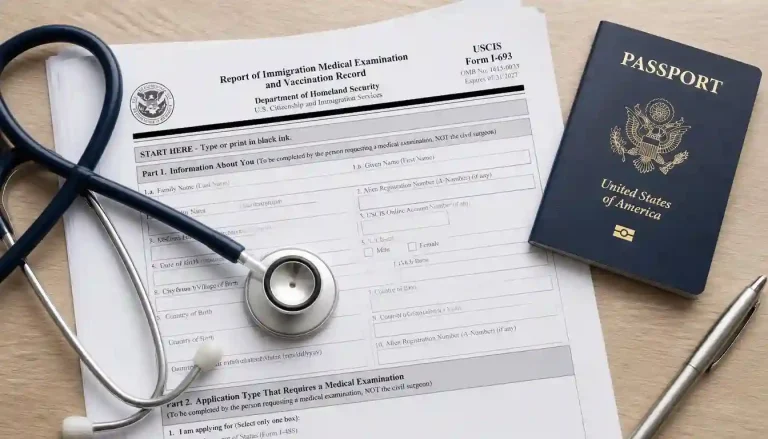
Mandatory Police Certificates and Medical Exams
The NVC and U.S. embassy strictly require police certificates only if the stepchild is 16 years of age or older on the day of the interview.
Regarding medical exams, many stepchildren born outside the U.S. received the BCG vaccine at birth. This frequently triggers a false positive on the required TB screening at the embassy clinic.
A positive test legally requires an 8-week sputum culture process. It is highly recommended to schedule the medical exam at least two months before the embassy interview to prevent massive delays.
Financial Sponsorship and Domicile
Under the Child Citizenship Act of 2000, stepchildren do not get automatic citizenship upon entering the U.S. Therefore, the U.S. citizen stepparent must submit a fully executed Form I-864 (Affidavit of Support).
If the stepparent lives abroad, they must prove a “U.S. Domicile” by uploading concrete proof of re-establishing residency. This can include signing a U.S. lease or securing a U.S. job offer.
Handling Divorces and CSPA Age Freezes
If the U.S. citizen and the biological parent divorce before the stepchild enters the U.S., the CR2 visa is automatically revoked.
However, if they divorce after the stepchild arrives with a 2-year conditional green card, the stepchild does not automatically lose their residency. They can file their own independent Form I-751 with a waiver to remove the conditions, completely independent of the parents’ failed marriage.
When it comes to aging out, the Child Status Protection Act (CSPA) legally freezes the stepchild’s age on the exact date USCIS receives the Form I-130 petition.
Even if processing takes years and the child physically turns 22, their immigration age remains safely under 21. Just remember that the stepchild must remain strictly unmarried; marrying at any point will instantly destroy the CR2 visa.
Airport Procedures and the Final Green Card
Once the visa is printed, you must pay a final $235 USCIS Immigrant Fee online before the stepchild travels. If you fail to pay this fee, USCIS will never produce the physical plastic Green Card.
At the airport, the CBP officer will take your sealed yellow envelope. Do not open this envelope yourself under any circumstances.
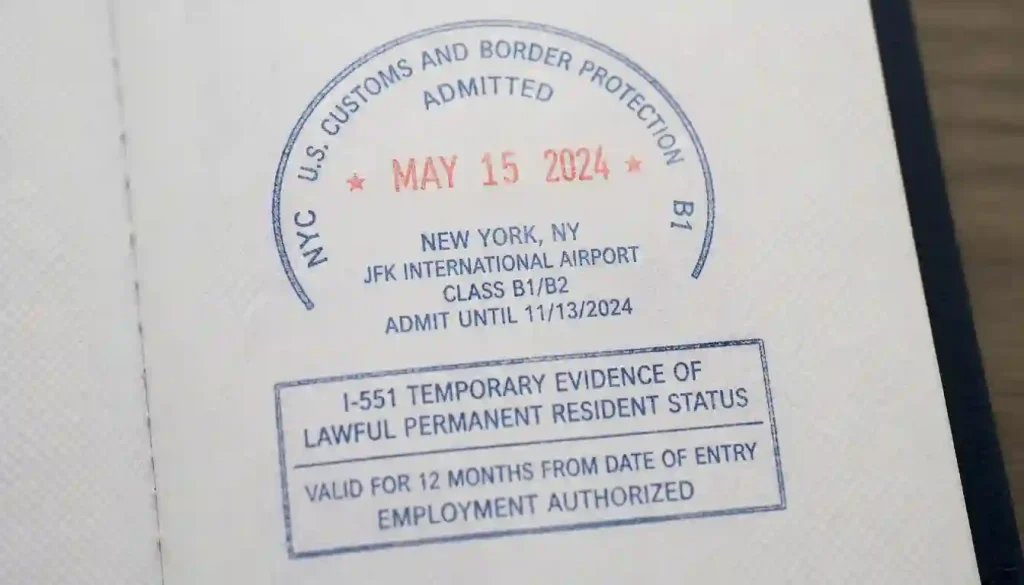
If you moved to a new house during the processing time, explicitly tell the officer your new address so the Green Card doesn’t get lost in the mail.
The moment the officer stamps the CR2 visa, it legally transforms into a Temporary I-551 Green Card, valid for exactly one year. You can use this stamp immediately for school enrollment and medical insurance without waiting for the plastic card to arrive.
FAQs
Can the embassy demand a DNA test for a stepchild?
Yes, but the test is strictly between the foreign biological parent and the stepchild. Embassies typically demand DNA if the birth certificate was “late-registered” (issued years after birth). Submitting original hospital birth records alongside the certificate can help avoid this delay.
Can the stepchild travel to the U.S. before the biological parent?
Yes. A CR2 stepchild is an “Immediate Relative” with an independent, standalone petition. They can enter the U.S. alone or with the U.S. citizen stepparent, even if the biological parent travels months later.
Can we change the stepchild’s last name during the CR2 process?
It is highly advised not to do this mid-process. Without a finalized legal adoption, changing the surname will completely stall your NVC case because the name on the DS-260, passport, and birth certificate must match exactly. Keep their original name for the visa and legally change it in a U.S. family court later.
Source of Information
- Official statutory processing times and petition guidelines: USCIS Official Portal
- Child Status Protection Act (CSPA) & visa bulletin rules: U.S. Department of State Travel Guidelines
- Hague Convention international child custody regulations: USCIS Policy Manual