Form I-751 Removal of Conditions Guide: Secure Your 10-Year Green Card
Getting your initial U.S. marriage visa was a huge win. But if you were married for less than two years when your residency was approved, that victory came with a catch: an expiration date.
Your conditional green card is only valid for two short years. If you do not act before it expires, you automatically lose your legal right to live and work in the United States.
To fix this, you must file Form I-751 (Petition to Remove Conditions on Residence). This is your direct roadmap to transitioning from a temporary resident to a permanent one with an unrestricted 10-year green card.
Whether you recently moved from the UK, Canada, or the Middle East, the stakes are high. One missing document or missed deadline can ruin your legal status. Let’s dive into the exact legal steps, hidden waivers, and insider strategies to get your petition approved without a stressful fraud interview.
Key Takeaways: Form I-751 at a Glance
- The 90-Day Window: You must file exactly within the 90 days before your conditional card expires.
- Current Filing Fees (2026): It costs $750 to file by mail, but only $700 if you file online. Biometrics are now included (no extra fee).
- Automatic Extension: A properly filed receipt notice extends your legal residency and work rights for 48 months.
- Solo Filing (Waivers): You can file on your own without your spouse if you are divorced, widowed, or suffered abuse (the abuse waiver has a $0 filing fee).
What is Form I-751 and Why is it Mandatory?
Under federal immigration law, standard marriage-based residency has a built-in probation period. USCIS uses this two-year window to aggressively detect and prevent marriage fraud.
Form I-751 (Petition to Remove Conditions on Residence) is how you legally lift this probation. It officially transitions you from a temporary resident to a permanent one.
If you successfully completed your initial I-485 Adjustment of Status, you already know how strict USCIS officers can be. The I-751 petition is their absolute final check to ensure your relationship is truly bona fide (real).
This form is completely mandatory. You cannot simply renew a two-year conditional green card like you would a standard driver’s license.
If you ignore this filing requirement, your legal status terminates automatically on the exact expiration date printed on your card. You will instantly become deportable.
For expats who navigated the complex U.S. family-based green card process from Europe, Australia, or the Middle East, starting over is simply not an option. You must submit this petition with overwhelming evidence to secure your permanent future in America.
The Strict 90-Day Filing Window (Do Not Miss This)
Timing is everything when it comes to removing your green card conditions. You cannot just file your petition whenever you feel ready.
USCIS has a very strict rule: your 90-day filing window opens exactly 90 days before the expiration date printed on the front of your conditional green card.
Do not file early! This is a very common mistake that causes huge delays.
If your application package arrives at the USCIS lockbox even one single day before that 90-day window opens, they will instantly reject it and mail it right back to you.
For expat professionals managing busy careers between the USA and the Middle East, keeping track of this exact date is crucial. A rejected package wastes your valuable time and puts your legal status in serious danger.
Can You File Late? (The “Good Cause” Exception)
Life is unpredictable. Sometimes a severe medical emergency or an unexpected family crisis back in the UK or Canada can cause you to miss the deadline.
If your conditional green card expires before you submit the paperwork, you are officially out of status. However, you can still save your residency using a helpful rule known as the “good cause” exception.
USCIS officers have the power to accept a late I-751 petition, but you must prove that the delay was completely out of your control. You cannot simply tell them that you forgot the date!
When filing late, you must submit a formal, sworn written statement (an affidavit) explaining the exact reason for the delay. Acceptable reasons usually include:
- A prolonged hospital stay
- Severe financial hardship
- The death of an immediate family member
Always include heavy proof to back up your story. For example, if you were hospitalized while visiting a Schengen country, make sure to attach your translated medical records and flight itineraries. Solid proof guarantees that USCIS will accept your late filing without issues.
Filing Jointly vs. Requesting a Waiver
Most applicants file the I-751 petition jointly with their American spouse. This simply proves to the government that your marriage is still ongoing and real.
When filing jointly, both of you must sign the official paperwork. You also need to submit strong, shared financial and housing documents covering the last two years.
But what happens if your marriage falls apart?
U.S. immigration law understands that sometimes marriages fail. If your U.S. citizen spouse passes away, becomes abusive, or you go through a divorce, you are not automatically deported.
Instead, you can legally skip the joint filing rule by asking for a waiver. This option allows you to file the entire petition by yourself, completely without your ex-spouse’s signature.
How to File if You Are Divorced or Separated
Filing with a divorce waiver is very common, but expect USCIS to look at your case much closer. You must clearly prove that your marriage was real from the beginning (entered in “good faith”) and not just for a green card.
The biggest advantage here is timing. Unlike a joint petition, you can file a divorce waiver at any time—you do not need to wait for the standard 90-day window to open.
However, to get approved, you must eventually provide the final, judge-signed divorce decree. A simple legal separation agreement is usually not enough.
What if your divorce is still pending?
You can still file your I-751 petition. Just include a cover letter explaining that your divorce is currently in court. USCIS will later send you a Request for Evidence (RFE). This automatically buys you the extra time you need to get your final divorce papers before they make a decision.
The Abuse and Extreme Cruelty Waiver
If your U.S. citizen spouse subjected you or your child to physical battery or extreme mental cruelty, you do not need to wait for a divorce.
You can safely and independently file Form I-751 under the domestic abuse waiver immediately. Like the divorce waiver, you do not have to wait for the 90-day window to open.
Important Financial Update:
The government filing fee for an abuse-based I-751 waiver is now $0 (completely free).
To get this waiver approved, you must support your petition with strong, verifiable evidence. Make sure to include:
- Detailed police reports
- Medical evaluation records or therapy notes
- Formal, court-issued protection or restraining orders
The Golden Evidence Checklist for a Bona Fide Marriage
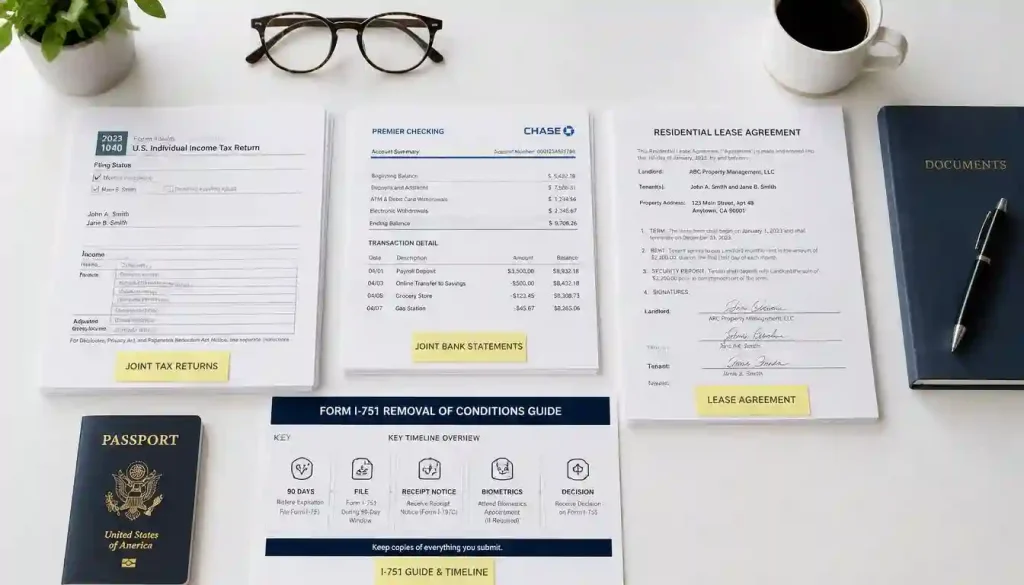
When following this Form I-751 removal of conditions guide, remember that your success relies on an undeniable paper trail. USCIS officers are highly trained to spot fake relationships. They simply do not care about your romantic love letters, holiday greeting cards, or social media photos.
What they actually want to see is shared money and joint assets. They need hard proof that you and your spouse have completely combined your financial lives in the United States.
For many expats who are used to keeping separate bank accounts in the UK, Canada, or the Schengen zone, this rule can be a major trap. To win your case, you must actively combine your lives on paper.
Quality Over Quantity: What USCIS Actually Wants
Sending 500 pages of random documents will only frustrate the officer reviewing your case. You need high-quality, legally binding evidence.
Joint IRS tax returns, shared property deeds, and co-signed residential leases are the absolute gold standard.
Here is a clear breakdown of the exact documents USCIS wants to see:
| Category | Weak Evidence (Avoid Relying On) | Strong Evidence (Highly Recommended) |
|---|---|---|
| Financials | Venmo or PayPal transfer receipts | Jointly filed IRS tax returns and shared bank statements |
| Housing | A handwritten letter from your landlord | A formal residential lease signed by both spouses |
| Insurance | Named only as an emergency contact | Listed as the primary beneficiary on life and health insurance |
| Lifestyle | Hundreds of casual selfies | Flight itineraries and hotel bookings for joint vacations |
The Role of Third-Party Affidavits
Financial documents are your strongest proof, but USCIS also wants to hear from the people in your life. You should include at least two sworn affidavits (letters) from friends, family members, or religious leaders who know you well as a couple.
These letters should ideally be notarized. Tell your friends not to use generic, copy-pasted templates. The letters will only help if they include specific, personal details and real stories about their regular interactions with you and your spouse.
Surviving a Request for Evidence (RFE)
If USCIS feels your initial application is weak or missing information, they will mail you a formal Request for Evidence (RFE).
Do not panic—an RFE is not a denial. It simply gives you a strict 87-day window to submit additional, newly dated financial or housing proof to support your case.
However, you must take it very seriously. Never ignore an RFE. If you fail to respond on time with strong evidence, your case will be automatically denied, which can immediately trigger deportation proceedings.
How to Avoid a Stokes Interview
Unlike your first green card application, an in-person interview is not always mandatory for the I-751 petition. USCIS officers can legally skip the interview entirely, but they will only do this if your paperwork is incredibly strong.
If your evidence is weak, missing, or looks suspicious, you and your spouse will be called in for a Stokes Interview. This is a very strict fraud investigation.
During a Stokes interview, you and your spouse are separated into two different rooms. The officers will ask both of you highly specific questions about your daily household routine to see if your answers perfectly match.
To avoid this, your initial application must be flawless. Make sure you submit strong, shared financial proof covering your entire two-year conditional period. If you do receive an interview notice, you must prepare rigorously by reviewing common US Marriage Visa Interview Questions and Answers.
I-751 Processing Fees and Current Timelines
It is extremely important to get your filing fees exactly right. As of 2026, the current USCIS filing fee for Form I-751 is $750 if you file by mail, but it drops to $700 if you file online.
The good news is that the old $85 biometrics fee has been completely removed—fingerprinting is now fully included in the standard filing fee.
What about processing times?
USCIS is currently experiencing delays. Depending on your specific service center, it can take anywhere from 18 to 36 months to receive a final decision.
However, shortly after you apply, USCIS will mail you a Form I-797 receipt notice. Keep this paper safe! This receipt legally extends your conditional green card status for an additional 48 months.
This 48-month extension allows you to continue working legally in the U.S. and travel back to Europe or the Middle East without any issues while you wait for your permanent 10-year card.
What if Your 48-Month Extension Expires? (The ADIT Stamp)
With current USCIS delays, your 48-month extension letter might actually expire before you receive a final decision. If this happens, do not panic.
You will not lose your job or your residency. You simply need to call USCIS and request an ADIT Stamp (also known as an I-551 stamp).
An officer will schedule an appointment to place this highly secure ink stamp directly inside your valid foreign passport. This stamp acts as your temporary green card. It perfectly protects your right to work and travel internationally for another full year while USCIS finishes processing your case.
The Address Change Trap (Form AR-11)
Moving to a new house while your petition is pending requires quick action. By law, you must notify USCIS of your new physical address within 10 days of moving by filing Form AR-11.
If you forget to update your address, USCIS will mail your critical extension letters and biometrics notices to the wrong house. If these letters are returned to them, USCIS will likely deny your entire case, assuming you abandoned it.
If you previously navigated the CR1 Visa Processing Time Middle East, you already know how slow immigration agencies can be. Patience and highly organized paperwork are your best tools for success.
The Form N-400 Combo Interview Strategy
Because I-751 processing times regularly take more than two years, something very interesting might happen: you may become eligible for U.S. citizenship before your 10-year green card even arrives!
If you have been married to and living with your U.S. citizen spouse for three consecutive years, you can legally file Form N-400 to apply for naturalization.
When you do this, USCIS will often combine both files at your local field office. This allows the immigration officer to approve your condition removal and your U.S. citizenship at the exact same time during a single “combo” interview.
FAQs
Can I travel outside the U.S. while my I-751 is pending?
Yes, you can travel internationally. You just need to carry your expired conditional green card and your original 48-month extension receipt notice (Form I-797) together. This combination perfectly proves your legal status to airlines and border officers when you return to America.
What happens if we get divorced AFTER filing a joint petition?
Do not panic. If you filed jointly but your marriage falls apart before USCIS makes a decision, you can legally switch your application to a divorce waiver. You just need to write a letter to USCIS explaining the situation and send them the final judge-signed divorce decree. You do not have to pay the filing fee again.
Can I change jobs or start a new career with an expired green card?
Absolutely. Your 48-month extension letter serves as full legal proof of your right to work in the United States. When you start a new job, simply show your employer your expired green card along with the I-797 receipt notice for their standard background checks.
How do I check if my I-751 has been approved?
You can track your case status online anytime. Look at your I-797 receipt notice and find the 13-character receipt number (it usually starts with letters like EAC, WAC, or LIN). Simply type this number into the official USCIS “Case Status Online” webpage to see real-time updates on your petition.
Official Sources & References
- USCIS Official Form I-751 Filing Guidelines
- USCIS Fee Schedule and Calculator
- U.S. Department of State Travel Warnings and Updates