Germany Job Seeker Visa vs Opportunity Card Requirements & Points Guide
Foreign professionals planning to enter the European labor market face a decisive legal choice when targeting employment in Europe’s largest economy. Evaluating the germany job seeker visa vs opportunity card requirements reveals that the modern germany opportunity card (Chancenkarte under Section 20a AufenthG) offers far superior flexibility through points-based entry and legal secondary employment rights.
While the legacy germany job seeker visa strictly demanded full degree equivalence prior to departure, this updated immigration framework creates an accessible pathway built on fundamental Schengen visa application requirements for skilled global talent.
The German Skilled Immigration Act (Fachkräfteeinwanderungsgesetz) fundamentally restructured how international talent secures residency. Knowing how to substantiate academic accreditation, deposit statutory subsistence funds, and navigate centralized consular interfaces prevents costly procedural delays. Selecting the correct entry track early protects your relocation budget and accelerates your long-term transition into an EU Blue Card or permanent settlement permit.
Quick Summary (Featured Snippet Target):
The germany opportunity card (Chancenkarte Section 20a) replaces the restrictive germany job seeker visa by introducing a dual-track entry pathway. Key chancenkarte requirements include a minimum 6-point score (or full degree equivalence), a mandatory germany blocked account funded with €1,091/month (€13,092/year), permission for 20 hours/week part-time work, and an initial 12-month legal stay in Germany.
Germany Job Seeker Visa vs Opportunity Card Requirements: Core Framework
The statutory divergence between both immigration routes dictates everything from your daily job search allowances to the initial duration of your residency vignette. When evaluating the germany job seeker visa vs opportunity card requirements, filing under the incorrect legal basis risks an administrative refusal if your academic profile lacks direct institutional comparability.
The comparison table below details the foundational legal parameters of both immigration options:
| Eligibility Dimension | Legacy Job Seeker Visa (Section 20) | Opportunity Card (Chancenkarte Section 20a) |
|---|---|---|
| Legal Basis | Section 20 AufenthG (Strict equivalence) | Section 20a AufenthG (Dual-track framework) |
| Degree Equivalence | 100% full equivalence mandatory upfront | Full recognition OR points-based alternative |
| Part-Time Work Rights | Strictly prohibited (Job search only) | 20 hours/week secondary employment allowed |
| Trial Work Allowance | Up to 10 hours trial work | Up to 2 weeks paid trial work (Probearbeit) |
| Initial Validity | Up to 6 months strictly | Up to 12 months (extendable up to 3 years) |
| Application Method | Traditional paper dossier at consulate | Centralized digital filing on Auslandsportal |
Dual-Track Entry: Understanding Chancenkarte Germany
The primary innovation of chancenkarte germany is its dual-track qualification architecture. Qualified applicants no longer face an automatic refusal simply because their foreign qualification lacks immediate, full equivalency under traditional German standards.
- Track 1: Direct Skilled Worker Track (Bypassing Points): Candidates holding a university degree or vocational credential evaluated as fully equivalent to German standards qualify automatically as Fachkräfte. This requires your institution and degree program to hold an H+ standing on the official Anabin database, or an explicit Statement of Comparability from the Central Office for Foreign Education (ZAB). These applicants bypass the 6-point requirement entirely.
- Track 2: Points-Based Assessment Track (Minimum 6 Points): Candidates whose academic qualifications are not formally recognized as identical can still qualify. The prerequisite requires holding a state-recognized vocational or university degree of at least 2 years from your home country, verified alongside German A1 or English B2 proficiency. “After clearing these baseline gates, you must score at least 6 points across age, experience, and language proficiencies under the official Make it in Germany scoring rules.”
Calculating Scores with an Opportunity Card Points Calculator
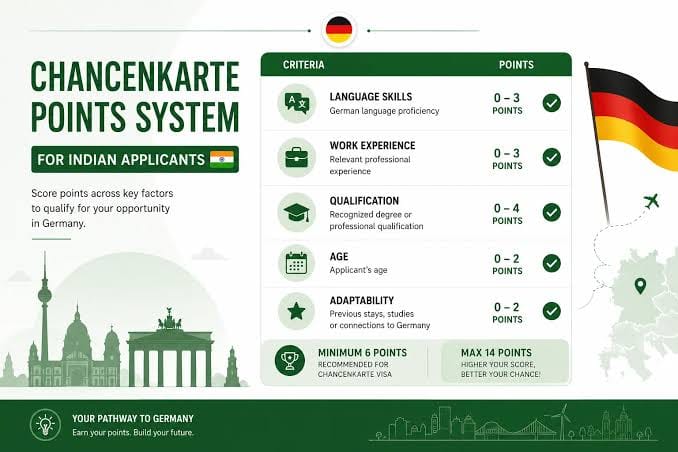
Applicants qualifying under Track 2 must achieve at least 6 points under the statutory scoring rules established by the Federal Ministry of the Interior. Treating this scoring matrix as a manual opportunity card points calculator helps verify eligibility before booking a consular slot:
| Assessment Category | Point Value | Mandatory Qualification Criteria |
|---|---|---|
| Partial Recognition | 4 Points | Official assessment confirms degree requires compensatory training |
| Shortage Profession | 1 Point | Occupation falls under official bottleneck lists (STEM, Healthcare, IT) |
| Professional Experience | 2 to 3 Points | 3 points for 5+ years experience; 2 points for 2+ years experience |
| German Language Skills | 1 to 3 Points | 3 points for B2; 2 points for B1; 1 point for A2 level certification |
| English Language Skills | 1 Point | Documented C1 level English proficiency (IELTS 7.0+ or TOEFL 95+) |
| Applicant Age Profile | 1 to 2 Points | 2 points for under 35 years; 1 point for candidates aged 35 to 40 |
| Prior Germany Stay | 1 Point | At least 6 consecutive months of lawful stay in Germany within last 5 years |
Essential Chancenkarte Requirements: Blocked Accounts and Work Rights
Meeting the baseline chancenkarte requirements demands careful financial planning alongside credentials verification. Every candidate seeking entry under National Visa (Category D) regulations must verify reliable personal maintenance, as German consular missions strictly prohibit relying on public social welfare while conducting an active job search.
- Mandatory Germany Blocked Account Threshold: Applicants must open a certified germany blocked account (Sperrkonto) containing at least €1,091 per month. For the standard 12-month validity period, the account must hold a total capital deposit of €13,092 before consular filing, following verified personal funding standards similar to Schengen visa bank statement guidelines.
- Secondary Part-Time Employment: Unlike the legacy job seeker permit, the Opportunity Card explicitly authorizes up to 20 hours per week of secondary employment. This legal right allows candidates to cover living expenses from their first month in the country.
- Two-Week Trial Work (Probearbeit): Permit holders can engage in up to two weeks of paid trial work with prospective German employers. This trial window gives both sides a practical way to assess technical compatibility before signing an official employment contract.
- German University Graduate Exceptions: Foreign students who graduate directly from German universities do not need this specific permit. They retain access to the dedicated 18-month Job Seeking Residence Permit under Section 20 Abs. 3 AufenthG, which grants unrestricted full-time employment rights across any sector.
Auslandsportal Digital Filing and Consular Tracking
Lodging your application follows modern administrative workflows designed to reduce processing backlogs at diplomatic missions:
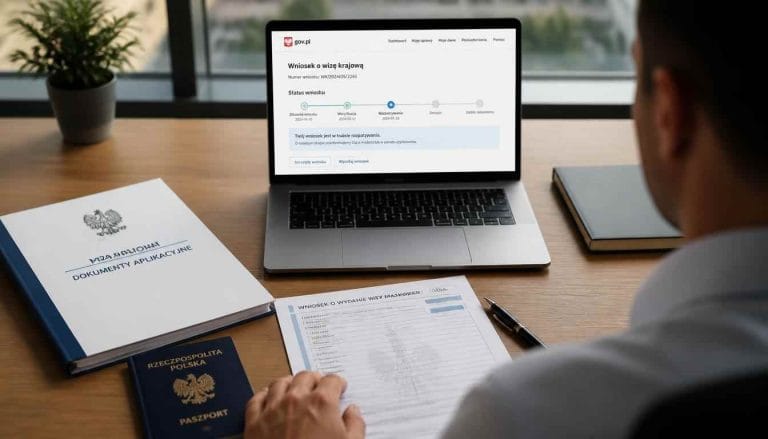
- Digital Intake via Auslandsportal: Begin your formal filing on the Federal Foreign Office’s centralized Auslandsportal. Complete the master questionnaire and upload certified digital copies of your passport, CV, and financial proof.
- Credential Verification: Upload academic certificates alongside your formal ZAB equivalence statements or Anabin printouts. If scoring points under Track 2, include verified language certificates (Goethe-Institut, Telc, IELTS, or TOEFL) and signed reference letters from past employers.
- Consular Biometrics and Tracking: Once consular officers complete the preliminary digital audit, attend your scheduled appointment at the embassy, consulate, or designated external service center. You can regularly track your visa application status on VFS Global to monitor your passport delivery.
- Addressing Procedural Refusals: If an administrative error or missing document leads to an unexpected visa denial, you retain the legal right to challenge the decision. You can resolve underlying evidential gaps using the principles outlined in our guide on how to appeal a visa refusal.
FAQs
Do I need to score 6 points if my degree is already recognized?
No. Candidates holding a foreign degree verified as fully equivalent to a German credential on the Anabin database qualify directly under Track 1 as skilled workers without calculating points.
What is the exact blocked account amount for the Opportunity Card?
The statutory maintenance threshold requires a germany blocked account funded with €1,091 per month, which equals €13,092 for the full 12-month validity period of the Chancenkarte.
Can I work full-time while holding an Opportunity Card?
No. Full-time work is prohibited during the initial job search period. You are restricted to 20 hours per week of secondary employment, alongside up to two weeks of full-time trial employment with prospective employers.
Can the Opportunity Card be extended beyond 12 months?
Yes. If you secure qualified employment or need additional time to finalize an EU Blue Card employment contract, the local immigration office (Ausländerbehörde) can extend your permit for up to an additional two years.
Can an applicant submit the Opportunity Card application online?
Yes. The German Federal Foreign Office processes initial applications, document uploads, and preliminary verifications digitally via the centralized Auslandsportal platform before your biometric appointment.
Strategic Blueprint for Your German Career Path
Navigating the germany job seeker visa vs opportunity card requirements requires matching your academic background against clear statutory benchmarks. Verify your university standing on Anabin early, calculate your point total if utilizing Track 2, and ensure your blocked account meets current statutory funding rates.
Secure your certified translations, CV, and employment verification letters well before your physical appointment. By submitting an accurate digital dossier through the Auslandsportal and taking strategic advantage of your 20-hour work rights, you establish a direct, compliant bridge to permanent professional residency in Germany.
Official Verification and Statutory Resources
- Make it in Germany Official Portal: Official federal portal for international qualified professionals, detailing Chancenkarte scoring and skilled immigration legislation.
- Auslandsportal Digital Services: Centralized online platform for lodging German national visa applications and undergoing preliminary consular reviews.
- Central Office for Foreign Education (ZAB): The official federal authority managing the Anabin database and issuing formal Statements of Comparability.