Schengen Visa Bank Statement Balance and Sponsorship Rules
A visa officer assesses your bank statement not simply to check the final closing figure, but to evaluate the financial narrative of your daily life. Under official European consular directives, understanding the schengen visa bank statement balance and sponsorship rules dictates whether an applicant possesses genuine financial sustainability or presents an unmitigated risk of unauthorized settlement.
Reviewing the overarching Schengen Visa Application Requirements and Appointment Booking Guide establishes the baseline legal criteria before preparing your financial dossier. Sudden lump-sum deposits injected shortly before submission frequently lead to immediate administrative refusals, regardless of total balance size.
Quick Summary: Financial Means at a Glance
Under Article 6 of the EU Visa Code, satisfying proof of financial means Schengen visa regulations requires maintaining a clean 3 to 6-month active banking history. Applicants must maintain a minimum bank balance for Schengen visa covering country-specific daily subsistence rates (€45–€120/day), unpaid lodging, and a 20% foreign exchange buffer. If sponsored, informal invitations fail without a legally binding municipal Schengen visa sponsorship letter.
Minimum Bank Balance for Schengen Visa: Country-Specific Daily Rates
| Country | With Prepaid Hotel | Without Prepaid Hotel | Minimum Baseline |
|---|---|---|---|
| France | €32.50 / day | €120.00 / day | €65.00 / day (Hotel booked) |
| Germany | €45.00 / day | €45.00 – €80.00 / day | No flat baseline |
| Italy | €27.89 / day | €44.93 / day | €206.58 fixed (1–5 days) |
| Spain | €113.40 / day | €113.40 / day | €1,020.60 minimum flat |
| Switzerland | CHF 100 / day | CHF 100 / day | CHF 30 / day (Students) |
| Netherlands | €55.00 / day | €55.00 / day | €55.00 minimum / day |
Schengen member states define minimum subsistence thresholds under Article 6 of the EU Visa Code. The daily required amount varies widely depending on your primary destination and whether accommodation is
How to Calculate Required Bank Balance: Mathematical Formula
Calculating your required closing balance requires accounting for hidden contingencies, internal transit, unpaid lodging, and foreign exchange volatility. Holding the exact bare minimum in local currency exposes your file to immediate refusal if exchange rates fluctuate during consular assessment.
To determine precisely how much bank balance is required for Schengen visa applications, follow this straightforward 3-step calculation:
- Calculate Daily Expenses: Multiply your destination country’s daily rate by the number of days you plan to stay.
- Add Unpaid Accommodation & Buffer: Add any unpaid hotel bookings plus a recommended €1,000 emergency fund.
- Apply the 20% Currency Cushion: Multiply the total by 1.20 (20% extra) to safely absorb currency exchange rate drops and foreign transaction fees.
Step-by-Step Example (14-Day Trip to France):
- Daily Allowance: €120/day × 14 days = €1,680
- Unpaid Hotel Bookings: €1,400
- Emergency Buffer: €1,000
- Base Required Amount: €1,680 + €1,400 + €1,000 = €4,080
- Final Target Balance (with 20% cushion): €4,080 × 1.20 = €4,896
Maintain liquid funds at or above this target threshold in your bank account for at least 90 consecutive days before applying. If you are calculating total itinerary duration across borders, cross-check our Schengen 90 180 Rule Calculator and Multi Entry Rules Guide.
Schengen Visa Bank Statement Requirements: Red Flags vs. Authentic Profiles
Consulates evaluate transaction frequency, payroll source codes, and balance stability under strict schengen visa bank statement requirements. Understanding what triggers administrative scrutiny keeps your file fully compliant:
- Red Flag (Parked Funds / Lump Sums): A sudden €5,000 deposit appearing days before statement printing without an identifiable transaction trail (such as a documented property sale or gratuity payout) is flagged as borrowed money.
- Green Flag (Payroll Alignment & Tax Reconciliation): Regular monthly salary credits matching your payslips, supported by official Income Tax Returns (ITR) or tax clearance certificates demonstrating consistent declared revenue.
- Red Flag (Account Depletion Pattern): An account that maintains a near-zero balance all month and spikes only on the statement printing date.
- Green Flag (Operational Cash Flow): An active account showing normal day-to-day living expenses (groceries, utilities, fuel, rent) alongside consistent residual savings.
- Red Flag (Credit Limit as Cash Substitute): Submitting high-limit credit card statements in place of liquid funds. Consulates treat credit cards solely as secondary convenience proofs; credit lines do not qualify as liquid subsistence cash.
- Red Flag (Unverified Neo-Bank Records): Digital statements lacking official cryptographic verification markers, branch dry seals, or scannable QR verification hashes.
Schengen Visa Sponsorship Letter & Third-Party Sponsorship Rules
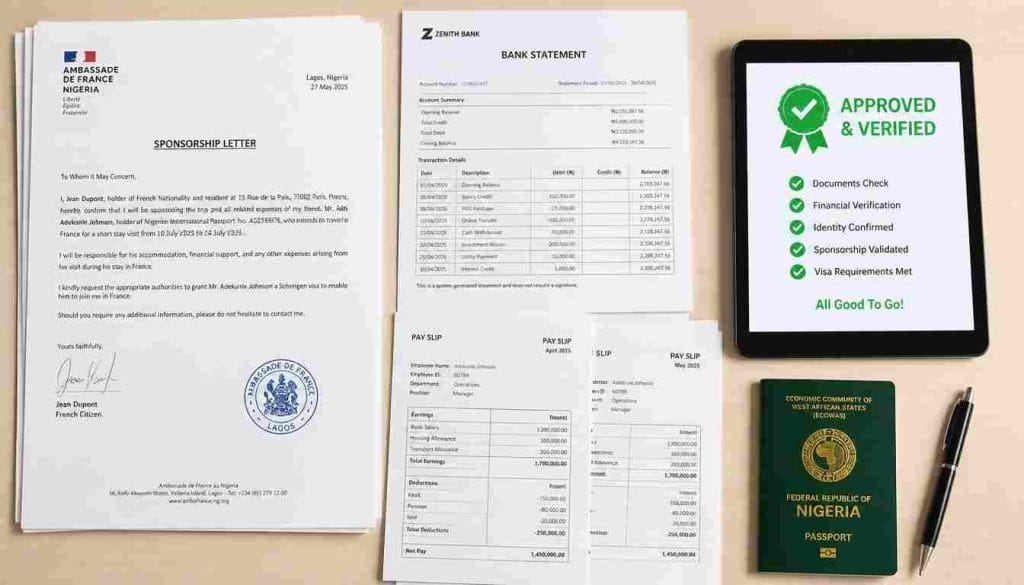
When an applicant lacks sufficient personal liquidity, European immigration law permits third-party financial guarantees under strict conditions. Meeting the baseline schengen visa sponsorship letter criteria requires understanding four distinct tiers:
1. First-Degree Family Sponsorship Only
Financial sponsorship is generally recognized only from first-degree relatives (parents, legal spouses, or adult children). Informal financial undertakings from distant relatives or friends face extreme refusal rates unless backed by a registered statutory declaration.
2. Strict Prohibition on Multi-Party Sponsorship
Splitting travel expenses across multiple informal sponsors (e.g., combining bank balances from an uncle, a cousin, and an acquaintance) is categorized as high-risk irregular funding. European consulates require a single, legally accountable guarantor.
3. Formal National Sponsorship Declarations
Informal written letters carry no legal weight. The European host must secure an official municipal guarantee:
- Germany: Verpflichtungserklärung issued by the local Foreigners Authority (Ausländerbehörde).
- France: Attestation d’Accueil certified by the local Mayor’s office (Mairie).
- Switzerland: Verpflichtungserklärung / Déclaration de prise en charge approved by the cantonal migration office.
- Italy: Fideiussione Bancaria (Bank Guarantee) alongside an Atto di Fidejussione.
- Spain: Carta de Invitación certified by the National Police Station (Comisaría de Policía).
4. Corporate Sponsorship Standards
For commercial travel, the applicant must provide a formal corporate guarantee adhering to Schengen Business Visa Invitation Letter Requirements, confirming whether the sending enterprise or the European host covers accommodation, per diems, and health emergency costs.
Proof of Financial Means Schengen Visa: Statement Presentation
Physical formatting and banking verifications must adhere to strict consular intake standards under official proof of financial means Schengen visa regulations:
- Timeframe: Exactly 3 to 6 consecutive months preceding the appointment date. The final transaction date must not be older than 7 to 14 days from your submission slot.
- Authentication: Every page must feature a wet-ink bank branch stamp and authorized teller signature, or an authentic electronic stamp containing a dynamic verification QR code.
- Language & Currency: Non-English statements must include an official sworn translation of the main headers and column legends. Adding an official currency conversion sheet based on European Central Bank rates is recommended.
- Investment Portfolios: Fixed deposits, mutual funds, and share portfolios serve solely as secondary wealth proof. They cannot replace liquid checking or savings accounts.
When drafting your travel dossier, referencing our walkthrough on how to write cover letter for schengen tourist visa with sample allows you to explain specific financial line items, annual bonuses, or tax declarations clearly.
If your journey involves multi-country transit, ensure your accommodation and transport match your funding proof by following Schengen Tourist Visa Flight Itinerary & Dummy Ticket Rules, and secure coverage aligned with Schengen Visa Travel Insurance Requirements and Minimum Coverage.
Actionable Schengen Visa Sponsor Documents Checklist
If your journey relies on a third-party guarantor, assemble this mandatory schengen visa sponsor documents checklist to avoid procedural rejections:
| Sponsor Category | Mandatory Legal Instruments | Required Financial Proof | Relationship Proof |
|---|---|---|---|
| First-Degree Family | Official Sponsorship Form (Verpflichtungserklärung, Attestation d’accueil) | Last 3 months’ pay slips, tax clearance notice | Birth / Marriage certificate |
| Corporate / Business | Guarantee letter on formal company letterhead | 6 months company bank statements, trade register | B2B contracts, commercial invite |
| Friends / Kin | Notarized formal guarantee with municipality endorsement | Audited personal bank statements & liquid assets | Photos, chat logs, timeline proof |
FAQs
Can I submit multiple personal bank accounts to show combined liquidity?
Yes. You can submit both your checking and savings accounts if both are in your name, active for 6 months, and officially bank-stamped.
Are fixed deposit certificates accepted as primary proof of funds?
No. Fixed deposits and investments are secondary assets; consulates strictly require liquid funds in an active checking or savings account.
How is a joint bank statement evaluated for solo travel?
It is accepted only if all account co-holders submit a notarized No-Objection declaration permitting you to use the funds.
Can a friend in Europe act as my financial sponsor?
No. Friends can only provide accommodation invitations; direct financial sponsorship is generally restricted to first-degree relatives.
What should I do if a large deposit recently entered my account?
Provide verifiable documentary proof for the source of funds, such as a property deed, payroll bonus slip, dividend receipt, or tax record.
Summary Action Plan for Financial Compliance
Achieving full compliance with schengen visa bank statement balance and sponsorship rules requires maintaining clean, unmanipulated banking records over an extended timeframe. Avoid borrowing funds to inflate your closing balance, verify that your salary credits align with official tax or payroll slips, maintain a 20% exchange volatility buffer, and secure municipal sponsorship undertakings early.
Applicants navigating unique regional appointment procedures should consult How to Book Schengen Visa Appointment from UAE VFS Global, review How to Apply for Schengen Visa from Saudi Arabia for Expats, or explore the Easiest Schengen Countries to Get Visa from Dubai for Expats.
Once submitted, applicants can monitor processing milestones using How to Track Schengen Visa Application Status on VFS Global Online. If an application faces an unexpected financial rejection, reference our proven framework on How to Appeal Schengen Visa Refusal Reason 2 to draft an administrative remonstrance appeal.
Official Diplomatic & Financial Portals
- European Commission – Schengen Visa Code: Official legislative text and minimum subsistence regulatory standards.
- Auswärtiges Amt – Germany Visa Requirements: Federal Foreign Office guidelines on financial solvency and Verpflichtungserklärung.
- France-Visas Official Portal: Official portal for French subsistence rate calculations and visa requirements.