
Common Tourist Visa Rejection Reasons: Proven Fixes
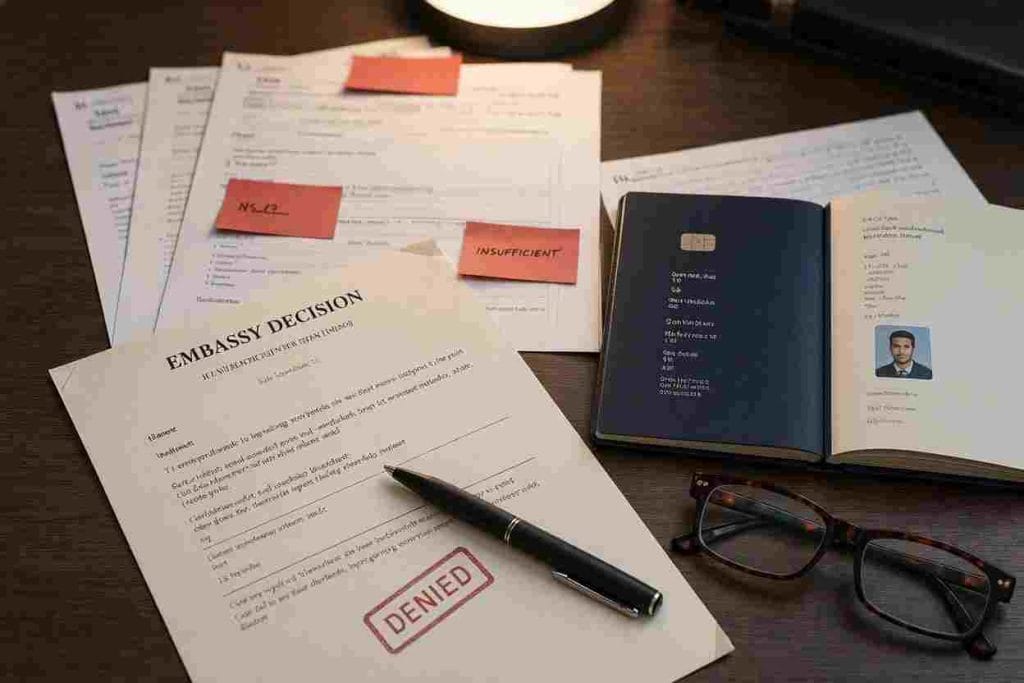
Vague itinerary timelines and sudden, unverified banking transactions trigger the majority of consular refusals across major diplomatic posts. Understanding Common Tourist Visa Rejection Reasons enables travelers to audit their paperwork, reconcile conflicting data points, and present a legally compliant application portfolio.
Consular adjudicators work under strict statutory presumptions, assuming temporary visitors harbor immigrant intent unless proven otherwise by clear physical evidence. Identifying potential evidentiary deficiencies before submitting your biometric appointment and digital forms protects your immigration record from costly refusals.
Statutory Triggers of Common Tourist Visa Rejection Reasons
Immigration authorities assess visitor applications under statutory codes that demand clear proof of genuine nonimmigrant intent. Navigating Common Tourist Visa Rejection Reasons requires understanding that visas are denied because an applicant fails to establish verifiable domestic, financial, or professional stability.
Visa officers review incoming applications against rigid legal tests codified in national legislation, such as Section 214(b) of the US Immigration and Nationality Act or Article 32 of the EU Visa Code. Caseworkers focus their evaluation on four distinct compliance pillars:
- Failure to Rebut Immigrant Intent: Failing to demonstrate economic, familial, or physical anchors that require you to leave the destination before legal stay limits expire.
- Dubious Financial Proof: Presenting bank records with unverified lump-sum credits, insufficient operational balances, or missing tax filings.
- Unclear Purpose of Stay: Providing inconsistent travel schedules, conflicting hotel vouchers, or non-credible leisure plans.
- Incomplete Document Portfolio: Leaving mandatory fields blank or failing to supply certified civil status records during document intake.
Meeting these statutory requirements alongside the global baseline standards outlined in our Tourist Visa Requirements: Global Travel & Approval Guide ensures your application clears administrative screening without negative casework notes.
Global Refusal Matrix: Legal Ground vs. Corrective Remedy
Consular rejection notices cite specific statutory paragraphs that correspond to distinct procedural mistakes. The following matrix links the most frequent refusal grounds across leading jurisdictions to practical corrective remedies:
| Jurisdiction & Legal Code | Core Administrative Ground | Primary Root Cause | Practical Corrective Remedy |
| US INA Section 214(b) | Presumption of immigrant intent | Weak domestic anchors, vague career prospects | Document long-term employment contracts, property deeds, and family dependencies |
| Schengen Code Article 32(1) | Justification for stay unproven | Unverified hotel reservations, unrealistic transit routes | Submit confirmed booking vouchers, daily sightseeing plans, and rail tickets |
| UKVI Appendix V: V 4.2 | Lack of financial plausibility | Unexplained large deposits (“funds parking”) | Provide 6 months of stamped bank statements showing origin of funds and tax receipts |
| Canada IRPR Section 179(b) | Unlikely to depart upon stay end | Temporary employment, excessive duration requested | Supply employer leave letters confirming return dates and ongoing payroll ties |
| Australia Migration Regs 600.211 | Genuine Temporary Entrant failure | Non-credible travel purpose, poor previous travel history | Provide itemized budgets, employer No Objection Certificates, and local commitments |
From what I’ve seen over the years, applicants often mistake an administrative refusal for a permanent ban. Most nonimmigrant refusals are simple evidentiary failures that can be resolved in subsequent filings by supplying missing documentation.
Administrative Processing vs. Final Refusal: Demystifying 221(g) Notices
Not every adverse consular outcome represents a permanent refusal. Adjudicating officers frequently issue temporary holds or conditional refusal slips that allow applicants to provide missing verification.
- Temporary Holds (Soft Refusals): Under US INA Section 221(g) or Schengen supplementary document requests, applications undergo administrative processing for security clearance, employer verification, or missing civil certificates.
- Submitting Supplemental Proof: Applicants issued a 221(g) or administrative slip have a defined submission window (typically up to 12 months) to provide the exact documents requested without paying a new visa fee.
- Final Statutory Denials (Hard Refusals): Decisions rendered under Section 214(b) or Appendix V close the processing record immediately, requiring a completely fresh application and fee.
Financial Irregularities and the “Funds Parking” Trap
Financial assessment is rarely about the total number shown on a closing balance statement. Visa officers evaluate the organic flow of capital over time to ensure funds belong to the applicant and have not been borrowed temporarily to pass consular screening.
- Sudden Unverified Capital Deposits: Depositing large lump sums shortly before printing bank statements triggers immediate refusal under anti-fraud protocols unless backed by property sale deeds or verified bonus slips.
- Mismatched Income-to-Expenditure Proportions: Declaring trip budgets that exceed 25% to 30% of your total liquid savings raises doubts regarding financial responsibility, as detailed in our Tourist Visa Financial Requirements: Bank Proof Guide.
- Lack of Continuous Cash Flow: Submitting frozen asset certificates or fixed deposits without active operating current accounts fails the liquidity test required for emergency overseas expenditures.
- Missing Tax Compliance Slips: Omitting official income tax assessments or revenue declarations prevents adjudicators from cross-verifying declared professional earnings.
Evidentiary Breakdown: Document Discrepancies vs. Consular Expectations
Documentary discrepancies between application forms and submitted exhibits create immediate credibility gaps during processing.
| Application Component | Frequent Evidentiary Defect | Verified Consular Standard |
| Banking Records | Unstamped internet printouts, single-month summaries | 6 months consecutive bank-stamped records with clear transaction history |
| Work Authorization | Informal leave emails, unsigned letters | Formal No Objection Certificate on corporate letterhead signed by HR |
| Accommodation | Dummy reservation slips from canceled bookings | Verifiable hotel vouchers or registered host tenancy contracts |
| Written Purpose | Generic boilerplate statements | Detailed cover letter outlining daily schedules and return commitments |
| Civil Status | Uncertified photocopies of family documents | Government-issued birth and marriage certificates with official seals |
A common rule of thumb is that any document submitted without institutional authentication, such as a bank stamp or corporate seal, is treated as non-verifiable by processing officers.
Uncovering Hidden Caseworker Notes: GCMS and FOIA Requests
Consular refusal letters typically contain standardized statutory language that obscures the officer’s underlying factual objections. Obtaining internal case records provides the exact rationale needed to structure an effective reapplication.
[Standard Refusal Letter] ➔ [Submit ATIP / FOIA Request] ➔ [Extract Internal Officer Notes] ➔ [Address Root Defect]
- Canada GCMS Notes: Under the Access to Information Act (ATIP), applicants can request Global Case Management System (GCMS) notes through a Canadian citizen or representative to review the officer’s exact assessment entries.
- United States FOIA Inquiries: Applicants can file a Freedom of Information Act (FOIA) request with the Department of State or USCIS to access their historical consular notes and electronic transmission history.
- Targeted Remediation: Reviewing caseworker notes reveals whether the denial stemmed from unverified phone calls to an employer, dubious bank entries, or itinerary inconsistencies, allowing you to target the exact concern.
Case Study: Overcoming Consecutive Refusals for Independent Contractors
Freelance professionals, digital agency operators, and independent consultants face elevated refusal rates due to non-traditional income streams. The following case study illustrates how restructuring evidentiary proof resolves administrative concerns.
[Prior 214(b) Refusal] ➔ [Indexed Tax Filings] ➔ [Client Contracts Linked] ➔ [Audit Report Attached] ➔ [Visa Granted]
Applicant Background & Initial Barrier
A freelance software developer suffered two consecutive tourist visa refusals under US INA Section 214(b) and Canadian IRPR Section 179(b). The adjudicating officers noted that the applicant had irregular incoming bank transfers from international platforms, lacked standard monthly pay stubs, and failed to demonstrate compulsory return ties.
The Strategic Remediation Plan
To overturn the negative presumption, the applicant restructured the document dossier for a subsequent filing:
- Engaged a certified chartered accountant to audit the preceding two fiscal years of independent income, creating a formal income-and-expenditure ledger.
- Submitted six active client retainer contracts demonstrating ongoing software maintenance deliverables that required physical presence back home.
- Drafted an indexed cover letter using the principles in How to Write a Tourist Visa Cover Letter, providing explicit financial commentary for every international deposit.
- Attached a commercial lease agreement for a physical home office along with local municipal property tax receipts.
By establishing economic legitimacy and transparent business ties, the applicant completely eliminated the suspicion of unauthorized foreign work and secured approvals across both jurisdictions.
Strategic Regional Comparison: Processing Nuances and Pitfalls
Different international consular systems evaluate visitor risk using distinct administrative methodologies. Understanding these operational differences prevents submitting mismatched evidence.
| Diplomatic Jurisdiction | Primary Refusal Trigger | Application Processing Venue | Mandatory Document Focus |
| United States | Oral interview credibility, weak domestic ties | In-person consular interview | Verifiable DS-160 entries, concise verbal testimony |
| Schengen Area | Unconfirmed transit routes, poor insurance coverage | Joint Visa Application Center (VFS/TLS) | €30,000 medical coverage, main destination compliance |
| United Kingdom | Unexplained deposit origin, Appendix V breaches | Online portal upload and biometrics | 6-month source of funds, verified employer leave |
| Canada | Short-term tenure, lack of international travel history | IRCC secure online account | Detailed itinerary, family ties, client info letter |
| Australia | Genuine Temporary Entrant doubts | ImmiAccount digital upload | Career progression evidence, financial stability |
Applicants preparing specific country applications can review localized compliance rules in our dedicated breakdowns for the USA B1/B2 Visa Requirements, US Visa Rejections, Canada Visitor Visa Requirements, Schengen Tourist Visa Requirements, and the UK Standard Visitor Visa.
Appeals, Administrative Reviews, and Reapplication Timelines
Choosing the correct legal path following a refusal depends strictly on the governing immigration rules of the destination country.
- Schengen Area Remonstrance Appeals: Applicants have a statutory right to lodge a formal written appeal (Remonstrance) within 30 to 60 days directly to the embassy that issued the refusal notice.
- UK and US Reapplication Standards: Neither the US B1/B2 nor the UK Standard Visitor Visa offers a statutory right of appeal for general tourists; applicants must submit a new application with corrected evidence.
- Canadian Federal Court Judicial Review: If an IRCC refusal is legally unreasonable or breaches procedural fairness, applicants may seek leave for Judicial Review at the Federal Court of Canada within 60 days.
Letter of Explanation Framework for Addressing Prior Refusals
When reapplying after an entry clearance refusal, you should include a dedicated Letter of Explanation that directly addresses previous caseworker concerns:
[Date]
To: The Adjudicating Visa Officer
Subject: Reapplication for Tourist Visa – Addressing Previous Refusal (Ref: [Previous File Number])
Dear Visa Officer,
I am submitting this application alongside updated evidentiary records following my previous refusal on [Date of Refusal] under [Statutory Refusal Section/Ground].
1. Clarification of Previous Evidentiary Concern:
The previous decision noted concerns regarding [Specify Concern, e.g., source of bank funds / lack of employment ties]. I wish to clarify that [Concise explanation of the factual context].
2. New Material Evidence Submitted:
To completely resolve this ambiguity, I have attached:
- Exhibit A: Certified chartered audit report confirming net annual business revenue.
- Exhibit B: Registered commercial property deed and updated employer leave approval letter.
I confirm my intent is strictly temporary and that I will return to resume my duties on [Return Date].
Yours faithfully,
(Signature)
[Typed Full Name]
Interview Credibility Failures and Non-Verbal Flags
For jurisdictions that mandate in-person consular appearances, interview conduct plays a decisive role in the final visa outcome. Even with complete paperwork, conflicting verbal statements can lead to an immediate denial.
- Memorized or Rehearsed Testimony: Reciting scripted responses causes adjudicators to doubt the authenticity of your declared travel intent.
- Inconsistency with Written Forms: Stating travel dates, host details, or income figures that differ from submitted digital portal entries generates serious credibility issues.
- Uncertainty Regarding Trip Financing: Failing to explain who is paying for specific itinerary components, particularly when relying on external sponsorship.
- Vague Employer Details: Inability to articulate job duties, tenure, or return-to-work dates smoothly during counter questioning.
Mastering verbal delivery through our comprehensive guide on Tourist Visa Interview Questions and Answers: Pass Guide ensures your statements reinforce your written exhibits untill adjudication is completed.
Mitigating Invitation Letter and Third-Party Sponsorship Pitfalls
Relying on foreign hosts or sponsors introduces secondary points of failure if the supporting relationship documentation lacks official validation.
- Lack of Legal Status Proof: Foreign hosts must provide verified copies of their permanent residence cards, citizenship certificates, or valid long-stay visas.
- Inadequate Accommodation Evidence: The host must demonstrate sufficient living space through tenancy agreements or property deeds to avoid overcrowding violations.
- Unsubstantiated Sponsor Solvency: When relying on a financial sponsor, you must supply their certified tax returns, employment contracts, and stamped bank statements.
Ensure all external host paperwork complies strictly with statutory standards by consulting our manual on Tourist Visa Invitation Letter Requirements.
Strategic Protocols for Overturning Prior Visa Refusals
Reapplying immediately after a refusal without introducing new, material evidence leads to rapid consecutive denials. Applicants must systematically address the specific legal grounds cited in their rejection notice before lodging a new file.
[Analyze Official Refusal Notice] ➔ [Identify Missing Evidentiary Elements] ➔ [Compile Third-Party Source Proof] ➔ [Submit Corrected File]
Actionable Remediation Checklist
- Obtain Official Refusal Notes: For jurisdictions like Canada or Australia, request internal caseworker notes (such as GCMS notes) to identify the exact reasons behind the decision.
- Resolve the Core Evidentiary Defect: If refused for funds, provide additional historic banking statements; if denied for ties, submit property registrations or employment promotion letters.
- Disclose All Prior Denials Transparently: Never conceal a past refusal on electronic forms. Consular databases share biometric records globally, and omissions lead to long-term fraud bans.
Coordinating future international travel through our guides for the Australia Visitor Visa Subclass 600, Japan Tourist Visa Requirements, and Dubai Tourist Visa for Foreign Travelers ensures your overall global profile remains compliant and transparent.
FAQ
Does a tourist visa refusal permanently damage future travel applications?
No, a standard refusal under nonimmigrant intent clauses is not a permanent bar; applicants can reapply successfully once they present new, verifiable evidence addressing the original deficiency.
How soon after a tourist visa rejection can an applicant submit a new file?
While there is no statutory waiting period, reapplying is advisable only after your circumstances have materially improved or after gathering comprehensive documents resolving the previous refusal points.
Can purchasing non-refundable flights and hotels overturn a visa denial?
No, consular authorities explicitly advise against purchasing non-refundable travel tickets before visa issuance, and prepaid bookings do not serve as proof of domestic ties.
What is the most effective method to prove strong ties to your home country?
The most persuasive ties include ongoing permanent employment with approved leave letters, registered real estate ownership, enrolled university degree programs, and immediate dependent family members.
Does having a wealthy sponsor guarantee tourist visa approval?
No, immigration officers evaluate the applicant’s personal background and incentives to return home; third-party financial backing cannot substitute for strong domestic ties.
Guide to Overcoming Visa Rejection
Overcoming Common Tourist Visa Rejection Reasons requires a disciplined, fact-based approach to assembling your visa dossier. Focus on demonstrating continuous financial solvency, maintaining absolute data consistency across all digital forms, and providing third-party verification for your employment and family obligations.
Audit your financial statements for unverified transactions, verify that your employer leave certificate matches your intended travel window, and index all supporting exhibits before attending your biometric intake or interview. Presenting an organized, transparent, and legally sound application eliminates administrative doubts and maximizes your chances of securing entry clearance.
Official Resources
- US Department of State – Visa Denials and Ineligibilities
- European Commission – Schengen Visa Code Rules
- UK Visas and Immigration – Standard Visitor Guidance
- Immigration, Refugees and Citizenship Canada – Refusals Policy
- VFS Global – International Visa Application Processing