Which Schengen Country Gives Multiple Entry Visa Easily? (Official Data)
Getting a multiple-entry visa (MEV) for Europe often feels like a lottery, but the reality is driven by hard data and strict consulate guidelines. If you are wondering which Schengen country gives multiple entry visa easily, the latest 2025/2026 European Commission statistics reveal exactly where your chances are highest.
Last year, out of nearly 10.3 million Schengen visas issued globally, over 5.3 million were multiple-entry visas. This creates a solid 51.7% Schengen-wide MEV average. However, depending on the consulate you apply to, your chances of getting a long-term MEV can either skyrocket or drop drastically.
If you want to understand the complete, step-by-step application workflow from start to finish, you can check out our detailed guide on How to Get Multiple Entry Schengen Visa.
The Highest Multiple Entry Schengen Visa Rate (Top 5 Countries)
When looking for the highest multiple entry schengen visa rate, five specific countries stand out from the rest. According to the latest European Commission country-total data, these nations approved the largest share of MEVs compared to their total issued short-stay visas.
| Schengen Country | MEV Share (%) | Refusal Rate (%) | Why It’s Recommended |
|---|---|---|---|
| Germany | 89.1% | 13.1% | Highest MEV issuance; best for regular business or family visits. |
| Switzerland | 66.7% | 12.5% | Perfect balance of high MEV approval and low visa refusal. |
| Belgium | 71.8% | 21.4% | Very high MEV rate, but demands rock-solid financial paperwork. |
| Netherlands | 62.5% | 15.1% | Consistent multi-year cascade issuance for lawful repeat travelers. |
| Greece | 61.6% | 14.7% | High multi-entry issuance during peak summer and cruise seasons. |
| Slovakia | Moderate | 9.9% | Lowest overall refusal rate in the entire Schengen zone. |
(Note: Germany closely follows this top 5 list with an impressive 13.1% refusal rate).
The “Main Destination” Rule: A Crucial Warning
Seeing Germany at the top of the MEV list does not mean you should arbitrarily apply to the German embassy just to get a longer visa. Under Schengen law, you must apply to the country that serves as your genuine “main destination” (the country where you will spend the most nights).
If your travel days are split equally, you must apply to your country of first entry. Submitting a fake travel itinerary just to target a high-MEV consulate is known as “visa shopping” and is the fastest route to an automatic rejection.
Easiest Schengen Visa from UK, UAE, and India
For expats and residents applying from these high-volume regions, consulate locations evaluate local status far more strictly than overall country statistics:
- Applying from the UK (BRP Holders): Your UK residence permit must be valid for at least 3 months past your trip. Apply via France or Germany if you have solid London/Edinburgh appointment slots and business travel ties.
- Applying from the UAE (Emirates ID): VFS/TLS appointments in Dubai fill up fast. Swiss and German consulates require 6 months of steady UAE salary transfer slips to grant long-term MEVs.
- Applying from India: Under the newly implemented EU cascade regime for India, applicants with two lawful Schengen trips within three years can directly access 2-year MEVs, scaling up to 5 years upon consistent lawful use.
The EU Visa Cascade Rules: How to Get 1-Year, 2-Year, and 5-Year MEV
Stop guessing how the embassy decides the length of your visa. The EU actually uses a strict mathematical formula known as the “Cascade Rules” (Article 24(2) of the Visa Code). If you use your previous visas perfectly without breaking any rules, your next visa automatically gets longer.
Here is exactly how the step-by-step upgrade works:
- 1-Year MEV: Got and lawfully used 3 short-stay visas within the last two years? You qualify for a standard 1-year multiple entry visa.
- 2-Year MEV: Used a 1-year MEV correctly within the last two years? You are next in line for a 2-year visa.
- 5-Year MEV: Used a 2-year MEV lawfully in the past three years? You hit the ultimate jackpot—a 5-year visa.
Notice how there is no standard 3-year or 4-year rule. It jumps straight from 2 to 5. And remember, even with a 5-year visa, the strict 90/180-day rule always applies. You cannot live in Europe continuously.
Proven Documents to Drastically Increase Your MEV Chances
Nobody gets a multiple-entry visa just by asking nicely. The visa officer needs solid proof that you won’t overstay and that you actually have a genuine reason to travel frequently.
Forget the magic tricks. Just focus on providing these exact documents:
- Clean Travel History: Attach copies of your old visas and entry/exit stamps. Prove you always came back home on time.
- A Real Reason to Return Often: Traveling just for fun once a year won’t get you an MEV. Show them business contracts, ongoing conferences, or a track record of regular family visits.
- A Specific Cover Letter: State clearly in your letter that you want a multiple-entry visa. List your exact planned trips for the next year and attach hotel or flight proofs for each.
- Rock-Solid Finances: Bank statements must show a steady monthly income, not just sudden large deposits. They want to see you can fund multiple trips without working illegally in Europe.
- Strong Home Ties: Got a permanent job, active business, or property back home? Show the official papers. They need to know you have a life you cannot simply abandon.
How to Specifically Request a Multiple Entry Visa on the Application Form
Applying for an MEV isn’t just about hoping the officer is generous. You must explicitly request it on your application form:
- Field 27 (Number of Entries Requested): Always tick “Multiple entries”. If you accidentally tick “Single entry”, the embassy will never grant an MEV, regardless of your travel history.
- Intended Date of Departure: State the exit date of your final intended trip within the next 1–2 years, not just your first 7-day vacation.
- Travel Insurance Coverage: For the first trip, full coverage is mandatory. Add a signed statement confirming you understand that valid travel health insurance is required for all subsequent entries.
The Passport Validity Trap (Why You Won’t Get a 5-Year MEV)
Under Schengen regulations, your visa validity can never exceed your passport’s expiration date:
- The 3-Month Rule: A Schengen visa must expire at least 3 months before your passport expires.
- The Multi-Year Constraint: If you qualify for a 5-year cascade visa but your passport expires in 2 years, the consulate will legally cap your visa at roughly 1 year and 9 months.
- Pro Tip: Always renew your passport before applying if you have strong prior travel history and want a 2-year or 5-year MEV.
Top 4 Mistakes That Lead to a Single-Entry Downgrade
Even with strong finances, consulates often downgrade applicants from MEV to Single Entry due to these 4 avoidable errors:
- Showing Only One Booked Itinerary: If your documents only prove a single 5-day holiday in Rome, the officer has no legal justification to issue an MEV. Always include a tentative second trip itinerary.
- Sudden Account Balancing: Depositing a large sum right before printing bank statements triggers anti-fraud scrutiny. Keep funds steady for at least 90–180 days.
- Vague Cover Letter Intent: Writing “I want to explore Europe multiple times” gets ignored. Writing “I have scheduled supplier inspections in Munich in June and a follow-up conference in Frankfurt in November” provides verifiable legal proof.
- Inconsistent Insurance: Submitting a policy that strictly covers only 7 days without checking the box for multi-trip awareness.
The Consular Discretion Clause: Article 24(2c) and Shortening Cascades
Most applicants believe the 1-2-5 year cascade is automatic. Under Article 24(2c) of the Schengen Visa Code, consular officers hold legal authority to bypass or shorten the cascade based on individual risk assessment:
- Doubt on Travel Continuity: If your prior visas were issued for business, but your new application is strictly for independent tourism, the officer can reset your cascade back to a single entry.
- Economic Drift: A sudden change in employment or drop in your home-country average monthly balance since your last visa gives the consulate grounds to issue a validity period matching only your immediate itinerary.
- The Discretionary Leap: Officers can legally issue a 1-year or 2-year MEV even on your first application if you prove an unassailable financial standing and present cross-border commercial commitments or high-level academic invitations.
The 90/180-Day Rolling Window Calculation Trick
A frequent cause of border interrogations and future visa refusals among MEV holders is miscalculating the 90/180-day limitation. It is not tied to a calendar year or visa validity dates:
- The Dynamic Looking-Back Rule: On every single day of presence inside the Schengen area, the border authority looks back exactly 180 days. Your total cumulative stay across all entries during that rolling 180-day window must never hit 91 days.
- Border Stamps Audit: Consecutive entries through different Schengen states (e.g., entering through Paris, exiting via Frankfurt, re-entering via Amsterdam) are cross-referenced manually at border control. Keeping a personal log of your entry/exit stamps prevents unintentional technical overstays that permanently disqualify you from multi-year renewals.
Multi-Jurisdiction Itineraries: The Legal Main Destination Formula
Consulates routinely penalize applicants who fail to document multi-country routes accurately:
- Equal Days Resolution: If you spend 4 nights in Germany and 4 nights in Switzerland, your main destination legally shifts to the country through which you enter the Schengen territory first.
- Primary Travel Motive Override: If you spend 2 nights in Germany for an essential trade fair and 5 nights in France for leisure, Germany remains the legal jurisdiction for the application because the primary purpose (professional commitment) supersedes the length of leisure stay.
- Internal Transit Evidence: Failing to attach train bookings (Eurail/DB), domestic flights, or cross-border car rental vouchers linking your multi-state movements is flagged as an incomplete itinerary, resulting in a single-entry downgrade.
The Multi-Trip Insurance Declaration Protocol
Standard single-trip insurance policies frequently cause consulates to restrict visa validity strictly to the dates of that single policy:
- The Article 15(2) Declaration: To secure an MEV, your application must include a signed undertaking (found on page 4 of the harmonized Schengen application form) acknowledging your legal obligation to hold valid travel medical insurance for every subsequent journey.
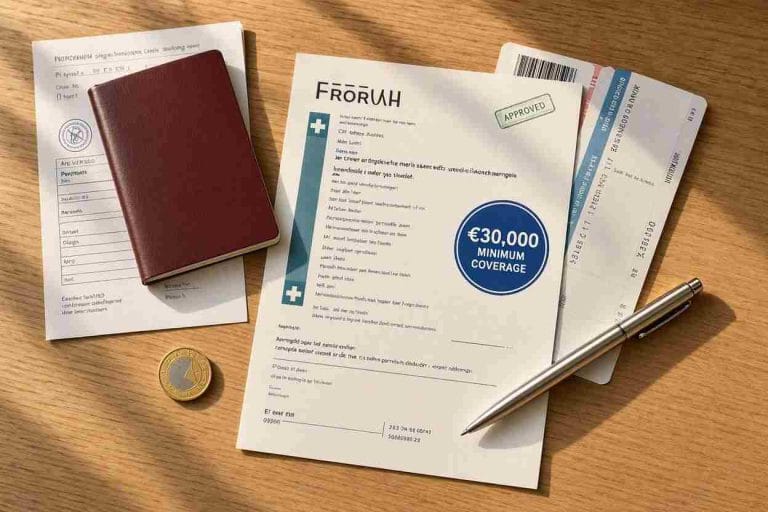
- Minimum Coverage Integrity: The insurance must provide at least €30,000 coverage across all member states, specifically covering repatriation for medical reasons, emergency healthcare, and emergency hospital treatment throughout the entire requested multi-year period or with an active annual multi-trip (AMT) policy.
Real-Life Experiences: What Actually Happens at the Embassy?
Data and rules only tell half the story. To truly understand which schengen country gives multiple entry visa easily, you need to look at real application outcomes. Here are two practical examples of what visa officers actually look for.
Case Study 1: The “Visa Shopping” Disaster
Many applicants search for the easiest country to get schengen visa 2026 and make a massive mistake.
- The Mistake: One applicant saw Germany’s high multiple entry rate. They applied to the German embassy with a fake 7-day Berlin hotel booking.
- The Reality: Their actual plan was to spend 10 days in Spain. The visa officer noticed their flight landed in Madrid with no internal flight tickets to Berlin.
- The Result: A direct rejection for “Visa Shopping.”
- The Lesson: Never chase high statistics. Always apply to your genuine main destination. The embassy verifies your internal travel routes strictly.
Case Study 2: The “Tentative Second Trip” Success
How do you force the embassy to give you a longer visa? You show them the future.
- The Strategy: An applicant applied to Slovakia. They chose it because it currently has the lowest schengen visa rejection rate (only 9.9%).
- The Smart Move: Their main trip was a 5-day holiday in Bratislava in June. But they did not stop there. They attached a tentative (unpaid) hotel booking for a conference in Italy in November.
- The Cover Letter: They explicitly requested a 1-year MEV in their letter. They explained both trips and showed enough bank balance to cover both.
- The Result: The consular officer approved a 1-year MEV on the very first try.
- The Lesson: If you only show a single 5-day itinerary, you will get a single-entry visa. Always provide a logical reason for a second upcoming trip.
The Hidden VIS Database: What Officers Actually See
Most applicants think each embassy evaluates them from scratch. This is a massive misconception.
- The 5-Year Digital Footprint: Every Schengen country uses the central Visa Information System (VIS). When you apply, the officer pulls your digital file.
- Internal Remarks: If the French embassy gave you a single-entry visa last year, they might have left a hidden note like “Weak home ties.” If you apply to Germany this year for an MEV, the German officer sees that exact note.
- How to Overcome This: You must actively prove that your financial situation has improved since your last application. Never submit the exact same profile twice if you want a visa upgrade.
The Transit Stamp Problem: Proving Your Main Destination
Here is a practical nightmare that ruins future MEV chances for thousands of travelers.
- The Scenario: You got a 1-year MEV from Germany. But there are no direct flights from your city to Berlin, so you flew via Air France and transited through Paris.
- The Issue: Your passport was stamped in Paris (your first point of entry into the Schengen zone). You never get a German passport stamp.
- The Consequence: When you apply for your MEV renewal next year, the German embassy looks at your passport, sees a French stamp, and assumes you lied about going to Germany. They will downgrade or reject you for “visa shopping.”
- The Solution: You must absolutely save your internal boarding passes (Paris to Berlin) and your German hotel checkout invoices. Attach these to your next application to legally prove you spent your main days in the country that issued the visa.
Self-Funded vs. Sponsored Applications: The MEV Gap
If you want a multiple-entry visa, how you pay for the trip changes everything.
- The Sponsorship Trap: If a family member or company in Europe issues an official sponsorship letter (Verpflichtungserklärung in Germany, or Attestation d’accueil in France), the consulate ties your financial safety strictly to that specific person/event. You will almost always get a single-entry visa covering only those exact dates.
- The Self-Funded Advantage: Consulates prefer independent travelers. If you fund the trip entirely yourself using your own strong bank statements and tax returns, the officer has the legal freedom to grant a 2-year or 5-year MEV, knowing you do not rely on someone else’s wallet to survive in Europe.
Interactive Tool: The 90/180-Day Rolling Window Calculator
A frequent cause of border interrogations and future visa refusals among MEV holders is miscalculating the 90/180-day limitation. It is not tied to a calendar year. On every single day you are inside the Schengen area, the border authority looks back exactly 180 days to ensure you haven’t exceeded 90 days total.
Use this calculator to model your trips and ensure you never accidentally overstay:
Schengen 90/180 Days Calculator
Enter your trip dates to check how many days you have used from your 90-day allowance.
The 15-Day Grace Period Myth
Here is a highly technical rule from Article 24(1) of the Visa Code that trips up thousands of travelers:
- Single-Entry Flexibility: A standard single-entry visa usually includes a “15-day grace period.” If you get a 10-day visa, the validity period is normally 25 days to give you flexible flight options.
- The MEV Hard Stop: Multiple-entry visas do not get this 15-day grace period. If your 1-year MEV expires on December 31st, you must exit the Schengen zone by 11:59 PM on December 31st. Staying even one hour into January 1st is a legal overstay that will permanently destroy your future cascade upgrades.
The “Second Trip” Border Cancellation Risk
Getting the multiple-entry visa is only half the battle. Keeping it is the real challenge.
- The Article 34 Trap: Having a 2-year MEV does not guarantee automatic entry on your second or third trip.
- Airport Interrogations: When you land for your second trip, border police treat you as a brand-new arrival. Under Article 34, they have the legal right to revoke (cancel) your entire MEV right at the airport.
- How to Protect Your MEV: Whenever you travel on an existing MEV, you must carry printed proof of your return flight, hotel bookings, and travel insurance for that specific trip. Never assume the visa sticker alone is enough to cross the border.
The First-Entry Point Myth (Where Should You Land?)
A huge misconception is that if Germany issues your visa, your flight must land in Germany. This is completely false.
- The Reality: You can legally fly into Paris (France) or Amsterdam (Netherlands) on a German-issued Schengen visa if flights are cheaper.
- The Golden Rule: The border police in Paris will ask why you have a German visa. You simply show them your connecting flight, bus, or train ticket proving that you are heading to Germany that same day or the next.
- Why It Matters: Knowing this rule saves applicants thousands of dollars in airfare. Just remember to keep all transit tickets as proof for your next MEV renewal.
The Legal “Cheat Code” for Your Cover Letter
If you want to drastically improve your odds of getting a 1-year or 2-year MEV, do not just politely ask for it. Speak the embassy’s legal language.
- Quote the Law: Somewhere in your cover letter, respectfully write: “As I have lawfully used my previous visas, I kindly request a Multiple Entry Visa in accordance with Article 24(2) of the Schengen Visa Code.”
- The Psychology: Visa officers process hundreds of generic applications daily. When they see you citing the exact EU law (Article 24), it instantly signals that you are an educated, highly reliable traveler who understands European immigration rules. It builds immediate trust.
Final Checklist for the Easiest Schengen Visa in 2026
Before you submit your passport, make sure you have checked these final boxes:
- Did you choose your true main destination rather than just chasing the highest statistics?
- Is your bank balance steady over the last 90 days?
- Did you check the “Multiple Entries” box on the application form?
- Did you include a tentative itinerary for a future trip?
FAQs
How much bank balance is required for a multiple-entry Schengen visa?
There is no official fixed amount. However, most embassies expect you to show at least €50 to €100 for every single day you plan to stay across your upcoming trips. Having a steady closing balance of €3,000 to €5,000 in your account over the last six months is generally considered a safe and strong profile.
Do I have to pay a higher embassy fee to get a multiple-entry visa?
No. The standard Schengen visa application fee remains exactly the same (currently €90 for adults), whether the embassy grants you a 7-day single-entry visa or a 5-year multiple-entry visa.
Can a freelancer or self-employed person get an MEV?
Yes, absolutely. Consulates care about your financial stability, not just a traditional 9-to-5 job. If you provide regular business bank statements, local tax returns, and ongoing client contracts, your chances of getting a multiple-entry visa are just as high as a salaried employee.
How long does it take to process a multiple-entry Schengen visa?
The processing time is identical to a standard single-entry visa. By law, embassies process most applications within 15 calendar days. However, during peak summer months or holiday seasons, processing can legally be extended up to 45 days.
If I get a multiple-entry visa from France, can I only visit France on my second trip?
No. Once you have successfully completed your first main trip to France (the issuing country), you can use that same active multiple-entry visa to travel directly to any other Schengen country (like Spain or Italy) for your future trips, without ever stepping foot in France again.
Official Sources of Information
To maintain full transparency and accuracy, all statistical data, refusal rates, and legal frameworks discussed in this guide are directly sourced from the official European Union and European Commission portals. You can verify the latest 2025/2026 records and regulations here:
- European Commission: Short-Stay Visas Issued by Schengen Countries – The central download hub for annual Schengen visa statistics, including specific consulate-level MEV shares.
- European Commission: 2025 Visa Statistics Release – The official publication detailing global refusal rates and overall multiple-entry visa percentages.
- EUR-Lex: Regulation (EU) 2019/1155 – The primary EU legal text outlining Article 24 and the strict rules for the 1-year, 2-year, and 5-year multiple entry visa cascade system.