How to Pass the US Citizenship Interview: Civics Questions and English Test
Are you worried about your upcoming naturalization exam? You are not alone. Thousands of permanent residents feel anxious about sitting in front of a USCIS officer. However, passing the us citizenship interview civics questions and english test is much easier than you think. You just need the right preparation strategy.
Whether you are currently working as an expat in the Middle East or living in the USA, knowing exactly what the officer will ask completely removes the fear.
This guide will break down the exact reading, writing, and history formats you will face. We will show you real-world examples so you can pass confidently on your very first try.
If you have not yet checked your basic eligibility or application steps, please review our comprehensive US Citizenship Naturalization Complete Guide first. Now, let’s explore exactly what happens when you step into the interview room.
What to Expect on Your Naturalization Interview Day
Walking into a USCIS field office can feel intimidating. The security is tight, and the waiting areas are often very quiet. But the actual interview is surprisingly straightforward.
When your name is called, the USCIS officer will escort you to a private office. You will remain standing, raise your right hand, and swear to tell the truth. After you sit down, the evaluation begins immediately.
The officer will first verify your identity. Then, the interview splits into three distinct parts:
- The N-400 Review: The officer goes through your application line by line. They will ask about your background, travel history, and marital status. This is also a hidden test of your spoken English.
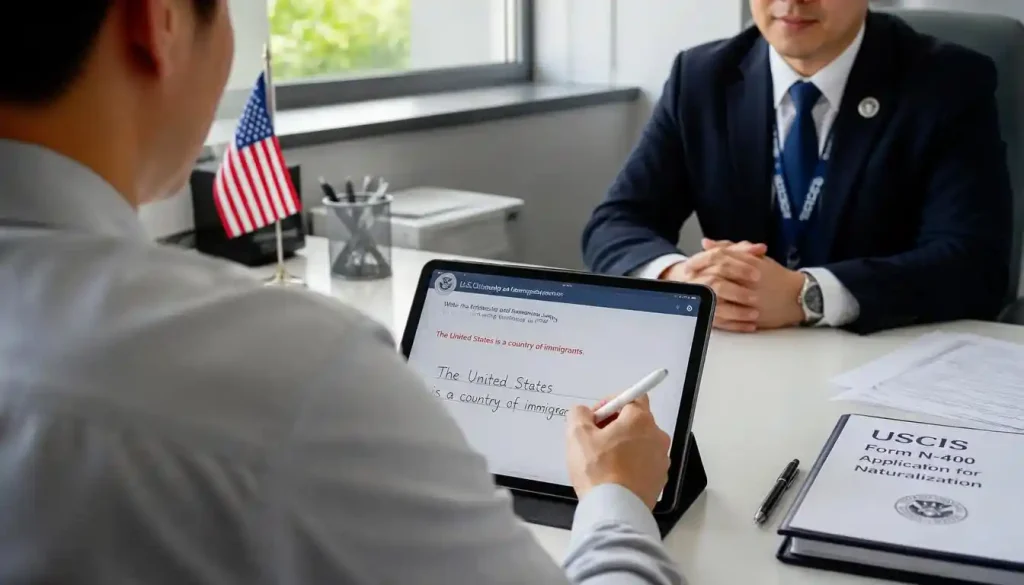
- The English Test: You must prove you can read and write basic English sentences on a digital tablet.
- The Civics Test: You will verbally answer questions about American history and government.
Many expats living in Schengen countries or Canada worry that their frequent trips abroad might cause tricky questions during the N-400 review. Just remember to relax.
As long as you answer truthfully and your spoken answers match the information on your submitted form, you have nothing to fear. The officer simply wants to confirm your details before moving on to the official reading and writing exams.
The US Citizenship English Test: Real Examples
Many applicants lose sleep worrying about the English portion of the naturalization exam. Do not panic. The government is not expecting you to speak like a university professor. They simply want to confirm that you can handle basic, everyday communication.
The evaluation consists of three specific components: speaking, reading, and writing. Let’s break down exactly what happens in each phase.
| Test Type | Officer’s Main Focus | Quick Success Metric |
|---|---|---|
| Speaking | Natural interaction during the N-400 application review. | Ability to respond to basic questions. |
| Reading | Pronunciation of standard civics vocabulary. | Pass rate: 1 out of 3 attempts. |
| Writing | Legibility and basic English spelling via dictation. | Pass rate: 1 out of 3 attempts. |
Speaking Component: How the Officer Evaluates You
Here is a secret many applicants do not realize: the speaking test does not have a separate, dedicated time slot. It actually begins the exact second you greet the officer.
Throughout the entire N-400 review process, the officer is actively evaluating your ability to understand and respond to instructions. If you are an expat who regularly communicates in English while working in the UK or Australia, you will find this part incredibly easy.
The officer will ask simple questions about your employment history, family, and current residence. If you do not understand a question, just ask them politely to repeat or rephrase it. Asking for clarification does not count against your score.
Reading Test: What Will You Be Asked to Read?
Once the N-400 review is complete, the officer will hand you a digital tablet. You will be asked to read one sentence out loud.
You will have up to three chances to get it right. If you read the very first sentence correctly, you pass immediately, and the officer moves on. The vocabulary is strictly pulled from an official, predefined USCIS list focusing on American history and civics.
- Example 1: “Who was the first President?”
- Example 2: “What is the capital of the United States?”
Take a deep breath. Read the sentence slowly and clearly. Do not rush. Minor pronunciation mistakes will not result in a failure as long as the officer can understand the core meaning of the sentence.
Writing Test: What Will You Be Asked to Write?
Immediately after the reading portion, the officer will dictate a sentence for you to write. You will use a stylus pen to write directly on the digital tablet.
Just like the reading section, you get three attempts, but you only need to write one sentence successfully to pass. The dictated sentence usually answers the question you just read.
- Example 1: “Washington was the first President.”
- Example 2: “Washington D.C. is the capital of the United States.”
Do not worry about having perfect handwriting. Furthermore, USCIS officers are forgiving of minor spelling, capitalization, or punctuation errors. As long as the sentence is legible and conveys the right message, you will successfully pass this phase.
Mastering the US Citizenship Interview Civics Questions
This is the part that makes most applicants incredibly nervous. Memorizing historical facts about a new country can feel completely overwhelming. However, the system is designed to be fair, not a trick to make you fail.
You do not need a university degree in American history. USCIS provides a public, standardized list of 100 exact questions.
The officer cannot ask you anything outside of this official document. If you dedicate time to studying this specific list, you will face absolutely zero surprises on your interview day.
How the Civics Test is Scored (The 6/10 Rule)
During the exam, the officer will ask the civics questions out loud. You must answer them verbally in English, unless you qualify for an age exemption.
They will ask a maximum of 10 questions from the official 100-question study guide. To pass, you only need to get 6 correct. That is a passing score of just 60%.
The best part? The moment you answer 6 questions correctly, the test instantly stops. You will not even have to hear or answer the remaining four questions. The officer will immediately congratulate you and move on to the final paperwork.
[Insert Image Here: An older expat smiling and shaking hands with a USCIS officer after passing the test]
The 65/20 Special Exemption Rule
Are you an older applicant? The US government offers a massive shortcut for senior permanent residents. It is crucial to know your rights if you fall into this category.
If you are 65 years of age or older, and you have held your Green Card for at least 20 years, you qualify for the special 65/20 exemption. This rule is a complete game-changer for many families.
Instead of studying the full 100 questions, you only need to review a heavily reduced list of just 20 specific questions. You still only need to answer 6 correctly to pass.
Additionally, you are completely exempt from the English requirement. You are allowed to take the civics test in your native language using a certified interpreter.
Proven Preparation Tips for Busy Permanent Residents
Are you balancing a demanding job in Dubai or managing a busy family life in Canada? Finding time to study for a massive exam can feel completely impossible.
However, smart preparation is far more effective than just staring at a textbook for hours. You can easily integrate your study routine into your daily life.
Here are some highly effective, proven strategies to help you master the material quickly:
- Download Official Audio Tracks: USCIS provides free MP3 audio files containing all 100 civics questions. Download these to your phone and listen to them during your daily commute or while exercising.
- Practice Speaking Aloud: Have a friend, spouse, or coworker randomly ask you questions in English. Getting used to answering out loud builds immense confidence for the actual interview day.
- Avoid Outdated Study Materials: Political leaders and government officials change regularly. Always ensure you are studying the most current, up-to-date version of the guide directly from the government portal.
Additionally, passing the exam is not just about memorizing facts. The administrative preparation is equally crucial.
To keep your application moving smoothly without unexpected roadblocks, you must carefully review the Form N-400 processing timeline and fees before you file.
Knowing the exact financial costs and local waiting periods allows you to plan your international travel and work schedules perfectly. It ensures you never miss a vital notice while living abroad.
FAQs
Can I be deported if I fail the citizenship interview test?
No, failing the US citizenship test will not result in deportation or negatively affect your current Green Card status. If you fail the English or civics portion, USCIS will simply schedule a second interview within 60 to 90 days to retest only the specific part you failed.
How do I get a medical waiver for the English and civics test?
If a physical, psychiatric, or developmental disability prevents you from learning English or civics, you can file Form N-648. A licensed medical professional must complete this document. If USCIS approves it, you are completely exempt from taking the standard educational testing requirements.
Will a strong foreign accent cause me to fail the English test?
Absolutely not. USCIS evaluating officers are fully trained to expect heavy regional accents from permanent residents. As long as the officer can clearly understand the basic meaning of your spoken answers and written sentences, your accent will not negatively impact your final naturalization score.
Are the civics answers updated if the US President changes?
Yes. You must provide the exact name of the currently serving official at the time of your actual interview, not the date you initially filed the application. Always check the official government website for any administration updates a few days before your appointment.
Sources & References
- Official government study materials and test updates: USCIS Citizenship Resource Center
- Legal guidelines for disability testing exemptions: USCIS Form N-648 Guidelines
- Current administration and elected officials tracking: USA.gov Official Elected Officials Directory