Navigating the unpredictable PERM labor certification timeline is usually the most frustrating part of securing an employment-based US Green Card.
On average, this entire process takes about 14 to 22 months from the moment you start until your final application is approved.
The U.S. Department of Labor (DOL) requires this mandatory test to prove that hiring a foreign worker will not take jobs away from qualified U.S. citizens or lower local wages.
In my experience, delays are rarely just the government’s fault. The biggest roadblocks usually come from simple employer mistakes.
Missing a strict 30-day advertising window or writing a confusing job description can easily waste months of hard work.
To get your Form ETA-9089 approved without unnecessary audits, your job duties, wage requests, and newspaper ads must line up perfectly right from the start.
The Legal Framework Behind PERM
The PERM process is the absolute first step for any U.S. employer looking to sponsor a foreign professional for a standard EB-2 or EB-3 green card.
Unlike a self-petition—where highly qualified individuals can bypass the employer process by meeting the strict EB-2 NIW requirements—standard employment-based green cards require a strict test of the local labor market.
Mandated by the Immigration and Nationality Act, the core purpose of this timeline is to protect the domestic workforce. Before permanently bringing a foreign worker into the broader system of USA work visas, the Department of Labor wants hard proof of two things:
- There are no willing or qualified U.S. workers available for the specific job.
- Hiring the foreign worker will not artificially lower the standard wages in that specific city or industry.
The 4 Core Phases of the PERM Timeline
- Phase 1: Prevailing Wage Determination (PWD) Request
- Phase 2: Mandatory Labor Market Recruitment
- Phase 3: Form ETA-9089 Filing
- Phase 4: DOL Final Adjudication & Audit Review
Stage 1: Prevailing Wage Determination (PWD)
The very first step in the PERM process is defining the job. The sponsoring employer must write a clear job description outlining the exact education, training, and experience required for the role.
Once the job duties are locked in, the employer submits Form ETA-9141 to the DOL to request a Prevailing Wage Determination (PWD). The DOL uses this form to set the absolute minimum salary the employer is legally allowed to pay the foreign worker.
| Step in Phase 1 | The Objective | Required Action & Forms | Average Timeline |
|---|---|---|---|
| 1. Job Description | Define the minimum requirements for the role. | Match job duties with official DOL O*NET codes. | 2 to 4 weeks |
| 2. PWD Submission | Request the official mandatory wage from the DOL. | File Form ETA-9141 via the DOL FLAG portal. | 6 to 8 months |
| 3. PWD Approval | Lock in the wage rate before starting recruitment. | Receive the official DOL Wage Notice. | Valid for 90 to 365 days |
A Quick Tip to Avoid Delays
Employers often make the mistake of adding too many “nice-to-have” skills to the job description. If your requirements exceed the DOL’s standard guidelines for that specific role, the government will stop the process and demand proof of a “business necessity.”
To avoid months of processing delays, keep your job duties strictly aligned with standard O*NET classifications.
Insider Tip: The O*NET “Degree Trap”
The most common mistake that triggers an automatic DOL audit is the “Degree Trap.” For example, if your company requires a Master’s degree for a Software Developer role, but the DOL’s ONET database classifies that specific job code as only needing a Bachelor’s degree, the system flags it immediately.
You will be forced to prove a strict “business necessity” for the higher degree, which instantly adds 6 to 8 months of delay to your PERM timeline. Always align your job requirements with the baseline ONET standard.
What If the DOL Prevailing Wage is Too High?
Sometimes, the DOL comes back with a required salary that is completely out of your company’s budget. You do not have to simply accept it and cancel the green card process.
If the official government wage is too high, your legal team can submit a private, independent wage survey (such as a Radford or Mercer survey) to justify paying a lower, more realistic local market rate.
For a more detailed breakdown of these early delays, check out our complete guide on exactly how long the overall perm processing time takes in 2026, starting with the Prevailing Wage step.
Stage 2: Testing the U.S. Labor Market (Recruitment)
Once the DOL approves your Prevailing Wage Determination, you can finally start recruiting. The core goal of this stage is simple: you must prove that no qualified U.S. worker is available for the job.
For professional positions (jobs requiring at least a Bachelor’s degree), the employer must run a very specific set of advertisements. You cannot just post the job on LinkedIn and call it a day.
- State Workforce Agency (SWA): You must place a job order with your local state workforce agency for 30 consecutive days.
- Two Sunday Newspaper Ads: You must publish the job opening in two separate Sunday editions of a major local newspaper.
- Three Additional Job Ads: You must choose three extra ways to advertise. Most employers use standard job search websites (like Indeed), their own company website, on-campus recruiting, or private employment agencies.
- Internal Notice of Filing: You must post a physical notice at the actual workplace for 10 straight business days. If the company operates fully remote, this notice must be distributed through the internal electronic network (like an intranet or Slack).
The 180-Day Rule and the “Quiet Period”
Timing is everything in Phase 2. Every single advertisement mentioned above must be completed within a strict 180-day window.
Once your very last advertisement runs, you cannot file the PERM application right away. You are legally required to wait for a mandatory 30-day “quiet period.” This gives prospective U.S. applicants enough time to see the ads and submit their resumes.
The “Remote Worker” Advertising Rule
Since the rise of remote work, this is the number one question employers ask: Where do we run the Sunday newspaper ads if the employee works from home in Texas, but our headquarters is in New York?
The DOL rule is strict. You must run the Sunday newspaper ads and the State Workforce Agency (SWA) job order in the geographic area of the company’s main headquarters, not in the city where the remote employee lives.
Stage 3: Filing Form ETA-9089
Once the 30-day quiet period ends, it is time to review the results of your recruitment campaign.
If any U.S. workers applied for the job, the employer must review their resumes carefully. The company must prepare a “Recruitment Summary Report.” This document lists every applicant and explains exactly why they were rejected based on strict, job-related reasons.
You cannot reject a U.S. applicant just because the foreign worker is “better”—the U.S. applicant only needs to meet the minimum requirements.
| Final Filing Steps | What You Need to Do | Strict Deadline |
|---|---|---|
| 1. Recruitment Report | Sign a report detailing lawful, job-related reasons for rejecting U.S. candidates. | Days 1 to 15 after the 30-day quiet period ends. |
| 2. Qualification Check | Verify the foreign professional actually met all job requirements before they were hired. | Must be done before submitting Form ETA-9089. |
| 3. ETA-9089 Filing | Submit the final application electronically through the DOL FLAG portal. | Exactly within 180 days of your very first advertisement. |
Real-Life Experience: The “Better Fit” Rejection Trap
One of the most heartbreaking PERM denials I have seen involved a tech company trying to sponsor a brilliant foreign software engineer. During the mandatory 30-day recruitment phase, a U.S. citizen applied for the job.
This U.S. applicant met all the baseline requirements listed in the job description, but the foreign worker was undeniably much faster and more skilled.
The employer naturally rejected the U.S. citizen, noting in their internal recruitment report that the foreign worker was simply a “better fit” and more talented.
The DOL immediately audited and denied the entire PERM application. Why? Because the PERM process is not about finding the best candidate; it is strictly about proving there is no minimally qualified U.S. worker available.
By rejecting a qualified U.S. citizen just because the foreign worker was “better,” the company violated federal labor laws, wasting thousands of dollars and forcing them to start the 18-month process all over again.
The Absolute Filing Deadline
Managing the overall PERM labor certification timeline comes down to one strict rule: you must file Form ETA-9089 before your 180-day recruitment window closes.
If you miss this filing window by even one single day, the DOL will consider your recruitment expired. All your expensive newspaper ads will become useless, and you will have to start the entire recruitment process over from scratch.
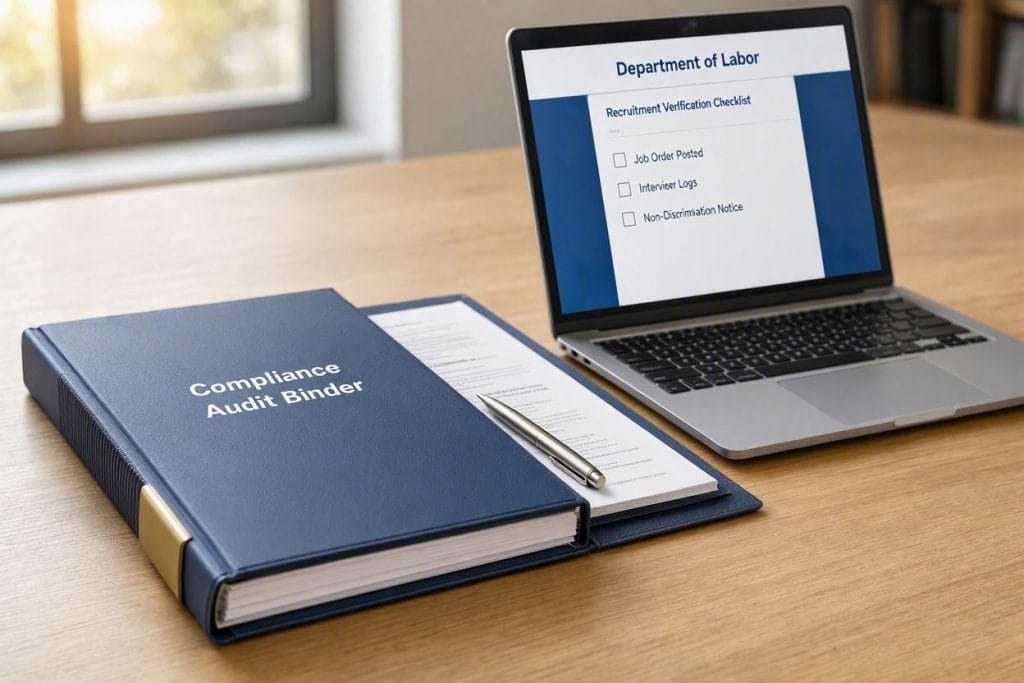
Stage 4: DOL Review and Audits
Once you submit Form ETA-9089, the Department of Labor (DOL) takes over. Their officers will review your application to make sure you followed all recruitment rules, ran the ads correctly, and did not make any data entry mistakes.
| Processing Path | What Happens Next? | Estimated Time |
|---|---|---|
| Path A: Standard Processing | The DOL reviews your file without any issues and issues a Direct Approval (Certified Status). | 12 to 14 Months |
| Path B: Audit Triggered | The DOL pauses your case and requests additional proof. You must submit your full audit file within 30 days. | Adds 6 to 8 Months |
Why Do Audits Happen?
In my experience, the DOL triggers audits for two main reasons. Sometimes, it is just a random quality check. Other times, specific “red flags” in your application trigger a targeted audit.
Common red flags include requiring a foreign language for the role, the employer being related to the foreign worker, or the company having recent layoffs. If you get audited, you only have 30 calendar days to send the DOL your complete recruitment and documentation file. Missing this deadline means an automatic denial.
End-to-End PERM Timeline Breakdown
When analyzing the latest perm labour certification processing times, timing becomes absolutely critical for your company’s hiring roadmap. Whether your employee is currently working under L-1 visa requirements in the USA or you are evaluating O-1 visa requirements for a specialized talent, you need to know exactly how long the PERM process takes.
Failing to plan ahead can lead to sudden gaps in your employee’s legal work status.
| Phase of the Process | Primary Action | Estimated Time |
|---|---|---|
| Phase 1: Wage Determination | DOL Prevailing Wage Review (Form ETA-9141) | 6 to 8 Months |
| Phase 2: Labor Recruitment | SWA Job Order, Print Ads, and the 30-Day Quiet Period | 2 to 3 Months |
| Phase 3: ETA-9089 Filing | Finalizing recruitment reports and electronic filing | 1 Month |
| Phase 4: Standard Adjudication | DOL Review and Final Certification Decision | 12 to 14 Months |
| Phase 4 (Alternate): DOL Audit | Compiling the audit file and supplemental review | Adds 6 to 8 Months |
| Total Standard Timeline | Complete cycle from start to certified approval | 18 to 22 Months |
How the PERM Timeline Protects Your H-1B Status
When you officially file Form ETA-9089 with the DOL, you lock in the foreign worker’s permanent Green Card “Priority Date.” This specific date is incredibly important because it dictates your exact place in line on the State Department’s visa bulletin.
A perfectly timed PERM application also offers massive legal protections under the AC21 regulation, especially for professionals who are close to maxing out their H-1B limits.
- The 365-Day Extension Rule: If you file the PERM application (or Form I-140) at least 365 days before hitting the 6-year H-1B limit, the foreign professional becomes eligible for 1-year H-1B extensions until a final decision is reached.
- Indefinite 3-Year Extensions: Once the PERM is certified and USCIS approves the Form I-140, beneficiaries from backlogged countries can obtain 3-year H-1B extensions indefinitely.
- Recapturing Priority Dates: If a worker eventually changes jobs, an established priority date (from an approved PERM and I-140) can usually be retained and applied to a future green card petition with a different employer.
Managing a global workforce involves juggling multiple immigration routes at once. Whether a corporate employer is hiring seasonal workers through H2B Visa Sponsor Jobs or exploring treaty investor options under the E2 Visa Requirements USA, filing the PERM application on time is the absolute foundation for protecting your employee’s legal work status.
Common PERM Rejection Pitfalls and Audit Triggers
The Department of Labor is notoriously strict when reviewing PERM applications. Even a tiny typo or a minor procedural mistake can lead to an instant denial or a lengthy audit.
- Mismatched Job Details: Your job requirements must match perfectly across every single document. If the duties listed in your newspaper ads look even slightly different from your Prevailing Wage Determination, your case will be rejected.
- Ignoring Recent Layoffs: If your company recently laid off U.S. workers in similar roles, you cannot simply hire a foreign worker to replace them. You must officially notify those laid-off U.S. workers and give them a fair chance to apply before filing the PERM.
- Making the Employee Pay: This is a massive legal violation. The sponsoring employer must pay for every single PERM-related expense. The foreign worker is strictly prohibited from paying the legal fees or covering the recruitment advertising costs.
- Hiding the Salary on the Internal Notice: Unlike normal job postings on LinkedIn, the physical “Notice of Filing” posted inside your office must include the actual salary or a salary range. If you use a range, the bottom number must equal or exceed the official Prevailing Wage. Leaving the salary off the notice is one of the fastest ways to get your application denied.
If you are tired of waiting and want to do your own perm tracking, you can check your official perm labour status directly through the DOL portal. Understanding your exact labour perm status helps you and your employer prepare for the next steps without guessing.
Frequently Asked Questions
Can the PERM labor certification process be expedited or rushed?
No. Unlike some USCIS petitions that offer premium processing, the Department of Labor does not offer any expedited service for prevailing wage requests (Form ETA-9141) or permanent labor certifications (Form ETA-9089). You must plan your timeline around the standard government processing queues.
What happens if a U.S. worker applies for the advertised position?
If a qualified U.S. worker applies during your recruitment campaign, you cannot proceed with the PERM application for that role. Under federal law, the position must remain open to any available, qualified U.S. citizen or green card holder who meets the baseline job requirements.
Can an employer withdraw a PERM application after it has been submitted?
Yes. The sponsoring employer can withdraw Form ETA-9089 at any time through the DOL FLAG portal before a final adjudication decision is made. However, filing fees or recruitment costs spent up to that point are generally non-refundable.
What happens if the foreign worker changes jobs while the PERM is pending?
A PERM labor certification belongs to the employer, not the employee. If the foreign national leaves the sponsoring company while the PERM or I-140 is pending, the petition becomes invalid, and the entire process must typically be restarted with the new employer.
Can experience gained with the sponsoring employer be used for the PERM?
Generally, no. The DOL strictly scrutinizes situations where a foreign national wants to use experience gained while working for the exact same employer. Unless you can prove that the current position is in a substantially different job classification, you must use experience gained prior to joining the company.
Official and Reliable Resources
- U.S. Department of Labor. (n.d.). Office of Foreign Labor Certification.
- U.S. Department of Labor. (n.d.). FLAG System – Prevailing Wage Portal.
- U.S. Citizenship and Immigration Services. (n.d.). Permanent Labor Certification.