If you were born abroad to U.S. citizen parents, you might already be a U.S. citizen by law. However, you cannot claim your rights without official proof.
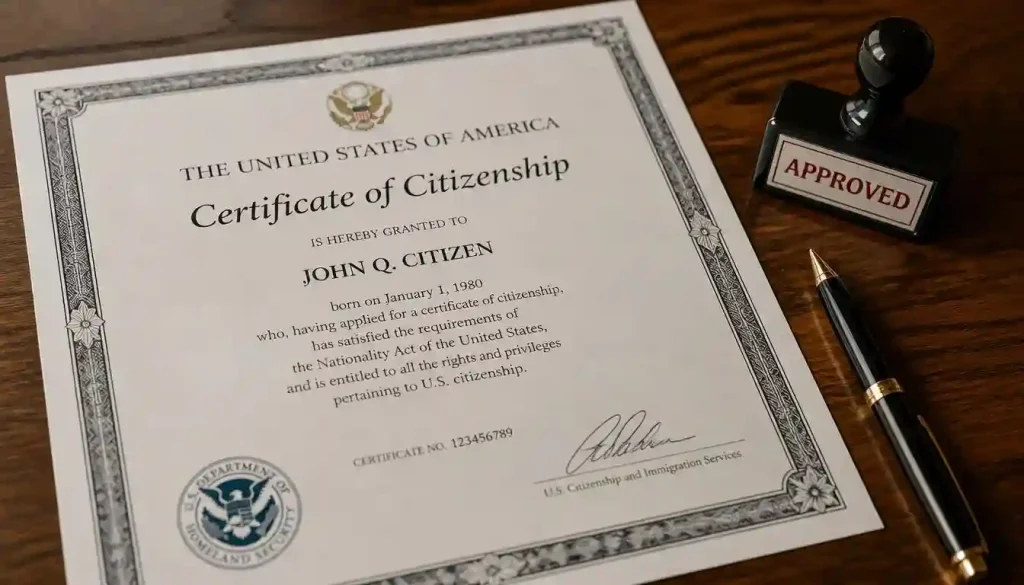
To secure this physical proof, you must file the Form N-600 Application for Certificate of Citizenship.
Unlike a passport that expires every 10 years, this certificate provides lifetime proof of your legal status. You will need this specific document for three main reasons:
- Getting an official U.S. passport
- Applying for federal government jobs
- Securing financial aid for college
USCIS rules for this application are extremely strict, and the filing fees are non-refundable. Here is exactly what you need to know to avoid costly mistakes and get your certificate approved.
What is the Form N-600 Application for Certificate of Citizenship?
Filing this form does not make you a new U.S. citizen. Instead, it asks USCIS to officially recognize a legal status you already have. You are simply requesting the physical certificate that proves your citizenship.
GenForeign-born children typically claim this status in one of two ways:
Derivative Citizenship (After Birth): You gain this if you were born to non-U.S. parents who later become naturalized citizens. To qualify, you must hold a valid Green Card and live in the U.S. under the legal and physical custody of your citizen parents.
Acquired Citizenship (At Birth): You receive this automatically if you are born abroad, but at least one of your parents is already a U.S. citizen at the time of your birth.
Who is Eligible to File Form N-600?
USCIS rejects many applications simply because people misunderstand the eligibility rules. You must meet specific legal conditions based on your situation.
Biological vs. Adopted Children
If you are a biological child born abroad to a U.S. citizen, you usually acquire citizenship at birth. However, your U.S. citizen parent must meet “physical presence” rules. This means they must have lived in the U.S. for a specific number of years before you were born.
Adopted children are also eligible, but the rules differ slightly. An adopted child must live permanently in the U.S. and be in the legal and physical custody of their U.S. citizen parent.
The Child Citizenship Act of 2000 (CCA)
The CCA makes it much easier for foreign-born children to gain derivative citizenship. A child automatically becomes a U.S. citizen if they meet three strict conditions:
- At least one parent is a U.S. citizen (by birth or naturalization).
- The child is currently under 18 years old.
- The child lives in the U.S. as a lawful permanent resident (holds a valid Green Card).
If you meet all three conditions, you skip the citizenship test entirely. You just file the N-600 to get your official certificate.
Form N-600 vs. N-400: What Is the Difference?
Many applicants confuse these two forms. Filing the wrong one can lead to denials and cost you hundreds of dollars in non-refundable USCIS fees.
Here is the basic rule:
- Form N-600: For people who are already U.S. citizens and need official proof.
- Form N-400: For permanent residents (Green Card holders) who want to apply to become new U.S. citizens.
If you are an adult Green Card holder looking to naturalize, you must file Form N-400. Before applying, carefully review the current Form N-400 Processing Timeline and Fees to understand the exact costs and wait times.
Check the table below to quickly compare the requirements:
| Feature / Requirement | Form N-600 (Certificate of Citizenship) | Form N-400 (Naturalization) |
|---|---|---|
| Current Legal Status | Already a U.S. Citizen (by birth or parents) | Lawful Permanent Resident (Green Card holder) |
| Purpose of the Form | To get a paper certificate proving status | To apply to become a new U.S. citizen |
| Civics & English Test | Not required | Mandatory (unless exempt) |
| Age Requirement | Can be filed at any age | Must be at least 18 years old |
| Oath of Allegiance | Sometimes required (if over 14) | Mandatory for all applicants |
Step-by-Step Guide: How to Apply for Your Certificate
You can file your Form N-600 Application for Certificate of Citizenship either online or by mail. If you are applying from abroad, filing online through a USCIS account is generally faster and safer.
Once USCIS receives your application, they will send you a receipt notice. After that, they will schedule a biometrics appointment to take your fingerprints and photographs.
Note: If the applicant is over 14 years old, they may have to take the Oath of Allegiance before USCIS hands over the official certificate.
Crucial Documents and Evidence Checklist
Providing the right evidence is the most important part of your application. You must clearly prove your legal relationship to your U.S. citizen parent.
Make sure to include the following documents in your packet:
- Your Birth Certificate: Must include an official English translation if issued in a foreign country.
- Parents’ Proof of Citizenship: A U.S. birth certificate, U.S. passport, or official Certificate of Naturalization.
- Parents’ Marriage Certificate: To prove a legal marriage existed at the time of your birth.
- Proof of Physical Presence: Tax records, school transcripts, or rent receipts showing your parents lived in the U.S. before you were born.
- Proof of Legal Custody: If your parents are divorced, you must provide court documents showing your U.S. citizen parent has legal and physical custody of you.
USCIS Filing Fees and Fee Waivers (Form I-912)
The standard filing fee for the Form N-600 Application for Certificate of Citizenship is $1,170.
This fee is strictly non-refundable. If USCIS denies your application, you will not get your money back. Always double-check your eligibility before applying to avoid losing this fee.
There are two main exceptions to this cost:
- Military Members: Active members and veterans of the U.S. Armed Forces pay no fee.
- Low-Income Applicants: If you have a low household income, you can apply for a fee waiver by submitting Form I-912.
How Long Does Form N-600 Processing Take?
Currently, USCIS takes about 5 to 14 months to process this application.
Your exact wait time depends on your local field office and whether you submitted all the correct documents in your initial packet.
If you are applying from outside the U.S., expect slight delays. International mail routing and scheduling your biometrics appointment at a local U.S. embassy or consulate usually add extra time to the overall process.
Common N-600 Denials (And How to Avoid Them)
USCIS is very strict when reviewing derivative citizenship applications. To avoid an expensive denial, watch out for these common mistakes:
- Missing Physical Presence Proof: The most common reason for denial is failing to prove that your U.S. citizen parent lived in the U.S. for the required amount of time before you were born.
- Filing the Wrong Form: If you were born abroad and still regularly live outside the U.S., you might actually need Form N-600K instead of the standard N-600.
- Worrying About the Wrong Test: N-600 applicants do not need to take an exam. While adults applying for regular naturalization must study the US Citizenship Interview Civics Questions and English Test, N-600 applicants skip this step entirely because they are already citizens by law.
FAQs
Can I apply for Form N-600 if I am already over 18?
Yes. There is no maximum age limit to file this form. You simply need to prove that you met all the legal requirements for derivative citizenship before your 18th birthday.
Do I need to attend an interview for this application?
Generally, no. USCIS usually approves the certificate based on the documents you submit by mail or online. They will only schedule an in-person interview if your evidence is incomplete or unclear.
Can I travel outside the U.S. while my N-600 is pending?
Yes. Filing this form does not restrict your international travel. You can continue traveling legally using your current foreign passport or valid Green Card.
Who must sign the application if the applicant is a child?
If the child is under 14 years old, the U.S. citizen parent or legal guardian must sign the form. If the applicant is 14 or older, they must sign the document themselves.
Sources of Information
To ensure complete accuracy and compliance with U.S. immigration laws, all details in this guide are sourced directly from current government policy portals:
- USCIS Official Form N-600 Guidelines: For the latest filing instructions, eligibility rules, and form updates.
- Child Citizenship Act of 2000 (CCA): For the exact federal legal framework governing derivative and acquired citizenship.
- USCIS Fee Waiver Form I-912: For official instructions on requesting an exemption from the standard $1,170 filing fee based on low income.