Disorganized booking confirmations and unexplained bank deposits are the fastest way to get your visa denied.
Consular officers evaluate hundreds of files weekly. They usually spend under 90 seconds reviewing your initial documents before deciding whether to dig deeper or just hit “reject.”
Understanding how to write a tourist visa cover letter is your secret weapon. It acts as your personal legal brief. It clarifies your funding, outlines your daily schedule, and most importantly—proves exactly why you must return home.
Core Principles of a Winning Cover Letter
Visa officers test one simple thing: does your travel plan match your real-life financial background?
A winning cover letter skips the emotional stories. Instead, it relies on solid facts, structured dates, and direct links to your supporting documents.
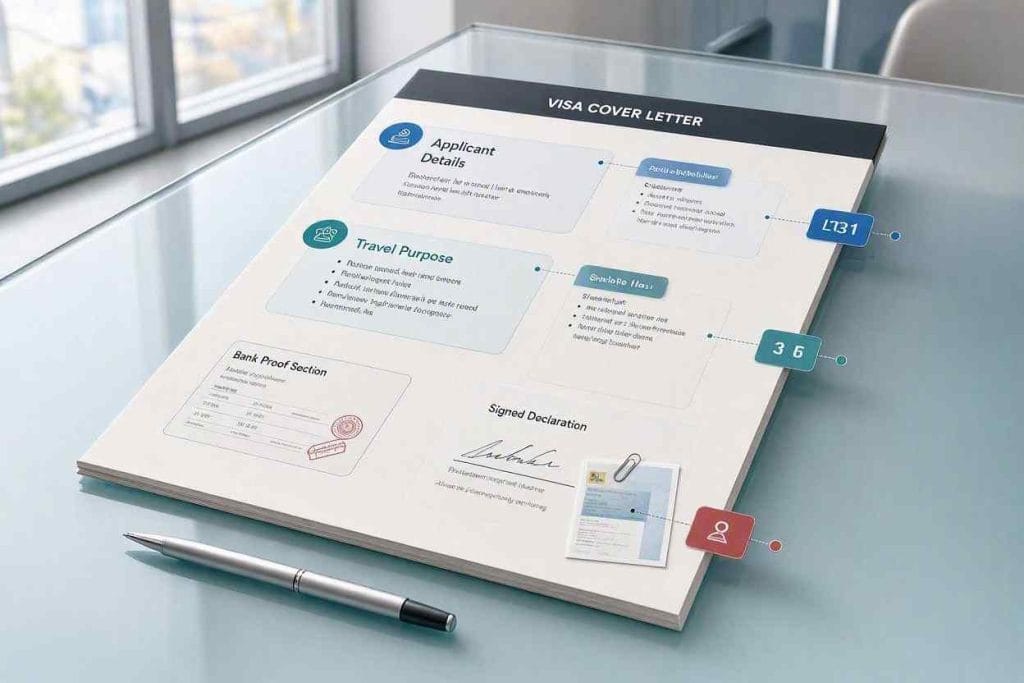
Every successful cover letter must anchor its presentation around five specific elements:
- Official Embassy Details: Addressing the exact consular section handling your file.
- Clear Trip Dates: Stating your exact entry, exit, and main leisure activities.
- Daily Breakdown: Outlining where you will sleep and how you will travel between cities.
- Financial Proof: Explaining how you will pay for the trip, with direct references to your stamped bank statements.
- Reasons to Return: Documenting your active job, business, or family ties that force you to come back home.
Integrating these core elements alongside the baselines in our Tourist Visa Requirements: Global Travel & Approval Guide ensures your application meets strict intake standards without triggering extra scrutiny.
Physical Formatting Rules for a Professional Look
A messy, unformatted letter creates an immediate bad impression. Visa officers appreciate a clean, professional document that they can scan quickly.
- Standard Font & Sizing: Stick to formal, easy-to-read fonts like Arial, Calibri, or Times New Roman. Keep the size between 11pt and 12pt with a 1.15 line spacing.
- Page Margins: Print your document on standard A4 or US Letter paper. Keep a 1-inch (25.4 mm) margin on all four sides so the page does not look cluttered.
- Keep It Short: Limit your letter to a maximum of two pages. If you are visiting a single country, a crisp one-page letter is always preferred.
- The “Wet Ink” Signature: Never use a typed or digital signature. Always print the final letter and sign it by hand using a dark blue or black pen right above your typed name. This proves authenticity.
Strategic Architecture: How to Structure Your Letter
A well-structured letter helps the visa officer find exactly what they are looking for in seconds. If your letter is hard to read or misses key details—like skipping a travel date—it can easily delay your visa processing.
| Letter Section | What to Include | Why the Embassy Cares |
|---|---|---|
| Formal Salutation | Embassy name, location, and processing center. | Shows you applied to the correct consulate jurisdiction. |
| Applicant Profile | Full name, passport number, job title, and nationality. | Matches your identity with their online visa portal. |
| Itinerary Overview | Exact dates, hotel names, and internal transit plans. | Proves your travel plan is realistic and logical. |
| Financial Details | Bank name, account number, and total available funds. | Shows you can afford the trip without working illegally. |
| Return Incentives | Job leave approval, business license, or family ties. | Proves you have strong reasons to return home on time. |
| Document Index | A numbered list of all attached supporting documents. | Ensures the officer does not miss any of your proofs. |
From my experience, visa officers appreciate short, to-the-point facts rather than long, emotional stories. Keep your explanations brief and make sure they directly match your attached documents.
Ready-to-Use Tourist Visa Cover Letter Template
You can easily adapt this standard template for your own application. Simply replace the bracketed information with your exact travel dates, financial numbers, and employment details.
[Date of Application]
To: The Visa Adjudication Officer, Embassy of [Destination Country], [City, Country]
Subject: Application for Tourist Visa – [Your Full Name], Passport No: [Your Passport Number]
Dear Visa Officer,
I am writing to submit my application for a tourist visa to visit [Destination Country] from [Start Date] to [End Date]. The main purpose of my trip is tourism and cultural sightseeing.
1. Travel Itinerary & Accommodations:
- [Date 1 to Date 2]: Arriving in [City 1]. Staying at [Hotel Name / Booking Reference].
- [Date 3 to Date 4]: Traveling to [City 2] via [Train/Flight]. Staying at [Hotel Name].
2. Employment & Ties to Home Country: I have been steadily employed as a [Your Job Title] at [Company Name] for the past [X] years, earning a monthly net salary of [Amount/Currency]. My employer has approved my paid annual leave from [Date] to [Date] (Please see the attached Leave Approval Letter in Exhibit C). I will return to my professional duties immediately after this trip on [Return-to-Work Date].
3. Financial Declaration: I am fully self-funding this trip. My total estimated budget is [Total Budget Amount], which is easily covered by my personal savings. My attached bank statements from [Bank Name] (Account ending in [Last 4 Digits]) show a current available balance of [Current Balance].
Sincerely,
(Sign here with a blue or black pen)
[Your Typed Legal Name] [Your Phone Number] | [Your Email Address]
Role-Specific Cover Letter Templates: Find Your Match
A single generic template does not work for everyone. Visa officers expect different financial proofs depending on how you make your living. Choose the specific paragraph below that matches your profession and swap it into the “Employment & Financial” section of the standard template above.
| Your Profile | Main Focus in the Letter | Must-Attach Documents |
|---|---|---|
| Salaried Employee | Job stability and employer’s permission to travel | NOC (No Objection Certificate) & 3 months payslips |
| Freelancer / Business Owner | Business legitimacy and ongoing client projects | Trade license, tax returns, and client invoices |
| Sponsored Visitor (Student/Spouse) | Your sponsor’s financial capability to fund the trip | Sponsorship affidavit and sponsor’s bank statements |
Option A: The Freelancer & Business Owner Clause
“I am the founder and sole proprietor of [Business Name], established in [Year]. I have attached my commercial registration and recent tax returns (Exhibits C & D). My business generates an average monthly revenue of [Amount]. I am taking a short break from my ongoing client contracts, which I must return to fulfill by [Return Date]. All trip expenses are self-funded from my personal savings.”
Option B: The Sponsored Visitor (Students or Homemakers)
“As a full-time university student at [University Name] / homemaker, I do not hold active employment. My entire journey, including flights, accommodation, and daily expenses, is fully funded by my [Relationship, e.g., Father], [Sponsor’s Name]. I have attached their Sponsorship Affidavit, employment letter, and 6-month stamped bank statements (Exhibits E & F) confirming their capacity to support my trip.”
(For detailed banking requirements for sponsors, read our full guide on Tourist Visa Financial Requirements: Bank Proof Guide.)
Financial Proof: How to Show You Can Afford the Trip
Visa officers want to see a realistic budget. If you claim a 14-day trip to Paris will only cost $500, they will immediately doubt your application. Your cover letter must show that your available bank balance comfortably covers your estimated daily expenses.
| Expense Category | How to Estimate the Cost | What Proof to Attach |
|---|---|---|
| Daily Meals & Living | €70 to €100 / $80 to $120 per day | Stamped 6-month bank statements |
| Hotels & Lodging | Use your exact confirmed room rates | Pre-booked hotel vouchers or booking slips |
| Internal Transport | Cost of train, bus, or domestic flight tickets | Transit reservations or printed route estimates |
| The “Safe Balance” Rule | Total bank balance should be at least 3x your total trip budget | Bank solvency letter showing clear savings |
Exact Phrasing to Explain Your Funding Source
Depending on who is paying for your trip, copy and paste the correct sentence into the financial section of your cover letter:
If you are paying for yourself (Self-Funded):
“I confirm that I am personally financing the entire cost of this trip using my own savings. This is supported by the attached 6-month stamped bank statement from [Bank Name], which shows an available balance of [Amount].”
If someone else is paying (Sponsored Travel):
“My travel and accommodation expenses are fully sponsored by my [Relationship, e.g., Father / Spouse], [Sponsor’s Full Name]. I have attached their signed Sponsorship Affidavit and their certified 6-month bank statements (Exhibit B) as proof of their financial support.”
Before finalizing your budget, make sure your bank documents actually match the numbers you are claiming. For a complete checklist of accepted banking documents, review our Tourist Visa Financial Requirements: Bank Proof Guide so you can easily satisfy the embassy’s financial checks.
Real-World Case Study: How Freelancers & Remote Workers Get Approved
Freelancers, digital creators, and remote contractors often face extra questions from the embassy simply because they do not get standard monthly payslips. Without a traditional boss, visa officers might doubt your income stability.
The Challenge: An independent brand consultant applied for a European visa. They had great savings, but their bank statements showed random, irregular payments from different online platforms instead of a fixed monthly salary. To a visa officer, this looked unstable and suspicious.
The Strategy & Solution: Instead of just submitting the bank statements and hoping for the best, the applicant added a dedicated “Freelance Income Explanation” paragraph in their cover letter. They did four smart things:
- Explained the Job: Briefly outlined their 4-year history of running a successful freelance business.
- Connected the Dots: Matched those random bank deposits directly to signed client contracts and their recent tax returns, making it easy for the officer to trace the legal income.
- Proved the Budget: Highlighted that the entire vacation would cost less than 12% of their total liquid savings.
- Created a Reason to Return: Mentioned an upcoming major client project that was scheduled to start right after their trip, proving they physically needed to return home.
The Result: By simply explaining their irregular income and proving they had ongoing projects back home, the applicant erased the embassy’s doubts and walked away with a multiple-entry visa.
Visa Cover Letter Rules for Major Embassies
Every embassy has its own unique way of reviewing application letters. Adjusting your cover letter to match a specific country’s preferences helps you avoid silly compliance mistakes.
| Embassy / Country | Recommended Length | What the Officer Cares About Most |
|---|---|---|
| Schengen Area (Europe) | 1 to 2 pages | Main destination rule, €30,000 medical insurance, and clear travel routes. |
| United Kingdom (UKVI) | 1 page (Preferred) | Clear source of funds, true visitor intent, and approved workplace leave. |
| Canada (IRCC) | 2 to 3 pages | Strong ties to your home country, detailed budget, and family commitments. |
| United States (B1/B2) | Optional (Interview focused) | A short summary that backs up your online DS-160 visa form. |
| Australia (Subclass 600) | 1 to 2 pages | Proving you are a genuine temporary entrant who will definitely return home. |
When you are planning a trip to Europe under the Schengen Tourist Visa Requirements, your letter must clearly show your main destination (the country where you will spend the most days) to comply with Article 5 of the Schengen rules.
Documenting Return Incentives and Economic Ties
The core goal of any visitor visa application is proving why you must return home before your visa expires. Every sentence about your background should reinforce your domestic stability:
- Steady Employment: State your job title, length of service, salary, and your confirmed return date backed by an official leave letter.
- Business Ownership: Detail your registered business, commercial leases, employee payroll, and tax filings.
- Real Estate & Assets: Reference properties you own, land deeds, or long-term local investments.
- Family Responsibilities: Mention dependent children, aging parents, or legal duties that require your physical presence at home.
Structuring Your Supporting Document Index
A great cover letter is useless if the visa officer cannot find your documents. Organizing your attachments into a simple, labeled index acts like a table of contents, helping consular staff locate your specific proofs instantly without confusion.
| Exhibit Number | Document Category & Contents |
|---|---|
| Exhibit 1 | Identity & Travel Auth: Current passport biodata page, past visas, and entry stamps. |
| Exhibit 2 | Financial Proof: Six months of stamped bank statements, tax returns, and solvency certificates. |
| Exhibit 3 | Employment Proof: Leave approval letter, No Objection Certificate (NOC), and recent salary slips. |
| Exhibit 4 | Travel Bookings: Confirmed round-trip flight reservations, hotel vouchers, and local transit tickets. |
| Exhibit 5 | Supplementary Proof: Travel insurance policy, marriage certificates, and property deeds. |
If you are staying with a friend or family member overseas, make sure their paperwork fully satisfies all Tourist Visa Invitation Letter Requirements before adding their details to your final index.
How to Handle Complex Histories and Past Refusals
Never try to hide past visa refusals, gaps in your employment, or sudden large bank deposits. Embassies share immigration data globally, and hiding facts will almost guarantee a rejection.
- Previous Visa Denials: Be honest about past refusals. Mention them briefly and explain what has positively changed in your life or finances since that last application.
- Employment Gaps: If you took time off for studying, parental leave, or starting a business, explain it clearly and attach a supporting certificate.
- Large Bank Deposits: If your bank statement shows a sudden big deposit (like a yearly bonus or selling property), explain exactly where the money came from and attach the receipt.
To avoid other common mistakes, read our complete guide on Common Tourist Visa Rejection Reasons before submitting your file.
Matching Your Letter with Online Forms and Interviews
Your cover letter must perfectly match what you type into the embassy’s online visa portal and what you say during a personal interview. Any mismatch between your letter and the online form is a massive red flag for visa officers.
- Online Portal Consistency: Double-check that your salary, travel dates, and contact details exactly match your online visa application form.
- Interview Preparation: Practice summarizing your letter’s main points until your verbal answers flow naturally without hesitation.
- Handling Consular Questions: Read our Tourist Visa Interview Questions and Answers: Pass Guide so your spoken answers perfectly match your written submission.
FAQs
Is a cover letter mandatory for every visitor visa application?
While some online application portals label cover letters as optional, consular officers use them to clarify complex bank deposits, multi-city travel routes, and domestic return ties.
Can families traveling together submit a single unified cover letter?
Yes, the primary applicant can submit a comprehensive cover letter detailing travel arrangements, passport numbers, and a combined budget for all accompanying family members.
What is the recommended length for an embassy cover letter?
A standard visitor visa cover letter should be one to two pages long, utilizing bulleted points and concise tables to ensure quick scannability by consular staff.
Should flight tickets be fully purchased before drafting the cover letter?
No, immigration authorities recommend providing verifiable round-trip flight reservations rather than non-refundable purchased tickets prior to formal visa approval.
How should the salutation be formatted if the adjudicator name is unknown?
Address the submission formally to “The Visa Adjudication Officer, Embassy of [Country Name], Visa Section, [City Name]” to maintain standard diplomatic protocol.
Do I need to translate my cover letter into the destination country’s language?
No. English is globally accepted by almost all embassies and visa processing centers. Unless the embassy’s official document checklist explicitly asks for a local translation, a well-written English cover letter is perfectly fine.
Is a handwritten tourist visa cover letter accepted?
While not illegal, handwritten letters are highly discouraged. Visa officers have limited time, and handwritten notes are hard to scan quickly. Always type your letter on a computer, print it on clean paper, and sign it by hand.
Can I use a digital or typed signature on my visa cover letter?
Most physical embassies strictly require a “wet ink” signature. This means you must print the document and sign it with a real blue or black pen. Digital or copied signatures are usually only accepted if you are applying for a fully online e-Visa.
Do I need a cover letter for an online e-Visa application?
Most online e-Visa portals do not strictly ask for one. However, if the portal has an “Additional Documents” or “Any Other Information” upload section, attaching a short cover letter explaining your travel route can easily prevent unexpected rejections.
How do I explain a recent job loss or unemployment in my cover letter?
Do not hide it. Briefly mention that you are currently between jobs, but put all the focus on your financial stability. Highlight your strong savings, family ties, or properties back home to prove you have solid reasons to return and find new employment.
Final Steps Before You Submit
A great cover letter ties your whole application together. Before you head to the embassy or hit submit online, do a quick final check to avoid silly mistakes:
- Check the Dates: Make sure your flight, hotel, and leave approval dates perfectly match the dates written in your letter.
- Verify the Money: Ensure the exact bank balance you claimed in the letter matches your printed bank statement.
- Organize Your Papers: Place your cover letter right at the top of your file, followed by your indexed supporting documents.
A clean, fact-based letter removes all confusion and gives the visa officer every reason to approve your trip.
Source of Information
For the most up-to-date visa policies and official document checklists, always verify with these government portals: