K1 Visa vs CR1 Spousal Visa Comparison: Which is Right for You?
Falling in love across borders is complicated enough, but deciding exactly how to bring your partner to the United States often feels like a legal maze.
Every international couple eventually faces the exact same crossroad: should we apply for a fiancé visa to reunite quickly, or get married abroad and apply for a spousal visa for long-term financial stability?
Making the wrong choice can cost you thousands of dollars and months of unnecessary separation. That is why a detailed k1 visa vs cr1 spousal visa comparison is the most consequential decision you will make in your entire immigration journey.
If you are already heavily leaning toward the fiancé route, be sure to review our complete step-by-step guide on how to apply for us k1 fiance visa.
The core differences dictate every practical challenge you will face—from upfront government fees to exactly when you can legally start working in America.
K1 Visa vs CR1 Visa: Understanding the Fundamental Difference
The fundamental difference between these two visas comes down to your official relationship status at the exact moment you file your first petition with USCIS.
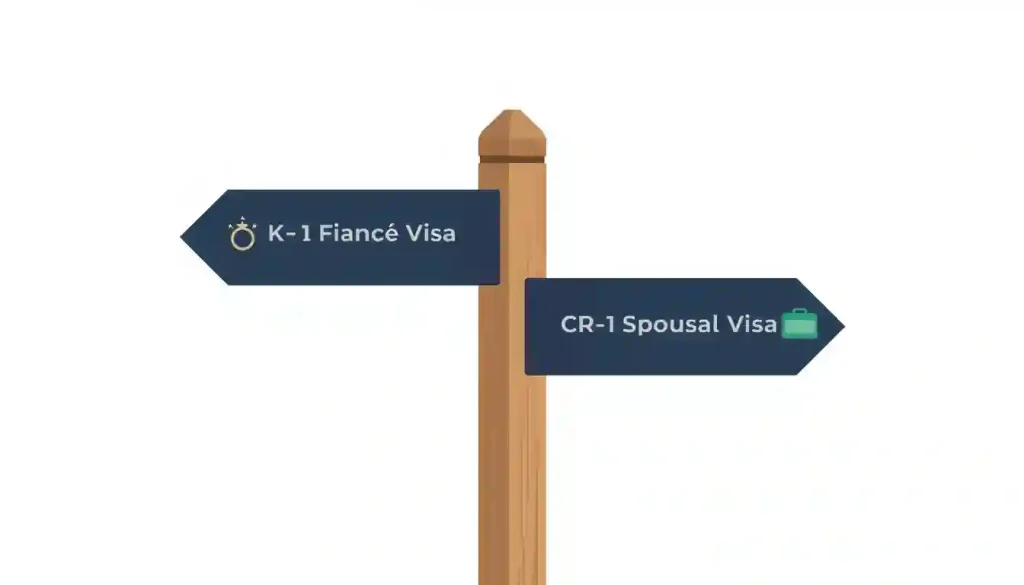
The K-1 Fiancé Visa (starting with Form I-129F) is exclusively for engaged couples. The foreign partner enters the U.S. on a temporary status, and the couple is legally mandated to marry within 90 days of arrival. After the wedding, they must file for a Green Card from inside the U.S.
The CR-1 Spousal Visa (starting with Form I-130) is for couples who are already legally married. The foreign spouse completes the entire Green Card process overseas through a U.S. embassy and enters the United States as a Lawful Permanent Resident from day one.
That single legal distinction drives every practical tradeoff you will face—from upfront government fees to work authorization.
Let’s compare the core differences directly:
| Feature | K-1 Fiancé Visa | CR-1 Spousal Visa |
|---|---|---|
| Relationship Status | Engaged, not yet married | Legally married before filing |
| Marriage Timing | Must marry within 90 days of U.S. entry | Marriage already occurred |
| Status Upon U.S. Entry | Nonimmigrant (Temporary) | Lawful Permanent Resident |
| Work Authorization | No. Must wait months for an EAD | Yes. Authorized to work immediately |
| International Travel | No. Must wait for Advance Parole | Yes. Free to travel internationally |
Total Cost Comparison: K1 vs CR1 Visa in 2026
When deciding between a fiancé visa and a spousal visa, the total financial impact is often the biggest deciding factor for couples.
Because the K-1 visa requires you to adjust your status (apply for a Green Card) after arriving in the United States, it is significantly more expensive than the CR-1 route.
Below are the exact 2026 mandatory government fees for a single applicant. (Note: These tables exclude variable costs like medical exams, travel, and legal fees).
K1 Visa Cost Breakdown (Including AOS)
The total expense for a K-1 visa accumulates across two separate stages: the initial overseas petition and the domestic green card filing after marriage. Here is the full breakdown of mandatory government fees you must budget for:
| Fee Type | Amount | Paid To |
|---|---|---|
| Form I-129F (Fiancé Petition) | $675 | USCIS |
| DS-160 (Visa Application) | $265 | U.S. Department of State |
| Form I-485 (Adjustment of Status) | $1,440 | USCIS |
| Form I-765 (Work Permit with I-485) | $260 | USCIS |
| Form I-131 (Travel Permit with I-485) | $630 | USCIS |
| Total Estimated Cost (With EAD & Travel) | $3,270 |
Pro Tip: File Form I-130 Online to Save Time and Money
Always file your CR-1 spousal petition (Form I-130) online through the USCIS portal instead of mailing paper forms. It reduces your mandatory filing fee from $675 to $625 (saving you $50 instantly) and generates an immediate official receipt notice (NOA1), cutting weeks of lockbox mailroom delays.
CR1 Visa Cost Breakdown
The CR-1 spousal route consolidates all filing fees into the overseas consular process, eliminating the expensive domestic adjustment stage entirely. Here is the full breakdown of mandatory government costs from the initial petition to Green Card production:
| Fee Type | Amount | Paid To |
|---|---|---|
| Form I-130 (Spousal Petition) | $675 (Paper) / $625 (Online) | USCIS |
| DS-260 (Immigrant Visa Application) | $325 | U.S. Department of State |
| Form I-864 (Affidavit of Support Review) | $120 | National Visa Center (NVC) |
| USCIS Immigrant Fee | $235 | USCIS (For Green Card production) |
| Total Mandatory Government Fees | $1,355 (Paper) / $1,305 (Online) |
The Direct Cost Difference: K-1 vs. CR-1 Head-to-Head
When you place the total mandatory government expenses side by side, the financial gap becomes crystal clear. Here is how both pathways compare directly before factoring in legal fees or travel costs:
| Visa Route | Total Government Cost | Difference vs. CR-1 |
|---|---|---|
| K-1 (Visa + Adjustment of Status) | $2,380 | $1,025 to $1,075 more expensive |
| CR-1 (Paper Filing) | $1,355 | Baseline |
| CR-1 (Online Filing) | $1,305 | Cheapest overall pathway |
The Cost Verdict: The K-1 visa is not just slightly more expensive—it is a massive financial burden compared to the CR-1 route. When you factor in the new separate fees for a K-1 work permit ($260) and travel document ($630) during the Adjustment of Status phase, the total K-1 government cost skyrockets to roughly $3,270. That makes the fiancé route nearly $2,000 more expensive than the CR-1 spousal visa.
Timeline Comparison: Which Visa is Faster?
When couples ask “which visa is faster?”, the answer completely depends on which finish line you are measuring. Are you measuring how fast you can reunite in America, or how fast you can hold a Green Card in your hand?
The timeline differences between the two visas are significant in 2026. Here is a realistic look at how long each phase takes:
| Milestone | K-1 Fiancé Visa (2026 Estimate) | CR-1 Spousal Visa (2026 Estimate) |
|---|---|---|
| Time to Physically Enter the U.S. | 10 to 16 Months | 14 to 20 Months |
| Adjustment of Status Wait Time | 12 to 18 Months (After marriage) | None (Skipped entirely) |
| Total Time to Get a Green Card | 22 to 34 Months | 14 to 20 Months |
Speed to Arrive in the U.S.
If your only goal is to physically end your long-distance separation as fast as possible, the K-1 visa is usually the winner.
Because the initial I-129F petition requires slightly less background processing than a spousal visa, a K-1 applicant can typically clear the embassy interview and fly to the United States in about 10 to 16 months.
In contrast, the CR-1 visa requires more heavy lifting upfront. USCIS and the National Visa Center (NVC) must completely process your I-130 petition and financial support documents before you even get an interview. This pushes the average U.S. entry time for CR-1 holders to roughly 14 to 20 months.
Speed to Receive the Physical Green Card
If your goal is to hold permanent residency status as quickly as possible, the CR-1 visa absolutely destroys the K-1 timeline.
When a K-1 fiancé arrives in the U.S., their immigration journey is only halfway done. They must get married, file Form I-485, and wait an agonizing 12 to 18 months for USCIS to process their Green Card. In total, a K-1 applicant might wait nearly three years from their initial filing date to finally hold a Green Card.
A CR-1 spouse completely skips the domestic processing line. The moment a CR-1 visa holder walks through U.S. customs at the airport, they are instantly recognized as a Lawful Permanent Resident. Their physical Green Card simply arrives in the mail a few weeks later.
Work and Travel Rules Upon Arrival (The Biggest Difference)
For many couples, the hardest part of the immigration journey is not the paperwork—it is surviving on a single income.
The most dramatic difference in our k1 visa vs cr1 spousal visa comparison is what the foreign partner is legally allowed to do on their very first day in America. This single factor often forces couples to rethink their entire strategy.
The K-1 Income Gap (Waiting for EAD)
A K-1 fiancé arrives in the United States as a nonimmigrant. This means you do not have the legal right to work or travel internationally upon arrival.
After your wedding, you must file Form I-485 to adjust your status, along with applications for a work permit (EAD) and a travel document (Advance Parole). In 2026, USCIS processing times for a K-1 work permit typically range from 4 to 8 months.
During this agonizing “income gap,” the foreign fiancé cannot earn a salary, work remotely, or even drive for a rideshare app. The U.S. citizen sponsor must be fully prepared to support the household, pay the massive $1,440 Green Card application fee, and cover all living expenses on just one income.
Furthermore, until the Advance Parole travel document is approved, the K-1 applicant is effectively trapped inside the U.S. Leaving the country for a sudden family emergency will instantly void the pending Green Card application.
The CR-1 Immediate Freedom (Green Card Upon Entry)
The CR-1 visa provides absolute financial and personal freedom from day one.
Because the entire Green Card process is handled by the embassy overseas, a CR-1 spouse is admitted into the United States as a Lawful Permanent Resident. The U.S. Customs officer at the airport will stamp your passport with an I-551 stamp, which immediately serves as a temporary Green Card.
What does this mean for your daily life?
- Immediate Work Rights: You can legally apply for jobs, accept salary offers, and build your U.S. career the exact second you leave the airport.
- Immediate Travel Freedom: You are free to fly back to your home country to visit family without asking USCIS for permission or risking your immigration status.
For couples who simply cannot survive on a single income, or those relocating to high-cost American cities, the CR-1 visa is the ultimate financial lifesaver.
The 2-Year Marriage Anniversary Hack (IR-1 Upgrade)
A common misconception is that all spousal visas result in a 2-year conditional Green Card. In reality, your Green Card type is determined by your marriage date on the exact day you enter the United States, not the day you filed Form I-130.
If processing delays push your entry date past your 2nd wedding anniversary, U.S. border officials will automatically admit you on an IR-1 visa. This grants you a permanent, 10-year unrestricted Green Card immediately, completely exempting you from filing Form I-751 (Removal of Conditions) and saving you over $750 in future fees.
The 90-Day Driver’s License & Real ID Trap (The Isolation Factor)
One of the most emotionally exhausting realities of the K-1 visa that official websites never mention is the American “driver’s license deadlock.”
Under strict U.S. REAL ID laws, state DMVs will not issue or renew a driver’s license if your lawful presence document has less than 30 to 60 days of validity remaining. Because a K-1 entrant’s initial I-94 is valid for only 90 days, you face a very narrow window to get a temporary license.
Once those 90 days pass, most states will completely deny you a driver’s license until your physical EAD work permit or Green Card arrives in the mail 4 to 8 months later. For foreign partners relocating to car-dependent U.S. suburbs, this often leads to months of acute isolation and zero personal mobility.
In sharp contrast, a CR-1 immigrant spouse receives an official I-551 permanent resident stamp at airport customs. This allows them to walk into the local DMV and obtain a standard multi-year REAL ID driver’s license within their first week in America.
Marriage Location and Wedding Planning
One of the most overlooked factors in the K-1 vs CR-1 debate is where you actually want to tie the knot.
If you are dreaming of a traditional American wedding surrounded by the U.S. citizen’s friends, family, and local community, the K-1 visa is your only legal option. You will fly to the U.S. as an engaged couple, host your wedding within 90 days, and celebrate domestically.
However, the K-1 visa strictly forbids you from getting legally married abroad.
If you want a destination wedding, or if it is culturally important to marry in the foreign partner’s home country, you must choose the CR-1 Spousal Visa. You will legally marry overseas first, and then apply for the CR-1 visa to bring your spouse to America.
Real-World Advice: The Practical & Emotional Reality
Beyond government fees and processing times, thousands of couples deeply regret their visa choice due to everyday practical struggles. Based on real-life experiences from immigration forums, here is what official websites don’t tell you:
- The 90-Day Wedding Planning Nightmare (K-1): Planning a traditional American wedding on a K-1 visa is incredibly stressful. Because you cannot predict exactly when the embassy will issue the visa, you cannot safely book a venue, hire catering, or send out invitations in advance. Most K-1 couples are forced to have a quick, 15-minute courthouse wedding just to meet the 90-day legal deadline, and host a “real” celebration months later.
- The Credit Score and Banking Blockade (K-1): Living in America without a Green Card or a steady paycheck is notoriously difficult. During the K-1 adjustment period, the foreign partner will struggle to open a solo bank account, get approved for a credit card, or even be added to the U.S. sponsor’s car insurance policy. CR-1 spouses bypass this completely because they arrive as permanent residents and can start building a U.S. credit score on day one.
Executive Decision Guide: Which Should You Choose?
After reviewing the costs, timelines, and legal restrictions, there is no universal “best” visa. The right choice depends entirely on your couple’s financial flexibility, career goals, and patience.
Use this practical checklist to make your final decision:
Choose the K-1 Fiancé Visa If…
- Speed of reunion is your 1 priority: You simply cannot bear to be apart for another 14 to 20 months and want to be together in the U.S. as quickly as possible.
- You want a U.S. wedding: You have your heart set on getting married inside the United States.
- You have a strong financial safety net: The U.S. citizen sponsor makes enough money to comfortably support both partners for 4 to 8 months on a single income.
- A career gap is acceptable: The foreign partner does not mind taking a 6-month break from working while waiting for their EAD work permit approval.
- You can afford the higher fees: You are comfortable paying the extra $1,000+ for the Adjustment of Status process later.
The Joint Sponsor Guarantee: I-134 Discretion vs. I-864 Law
If the U.S. petitioner does not meet the minimum income requirements and relies on a joint sponsor (co-sponsor), the visa category you choose can literally make or break your approval:
- K-1 Discretionary Risk: The fiancé visa uses Form I-134, which is not legally enforceable. Because of this, overseas consular officers have broad discretion to reject joint sponsors outright. High-fraud or high-volume embassies (such as Manila, Lagos, or Ho Chi Minh City) frequently refuse to accept co-sponsors for K-1 applicants, triggering an instant 214(b) or 221(g) denial.
- CR-1 Statutory Guarantee: The spousal visa uses Form I-864, an enforceable legal contract under Section 213A of the INA. By federal immigration law, U.S. embassies must accept a financially qualified joint sponsor who meets the 125% Federal Poverty Guidelines. If your petitioner has low income or irregular tax history, the CR-1 route is exponentially safer.
Choose the CR-1 Spousal Visa If…
- You need two incomes immediately: The foreign partner wants to start working and building their U.S. career the exact week they arrive.
- You want to save money: You prefer to pay the lower $1,355 total government fee and skip the expensive Adjustment of Status process entirely.
- You are already legally married: Or, you prefer to have your official wedding ceremony in the foreign partner’s home country.
- You need international travel flexibility: The foreign partner needs the freedom to fly back home for holidays or family emergencies immediately after moving to the U.S.
- You hate extra paperwork: You want to be done with USCIS the moment you land, rather than starting a second 18-month Green Card application process from scratch.
The Practical Decision Rule
If you are still stuck, ask yourselves this one deciding question:
Choose the K-1 if you are asking, “How quickly can we wake up in the same house?” Choose the CR-1 if you are asking, “How quickly can we both work, travel, and live a normal married life with zero immigration stress?”
FAQs
Can my partner visit the U.S. while our K-1 or CR-1 petition is pending?
Yes, with a valid B1/B2 tourist visa or ESTA, but entry is never guaranteed. K-1 applicants face heavy scrutiny due to suspected immigrant intent. CR-1 applicants typically have an easier entry if they carry clear proof of home ties, such as an active job contract, a lease, and a return ticket.
Can a K-1 holder work remotely for a foreign employer before getting an EAD?
No. U.S. immigration law defines employment by your physical location while doing the work, not where the employer is registered. Working remotely on a laptop inside the United States without an approved Employment Authorization Document (EAD) is unauthorized work.
Which visa route is cheaper if we have children (K-2 vs. CR-2)?
The K-1 route is cheaper upfront, but far more expensive in the end. While children can be included on the parent’s initial K-1 petition for free (saving the $625-$675 separate I-130 fee required for a CR-1), you will eventually have to pay a massive $1,440 (or $950 if under 14) Adjustment of Status fee for each K-2 child’s Green Card once they arrive in the U.S.
Does an online wedding qualify for a CR-1 visa?
Yes, but only if you meet in person afterward. Under INA § 101(a)(35), USCIS requires couples using virtual or proxy marriages to physically consummate the marriage post-ceremony. You must gather proof of an in-person meeting that occurred after the marriage certificate was issued before filing Form I-130.
Sources of Information
To verify official appeal policies, processing standards, and refusal guidelines, consult these primary government resources:
- U.S. Department of State: Administrative Processing Information (INA 221g)
- USCIS: Form I-129F, Petition for Alien Fiancé(e)
- USCIS: Form I-290B, Notice of Appeal or Motion
- USCIS: Form I-130, Petition for Alien Relative
- USCIS: Form I-485, Application to Register Permanent Residence or Adjust Status
- USCIS: Form I-864, Affidavit of Support Under Section 213A of the INA