Getting a Poland work visa can be a stressful journey. If you have ever waited in a crowded embassy holding a thick folder of documents, you know the feeling.
Preparing the perfect Poland national d type work visa appointment and document checklist is not just about ticking boxes. It is about organizing your papers perfectly to avoid an instant rejection. Often, the difference between getting your visa approved and facing a denial comes down to tiny paperwork mistakes.
Unlike a short tourist trip covered by standard Schengen Visa Application Requirements, the National D-Type visa is for the long term. It allows non-EU citizens to live and work full-time in Poland for up to 365 days.
However, your visa depends entirely on the work permit issued by the local Polish government (Voivode). If your employer’s details do not match the official labor database, your application will face costly delays—even if you are a highly qualified worker.
Document Checklist: National D-Type Work Visa
To make sure your application passes the embassy check without any issues, you must keep your paperwork perfectly organized.
| Document Category | What You Need | How the Embassy Checks It |
|---|---|---|
| Provincial Work Permit | Original Type A work permit (Zezwolenie na pracę) from the Voivode. | Cross-checked online via the official praca.gov.pl database. |
| Visa Application Form | Filled out online via the e-Konsulat or VFS portal. | Must be printed and signed by hand in field 37 (signature must match your passport). |
| Travel Passport | Must be valid for at least 3 months after your visa expires. | Must be issued within the last 10 years with at least 2 blank pages. |
| Proof of Accommodation | Rental agreement or an official housing letter from your employer. | Must show the full Polish address and exact rental dates. |
| Travel Medical Insurance | Minimum €30,000 emergency medical coverage. | The insurance company must be on the approved list of the Polish Ministry of Foreign Affairs (MSZ). |
| Professional Experience | Your certified diplomas, training certificates, or past salary slips. | Proves to the officer that your skills actually match the job you are hired for. |
You must submit two recent passport-size biometric photos (35x45mm) with an 80% face close-up on a plain white background. Do not edit or retouch these photos.
Work Permit Categories and Visa Codes
Before booking your embassy appointment, look closely at your documents. You will see a specific purpose code stamped on your papers.
- Code D-05a: Work based on an Employer Declaration (Oświadczenie).
- Code D-05b: Seasonal Work, mostly in farming or tourism (valid for up to 9 months).
- Code D-06: Standard Type A Work Permit (Zezwolenie na Pracę).
Type A Work Permit (Zezwolenie na Pracę Typ A)
This is the most common permit for long-term, full-time jobs in Poland. Before hiring you, your employer usually has to prove that they could not find any local Polish or EU citizens to fill the position. This proof is known as a labor market test (Informacja Starosty).
Employer Declaration (Oświadczenie)
This is a much faster and simpler process. However, this option is only available to citizens of a few specific countries that have special agreements with the Polish government.
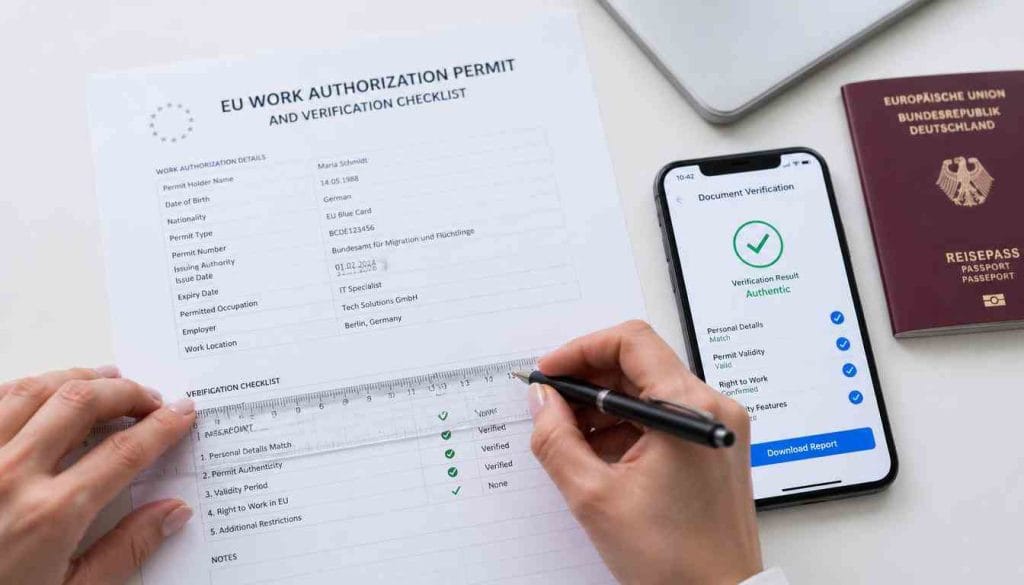
How to Verify Your Work Permit Online
Many applicants lose money by trusting fake agencies and scammers. Before you pay any non-refundable visa fees, you must check if your documents are real.
You should actively verify your Type A work permit (Zezwolenie na pracę) online. You can easily do this by checking the company’s registration number (KRS) and tax number (NIP) on the official Polish labor website (praca.gov.pl). You can also contact the local Voivodship Office to confirm that your job offer is 100% genuine.
Real-Life Warning: The “Ghost Employer” Trap
A common heartbreak for many applicants happens right at the embassy counter. Recently, an applicant from the Middle East received a genuine Type A work permit. However, securing a VFS appointment took him almost four months.
Frustrated by the delay, his Polish employer silently canceled the work permit and hired someone locally, without ever informing the applicant. When the applicant finally submitted his passport, the consular officer checked the praca.gov.pl database and saw the permit was officially voided. He received an instant rejection and lost all his visa fees.
The Lesson: Just because you hold a physical work permit document does not mean it is still active. Always contact your Polish employer via email or phone a few days before your VFS appointment to confirm they are still expecting you and have not canceled your permit in the system.
Securing an Appointment: e-Konsulat Lottery vs. VFS Booking
Booking your visa appointment is often the most frustrating part of the whole process. Depending on your home country, you will have to use one of two different booking systems:
The e-Konsulat Lottery System
In many countries, you must book directly through the Polish Embassy. To stop automated scripts from grabbing all the slots, the e-konsulat appointment system has been completely transformed into a randomized draw:
- The system opens for new registrations (usually on Saturdays).
- You enter your basic details into the registration pool.
- The system randomly selects applicants and sends an email with a confirmed appointment date.
- You go to the embassy on your given date to submit your file.
VFS Global Appointments
If you live in a region with thousands of applicants (like South Asia or the Middle East), you usually will not go to the embassy directly. Instead, you will book your slot through the poland work visa vfs document submission portal.
You Must Appear in Person
Whether you get selected in the e-Konsulat lottery or book through VFS, you must attend the appointment physically. You cannot send a travel agent on your behalf. During this appointment, you will hand over your original documents, give your fingerprints, and pay the visa processing fees.
Consular Interviews and File Preparation
Organizing your file perfectly according to the exact national d type poland visa document requirements saves you from instant rejections and delays. When your papers are clean and organized, the visa officer has fewer reasons to doubt your application.
Be Ready for the Consular Interview
Do not think that having an approved work permit guarantees your visa. The embassy officer will likely ask you a few questions in person or over the phone. They want to make sure you know exactly what your daily job duties are. You should also know enough basic English or Polish to communicate with your boss and coworkers.
Prove Your Past Work Experience
You must show the embassy that you are a real worker with actual skills. Bring solid proof of your past jobs. This includes experience letters from previous employers, bank statements showing your past monthly salary, or tax documents. This proves you are genuinely going to Poland to work.
How Long Does the Visa Process Take?
After you submit your passport and give your fingerprints, you will enter the standard polish embassy work visa processing timeline. Usually, you will get a decision within 15 to 30 days. However, if the embassy needs to do extra background checks on your profile, it can sometimes take up to 60 days.
What to Do After Arriving in Poland
Getting your visa and crossing the border is just the first step. Once you arrive in Poland, you must complete a few important legal tasks to secure your stay:
Register Your Address and Get a PESEL Number
Within 30 days of arriving, you must visit your local town hall (Urząd Gminy). You need to register your living address (this process is called Zameldowanie). Once you do this, the government will give you a PESEL number. This is your unique Polish tax and ID number. You will need it for almost everything, including opening a bank account or visiting a doctor.
Apply for a Residence Card (Karta Pobytu)
Your D-Type visa is only valid for a maximum of one year. If you plan to keep working in Poland after that, you cannot just renew the visa sticker in your passport. Instead, you must apply for a Temporary Residence and Work Permit (Karta Pobytu). Make sure to submit this application to your local Voivodship Office well before your current visa expires.
Final Document Checks Before You Submit
Before you walk into the embassy or VFS center, double-check these important details. Missing even one of these can cause an instant rejection:
- Check Your Medical Insurance: Your travel insurance must cover at least €30,000 for medical emergencies. Make sure your insurance company is on the Polish government’s approved list. Also, ensure your policy matches the general Schengen Visa Travel Insurance Requirements and Minimum Coverage.
- Show Enough Bank Balance: The embassy wants to see that you have enough money to survive in Poland until you get your first paycheck. Make sure your personal savings and salary slips follow the Schengen Visa Bank Statement Balance and Sponsorship Rules.
- Track Your Passport: After you hand over your documents, you do not have to just sit and wait in the dark. You can easily follow your application’s progress by learning How to Track Schengen Visa Application Status on VFS Global Online.
- What to Do If You Get Rejected: If you had a previous visa denial, you must prepare your new file extra carefully. You can learn how to fix past mistakes by reading How to Appeal Schengen Visa Rejection Under Refusal Reason 2. If your Polish work visa gets rejected, remember that you have exactly 14 days from the day you receive the refusal letter to submit an appeal (Odwołanie). Do not miss this strict deadline!
Keep in mind, submitting this appeal (Odwołanie) requires a mandatory re-evaluation fee of €80 at the consulate.
FAQs
Can I bring my family to Poland on a D-Type work visa?
Usually, you cannot bring your family with you right away. You must first arrive in Poland, start your job, and apply for your Temporary Residence Card (Karta Pobytu). Once you have your residence card and a stable income, you can apply for a family visa to bring your spouse and children.
Do I need an IELTS certificate to get a Polish work visa?
No, the Polish government does not require an official IELTS certificate for a standard work visa. However, you must know enough basic English or Polish to do your job safely and answer simple questions during your embassy interview.
How much bank balance do I need to show?
You need to prove you have enough money to survive in Poland before you receive your first salary. While there is no fixed rule, it is generally safe to show around €1,000 to €1,500 in your account. You should provide a clean bank statement covering the last 3 to 6 months.
Is there a maximum age limit for working in Poland?
There is no strict official age limit for a Poland work visa. You simply need to be at least 18 years old to sign a legal contract. As long as you are physically fit and capable of doing the specific job you were hired for, age will not be an issue.
Official Consular & Regulatory Directives
- Republic of Poland Official Consular Portal (e-Konsulat): Official government platform for national visa applications, lottery draws, and appointment bookings.
- VFS Global – Poland Visa Services: Authorized global outsourced partner for Poland National Type D visa submissions and biometric processing.
- Polish Public Employment Services (praca.gov.pl): Official labor ministry database for checking company registries, work declarations, and permit verifications.