If you are living in Dubai, Riyadh, Doha, or anywhere in the GCC and dream of working remotely from Europe, fulfilling the Portugal D8 digital nomad visa requirements from Middle East jurisdictions is your easiest and most direct legal path.
The baseline rule is simple: you need a valid GCC residency (like an Emirates ID or Iqama) and a steady remote income of at least €3,680 per month. If your paperwork is clean, the local embassy or VFS Global center usually approves your file within 60 to 90 days.
However, before you start packing your bags, you need to make a major decision: do you just want to live near the beach for a year, or do you want a permanent European passport? Just like standard Schengen visa application requirements, getting a Portuguese long-term visa from the Middle East requires perfect timing and flawless documents.
A solid bank history, a real remote job contract, and a registered Portuguese rental lease are the three pillars that will save your application from being rejected.
Quick Summary: Portugal D8 Visa from the Middle East
- Minimum Income: You must earn at least €3,680 per month continuously from outside Portugal.
- Valid GCC Residency: You need a valid Emirates ID, Iqama, or local civil ID with at least 3 to 6 months of validity.
- Two Different Paths: You can choose a 1-year Temporary Visa or a Residency Visa (which leads to citizenship after 5 years).
- Core Documents: A clean bank statement, a verified remote work contract, and a 12-month registered Portuguese lease are mandatory.
Choosing the Right D8 Visa Pathway
Portugal created the D8 visa exclusively for remote workers who earn their money from outside the country. Do not confuse it with the older D7 visa (which is for retirees or people with passive income like rent or dividends). For the D8, you must prove active, earned income.
To apply from the Gulf, your resident ID (like your Emirates ID, Saudi Iqama, or Qatari Civil ID) must be valid for at least another 3 to 6 months. If you are based in KSA, the embassy process is quite similar to the steps we covered in our guide on how to apply for a Schengen visa from Saudi Arabia.
Depending on your future plans, you have two distinct paths to choose from:
- 1. The Temporary Stay Visa (Visto de Estada Temporária): This is perfect if you just want to live and work by the beach for up to a year. It is valid for 12 months and allows you to travel in and out of Portugal freely. But remember, this route does not lead to permanent residency or a European passport.
- 2. The Residency Visa (Visto de Residência): This is the golden ticket to European citizenship. Initially, you get a 120-day visa to enter Portugal. Once you land, you will have a face-to-face meeting with the immigration office (AIMA). They will issue your 2-year residence card, which officially starts your 5-year countdown to a Portuguese passport.
| Visa Option | Initial Visa Duration | Document in Portugal | Leads to Citizenship? |
|---|---|---|---|
| Temporary Stay | Up to 12 Months | Sticker in your passport | No |
| Residency Track | 120 Days (2 entries) | 2-Year AIMA card | Yes, eligible after 5 years |
Income Limits and Bank Savings Rules
How much do you actually need to earn? The rule is straightforward: your remote income must be at least four times the Portuguese minimum wage.
Since Portugal recently raised its minimum wage to €920, you need to show a consistent monthly income of €3,680 or more (which is roughly AED 14,800, SAR 15,000, or QAR 14,600). You must prove this by providing original bank statements and payslips covering the last six months.
Understanding the Portugal D8 digital nomad visa requirements from Middle East is crucial, especially when it comes to proving your €3,680 monthly income to the consular officers.
But your monthly salary is not the only thing they check. Visa officers will closely examine your overall savings. Just as we highlighted in our breakdown of Schengen visa bank statement balance and sponsorship rules, suddenly dropping a massive amount of cash into your account right before applying is a huge red flag. Your money needs a clear, traceable history.
Pro Tip for Residency Applicants: If you are applying for the 2-year residency track, do yourself a massive favor. Get a Portuguese tax number (NIF), open a local bank account in Portugal, and transfer a safety net of €12,000 to €15,000 into it before you submit your file. This instantly proves to the embassy that you are financially secure on day one.
Your Financial Checklist:
- Primary Applicant Income: €3,680 gross per month (minimum).
- Recommended Savings Buffer: €12,000 to €15,000 in your bank account.
- Bringing Family Members: You must add an extra €460 per month for your spouse, and €276 per month for every child you bring along.
Proving Remote Work: Employees vs. Freelancers
Visa officers just want to be sure of one thing: you already have a stable job and will not try to look for local employment inside Portugal. How you prove this depends entirely on your working status:
If You Are a Full-Time Employee: You need to submit your standard employment contract along with an official “Remote Work Declaration” from your employer. This letter must be printed on your company’s official letterhead, state your exact salary, and clearly confirm that you are allowed to work remotely from Portugal indefinitely.
If You Are a Freelancer: You will need to show signed service agreements with your active clients. To prove your income is stable, you must also attach your business registration documents and match your monthly invoices perfectly with your last six months of bank deposits.
Document Checklist: Portugal D8 Digital Nomad Visa Requirements from Middle East
Here is a golden rule for applying from the Middle East: any official paper issued inside the GCC (like police clearances or marriage certificates) is useless in Portugal unless it is legally attested. You must get these documents notarized, attested by the Ministry of Foreign Affairs (MOFA), and translated into Portuguese.
Gather these required documents for your file:
- Your Passport: Must be valid for at least 3 months beyond your planned stay, with two completely blank pages.
- Valid GCC ID: Bring the original and a clear copy of your Emirates ID, Iqama, or Civil ID.
- Proof of Income: Your remote work contract or your freelance client agreements (as explained above).
- Bank Statements: 6 consecutive months of statements. These must bear original bank stamps and clearly show your salary deposits.
- Police Clearance Certificates (PCC): You need attested background checks from both your home country and your current GCC residence (issued within the last 90 days).
- Travel Insurance: A valid health policy covering at least €30,000 for emergency medical care. To make sure you buy the right policy, check out our guide on Schengen visa travel insurance requirements, as the rules for Portugal are exactly the same.
Accommodation and Getting Your Portuguese NIF
The number one reason applications from the Middle East get rejected is weak proof of accommodation. If you are applying for the residency visa, do not rely on short-term Airbnb reservations, hotel bookings, or a casual letter from a friend. Visa officers routinely reject these.
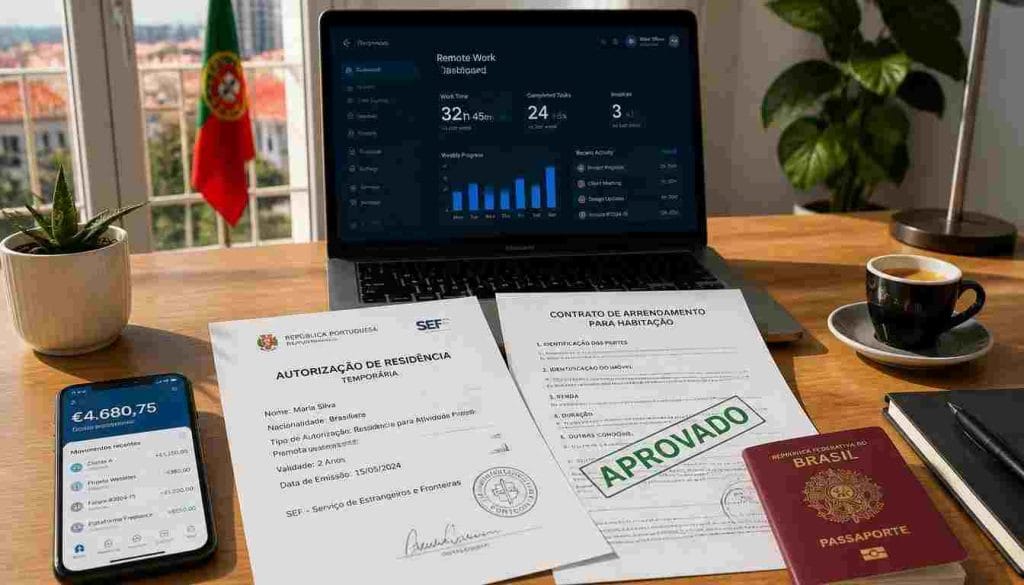
To secure an approved lodging document, follow this exact sequence:
- Get a NIF: Hire a fiscal representative to get your Portuguese Tax Number.
- Open a Bank Account: Set up your local Portuguese bank account.
- Sign a Lease: Sign a standard 1-year rental agreement.
- Register the Lease: Ensure the landlord registers it on the government portal.
To meet the strict legal requirements, you must provide a 12-month registered lease agreement (Contrato de Arrendamento). Your landlord has to register this contract on the government tax portal (Portal das Finanças) and give you the official stamped receipt. Alternatively, if you have already purchased residential property in Portugal, a copy of the property deed (Escritura Pública) will work perfectly.
Estimated Setup Costs for D8 Applicants
| Expense Item | Official Government Fee | Administrative / Service Costs | Estimated Total |
|---|---|---|---|
| National Visa Fee | €90 (AED 360 / SAR 370) | VFS booking fee (€25 – €40) | €115 – €130 |
| NIF Setup & Bank Account | Free at Tax Office | Fiscal representation (€100 – €250) | €100 – €250 |
| Attestations & Translations | Local MOFA fees ($40 – $80) | Certified translation (€60 – €120) | €100 – €200 |
| Annual Expat Health Cover | Not applicable | 1-Year policy (€180 – €350) | €180 – €350 |
| AIMA Residency Card | €170 – €185 issuance fee | In-country biometrics filing | €170 – €185 |
| Total Estimated Starting Costs: | €665 – €1,115 | ||
Step-by-Step Application Process
Applying from the GCC is a straightforward process if you follow the correct order. Here is exactly how to move your application through the local VFS center or the Portuguese embassy:
- Get Your NIF and Bank Account: First, hire a verified Portuguese fiscal representative to get your tax number (NIF), open your bank account, and transfer your savings.
- Secure a Registered Lease: Work with a licensed property broker in Portugal to sign a 12-month lease and get the official registration slip from the tax office (Finanças).
- Legalize Your Police Clearance: Get your background check from the local police (like Dubai Police or Saudi MOI). Then, get it attested by your local MOFA and translated into Portuguese.
- Book Your Consular Appointment: Appointment slots open in batches online and fill up fast. If you are applying from the Emirates, our guide on how to book a Schengen visa appointment from the UAE shows you exactly how to catch early-morning slots without paying expensive third-party agents.
- Submit Documents and Biometrics: Go to your appointment, hand over your perfectly organized folder, scan your fingerprints, and pay the visa fee.
- Track Your Application: The embassy usually takes 60 to 90 days to process D8 visas. While you wait, you can monitor your passport’s journey using our quick guide on how to track your Schengen visa application status on VFS Global.
Once approved, you will collect your passport with your 120-day entry visa sticker inside, along with the confirmed date for your final residency interview in Portugal!
FAQs
What is the main difference between the Portugal D7 and D8 visa?
The D7 is strictly for passive income (like pensions, dividends, or rental earnings), while the D8 is for active remote employees and freelancers earning from companies outside Portugal.
Can I show my UAE/Saudi bank statements, or must I open a Portuguese bank account?
You need both. Submit your GCC bank statements to prove your last 6 months of salary, and transfer your savings buffer (around €12,000) into a local Portuguese bank account before applying.
Will the embassy reject my application if I show an Airbnb booking?
Yes. For the residency visa, short-term stays like Airbnb or hotels will not work. You must provide a formal 12-month rental lease registered with the Portuguese tax office (Finanças).
Does my remote employer need an entity in Portugal?
No. Your employer or clients must be based outside Portugal. If a Portuguese entity pays your salary locally, you fall under a standard local work visa instead of the D8.
Can I travel to other European countries with a D8 visa?
Yes. Once you arrive in Portugal and pick up your official AIMA residence card, you can travel freely across all 29 Schengen zone countries without applying for extra tourist visas.
Final Thoughts: Starting Your Remote Life in Portugal
Getting your D8 visa approved from the Gulf comes down to proving two simple things: your income is steady, and your paperwork is spotless.Successfully fulfilling the Portugal D8 digital nomad visa requirements from Middle East is entirely possible if you organize your paperwork and financial records exactly as the embassy expects.
If you consistently earn over the €3,680 mark, secure a genuine 12-month lease, and get your police clearances properly attested by the MOFA, the consular officers have no reason to deny your file. Take it one step at a time—sort out your NIF and bank account first, secure your housing, and then hunt for that VFS appointment slot.
Do the prep work properly, and you will be working from a Portuguese café with a European residence card in no time.
Official Resources & Verification Portals
- AIMA Official Agency Portal: Official immigration rules, appointment rules, and residence permit information.
- Portal das Finanças Online Database: The official Portuguese portal for tax IDs (NIF) and registered rental contracts.
- Portuguese Ministry of Foreign Affairs (MNE) Visa Portal: Official scheduling portal and document lists for national long-stay entry visas.