[Last Updated: October 2026]
Imagine your UK indie rock band just locked in a high-profile, multi-city American tour, or your European theater ensemble was finally invited to perform in New York. The rush of landing dates across the Atlantic is unmatched—until the reality of US immigration law sets in.
Navigating the strict P-1B visa requirements for entertainers shouldn’t be the roadblock that derails your international tour.
A single procedural flaw on Form I-129—whether an unverified union consultation, an itinerary gap, or a misstep with the strict 75% rule—can trigger an unexpected Request for Evidence (RFE), canceled venues, and thousands in lost guarantees.
This updated 2026 guide cuts through the bureaucratic red tape. From navigating labor union clearances (like AFM or AGMA) to calculating exact USCIS petition fees and embassy timelines, here is your step-by-step roadmap to ensure your performance group hits the stage on schedule.
What is the P-1B Visa for Performance Groups?
The P-1B visa is a highly specialized US nonimmigrant classification designed exclusively for members of internationally recognized entertainment groups coming to the United States temporarily to perform.
The Collective Entity Rule
A crucial legal distinction makes this visa unique. Unlike other artistic visa categories, the P-1B is not meant for solo musicians, individual actors, or standalone DJs. You must be traveling, performing, and applying as a unified, established group (such as a touring rock band, a circus troupe, or a theater ensemble).
To qualify, your group’s collective reputation must be outstanding. USCIS requires solid documentary proof that your band or performance troupe is recognized globally, possessing a degree of skill and recognition substantially above what is ordinarily encountered in the arts.
Expert Legal Tip: P-1B vs. O-1B Visa – Which Do You Need?
A frequent mistake that leads to instant visa denials is applying under the wrong artistic classification.
- The P-1B Visa evaluates the reputation of the group as a whole. The fame of one individual member cannot carry the entire petition.
- The O-1B Visa, on the other hand, is specifically for solo artists and individuals with “extraordinary ability in the arts.” If a famous solo pop star is touring the US with their backing band, the lead singer requires an O-1B visa, while their backing musicians might qualify for O-2 support visas.
The Critical 75 Percent Rule (8 C.F.R. § 214.2)
One of the most complex legal hurdles for international touring acts is a strict USCIS regulation commonly known as the “75 Percent Rule.”
By law, at least 75 percent of your group’s core performing members must have had a substantial and continuous relationship with the group for a minimum of one year prior to filing the petition.
Real-Life Tour Trap: If a famous Australian rock band recently replaced their lead guitarist and drummer just two months before a major American tour, those new members might not qualify under the standard P-1B petition because they break the one-year continuous relationship requirement. The petition structure must be handled strategically.
Are There Any Exemptions to the Rule?
Yes. US immigration law provides specific, documented exemptions to this rigid timeline:
- Emergency Waivers: USCIS can waive the one-year requirement in exigent circumstances, such as a vital band member falling suddenly ill, leaving the group, or facing unexpected travel restrictions right before the tour.
- The Circus Exemption: There is a complete legal exemption for circus personnel. Circus performers and essential circus staff are entirely exempt from the one-year relationship requirement, provided the circus itself possesses a recognized, sustained national reputation.
Real-Life Case Study: Overcoming a “75% Rule” RFE Before Tour Kickoff
A four-piece alternative rock band from Manchester booked an 8-city US tour, but their founding bassist broke his wrist just six weeks before opening night. They brought in a talented touring session bassist and filed Form I-129.
USCIS immediately issued a Request for Evidence (RFE), challenging the petition because 25% of the performing lineup lacked the mandatory one-year history with the group.
The Solution: The band’s legal team responded within 72 hours by submitting two critical pieces of evidence:
- Official hospital records and doctor statements verifying the original member’s medical emergency.
- Archived gig contracts, old tour programs, and festival posters proving that the remaining 75% (the lead singer, guitarist, and drummer) had performed together continuously for over four years.
They upgraded to premium processing, and USCIS approved the petition in just 9 days without delaying a single tour date.
The takeaway: Never panic over an RFE. If an unexpected lineup change happens, back up your emergency with medical or contractual proof and double down on the long-term history of your remaining core members.
Essential P-1B Visa Requirements for Entertainers (The Audit Checklist)
Meeting the legal standards for a US visa for performers and artists requires much more than just a viral hit on social media or a single successful local gig. Consular officers and USCIS adjudicators demand undeniable, hard documentary evidence.
Your US sponsor or agent carries the legal burden of assembling a bulletproof Form I-129 petition. Let’s break down exactly what your legal dossier must contain to secure a seamless approval and keep your tour dates intact.
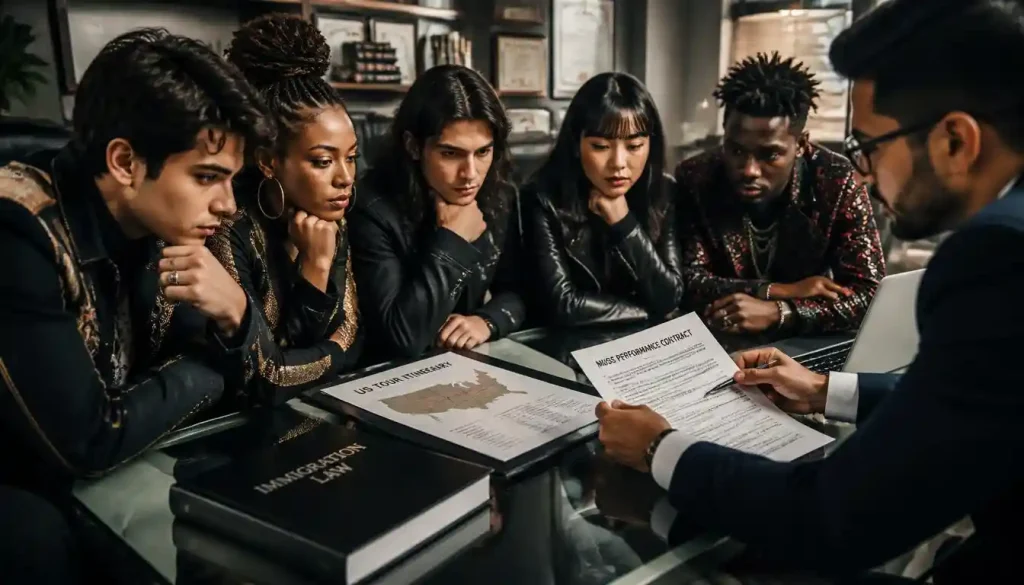
Proving Sustained International Recognition
The absolute cornerstone of your petition is proving your group’s “sustained international recognition.” The US government wants to see that your band or troupe is highly celebrated worldwide, not just within your home country.
To pass this strict legal test, your group must meet specific evidentiary criteria set by USCIS. There are two primary ways to prove this:
1. The One-Time Major Award Receiving a major, internationally recognized award—such as a Grammy, a Brit Award, or an Olivier Award—instantly qualifies your group.
2. The Alternative Evidence (Meeting 3 of 6 Criteria) If your group does not have a massive global award, US immigration law strictly mandates that you provide extensive documentation for at least three of the following six alternative criteria:
- Starring Role in Distinguished Events: Evidence that your group has performed (or will perform) as a starring or leading entertainment group in prestigious venues or major international festivals.
- Major Media Publications: Prominent features, reviews, or interviews about your group in major music magazines, international newspapers, or global trade journals.
- Box Office & Record Sales: Documented proof of significant commercial success, such as high record/album sales, millions of verified streams, or box office receipts of sold-out international tour dates.
- Industry Acclaim: Formal testimonials and advisory letters from recognized critics, labor unions, or government agencies praising your group’s elite status.
- High Compensation: Executed contracts proving your group commands a high salary or substantial prize money compared to others in your specific artistic field.
- Sustained Success: Proof that your group has achieved international recognition for a substantial and continuous period.
For instance, a theater group from France must legally show they are celebrated far beyond the Schengen borders by meeting at least three of these strict standards with verified paperwork.
Mandatory Document Checklist (The Ultimate Audit Table)
A missing signature or an incomplete tour schedule can instantly trigger a frustrating and costly Request for Evidence (RFE). Before mailing your packet to USCIS, verify your P-1B visa dossier against this strict audit table:
| Document Category | Specific Items Needed | Why It Is Required | Common Mistakes (RFE Triggers) ⚠️ |
|---|---|---|---|
| Union Consultation Letter | Written advisory opinion from an appropriate US labor organization (e.g., AFM for musical acts, AGMA for vocal/dance groups). | Mandatory by law to verify the group’s international standing and confirm US workers are not displaced. | Submitting an advisory opinion from the wrong union or providing a generic letter without specific group evaluations. |
| Sponsor & Agent Contracts | Fully signed petitioner contract, deal memo, or promoter agreements detailing compensation and performance terms. | Proves a legitimate US employment relationship and guarantees agreed performance fees or tour revenue splits. | Failing to detail exact compensation structures, missing authorized signatures, or vague conditional terms. |
| Detailed Tour Itinerary | Comprehensive schedule listing exact concert dates, venue names, physical street addresses, and city locations. | Proves the group is entering the US strictly for scheduled, qualifying entertainment events without unauthorized gaps. | Leaving dates marked as “TBD”, unverified venue addresses, or unexplained multi-week breaks between shows. |
| Proof of International Acclaim | One major international award (Grammy, Brit, etc.) OR documentation satisfying at least 3 of the 6 regulatory criteria. | Fulfills the core statutory requirement under 8 C.F.R. § 214.2 that the ensemble is internationally recognized. | Relying only on domestic/local press clippings or focusing on one member’s fame rather than the group’s collective profile. |
| 75% Rule Compliance Evidence | Historical gig flyers, archived tour rosters, old contracts, and payroll records covering at least one continuous year. | Legally verifies that at least 75% of performing members have been with the group for a minimum of 12 months. | Using unverified recent social media posts or failing to file an emergency waiver for newly replaced members. |
P-1B Visa Processing Time: Keeping Your Tour on Schedule (2026 Timeline)
For a touring music band or a traveling theater company, time is money. A delayed visa approval can instantly ruin a carefully planned, multi-million dollar US tour and disappoint thousands of ticket-holding fans.
Therefore, understanding the exact P-1B visa processing time is critical for your management team. The complete timeline involves two distinct phases: USCIS petition processing and the consular interview.
Phase 1: USCIS Petition Processing (Standard vs. Premium)
First, your US sponsor or agent submits Form I-129 to USCIS. Standard processing typically takes anywhere from two to six months, depending heavily on the service center’s current caseload.
The Exact USCIS Costs (2024-2026 Update): Under the current fee schedule, the base filing fee for a P-1B Form I-129 is $1,015, plus a mandatory $600 Asylum Program Fee (totaling $1,615 for standard employers). Small employers or nonprofits may qualify for reduced rates.
For entertainment groups with fast-approaching concert dates, waiting several months is impossible. Fortunately, your sponsor can utilize Premium Processing. By filing Form I-907 and paying an additional fee of exactly $2,805, USCIS is legally mandated to issue a decision (approval, denial, or RFE) within exactly 15 business days.
Phase 2: US Embassy Consular Processing (DS-160)
Once the Form I-129 petition is approved by USCIS, the legal process is not over. Group members must schedule an embassy interview in their home country, such as the US Embassy in London or Toronto, to get the actual physical visa foil stamped in their passports.
Each performing member must complete the online Form DS-160 and pay the mandatory $205 MRV consular fee. It is highly recommended to book these embassy appointments the exact moment your US agent receives the electronic USCIS approval notice (Form I-797B) to avoid missing your opening night due to long embassy wait times.
Top P-1B Visa Denial Reasons (And Exactly How to Fix Them)
Even world-renowned international bands and touring acts face sudden Request for Evidence (RFE) notices or a dreaded Notice of Intent to Deny (NOID) if their petition has procedural flaws. The artistic talent of your group is only half the battle; the legal construction of your filing determines your approval.
USCIS adjudicators and consular officers scrutinize petitions for specific gaps. Here are the top reasons for P-1B visa denials and the exact steps required to resolve them before filing:
1. Failing the Strict 75 Percent Rule
The most common trap for touring acts is failing to document that at least 75 percent of the performing lineup has been continuously active with the group for a minimum of one full year. If you recently replaced your drummer, bassist, or keyboardist before filing, USCIS will immediately question group eligibility.
- The Expert Fix: Submit exhaustive historical evidence establishing the long-term collaboration of the core lineup. Include dated gig contracts, archived concert posters, official album liner notes, past festival itineraries, and historic payroll records. If a core member was recently replaced due to an emergency or illness, your attorney must formally request an emergency waiver with supporting medical or logistical documentation.
2. Submitting an Inadequate Union Consultation Letter
USCIS strictly mandates a written advisory opinion from an appropriate US labor organization representing the specific artistic discipline (such as the American Federation of Musicians [AFM] for musical acts, or the American Guild of Musical Artists [AGMA] for dance and vocal ensembles). Submitting a generic, one-sentence letter or an opinion from the wrong union will stall or kill the petition.
- The Expert Fix: Your petitioner must submit the complete performance itinerary, member roster, and promotional portfolio directly to the appropriate labor union well ahead of filing. The resulting advisory letter must unequivocally state that the union has no objection to the tour and verifies that the group possesses sustained international recognition.
3. Applying as a Solo Performer Instead of a Group
This is an immediate statutory disqualifier. The P-1B classification is legally reserved for established entertainment ensembles. If a solo singer, headlining DJ, or stand-up comic applies under P-1B with temporary session players, USCIS will deny the petition.
- The Expert Fix: Individual headliners must apply under the correct classification. Solo artists with exceptional acclaim must file for an O-1B Visa for Extraordinary Ability in the Arts, while their accompanying musicians, vocalists, and stage crew enter on O-2 Support Visas. If you are an individual athlete rather than an entertainer, you must instead explore the P-1A Visa Requirements for Athletes.
4. Unexplained Gaps in the Tour Itinerary
USCIS heavily scrutinizes your calendar. If your submission shows multi-week or multi-month gaps between confirmed concert dates, adjudicators may suspect that group members intend to seek unauthorized off-contract employment during the downtime.
- The Expert Fix: Your US agent or petitioner must provide a comprehensive, tightly mapped schedule for the entire requested validity period. Every substantial break between live shows must be explicitly designated in the contract and itinerary as scheduled travel days, mandatory technical rehearsals, studio recording sessions, or authorized rest periods directly related to the tour.
5. Falling into the “Regional Recognition” Trap
Submitting accolades, reviews, and ticket sales that only cover your group’s home region or domestic market is a leading trigger for denials. USCIS requires verifiable acclaim that extends beyond national borders.
- The Expert Fix: Build an evidentiary record that demonstrates an international footprint. Supplement domestic press with foreign media coverage, official chart rankings in multiple countries, streaming platform analytics detailing global listener demographics, and confirmed performance history across international festivals outside your home territory.
Essential Support Personnel and Crew: The P-1S Visa
A world-class tour cannot function without its technical backbone. Front-of-house sound engineers, lighting directors, monitor technicians, stage managers, choreographers, and specialized wardrobe crew are indispensable to your live production.
Fortunately, US immigration law provides the dedicated P-1S classification specifically for essential support personnel accompanying P-1B entertainment groups.
Key Legal Rules for the P-1S Visa:
- Separate Form I-129 Required: Support crew members cannot simply be listed on the same petition as the performers. Your US sponsor or agent must file a separate Form I-129 specifically for the P-1S support staff.
- The “Essentiality” Standard: The petitioner must prove that the crew member provides services integral to the performance that cannot be easily replaced by available US workers.
- Documented Prior Working Relationship: Crew members must demonstrate substantial, verifiable experience working directly with your specific entertainment group before entering the US. General technical skill alone is not enough; their specific familiarity with your show’s production is key.
- Dedicated Labor Consultation: Just like performers, support crew require a separate advisory opinion from an appropriate theatrical or stage labor organization (such as IATSE—the International Alliance of Theatrical Stage Employees).
Transitioning from Touring to Permanent Residency (The Green Card Strategy)
A high-intensity touring schedule is exhilarating, but many successful international artists and performers eventually seek long-term stability and a permanent creative base in the United States.
While the P-1B is a temporary, nonimmigrant classification, navigating the transition to lawful permanent residency (a US Green Card) is entirely viable with proper legal foresight.
1. Dual Intent Protection (8 C.F.R. § 214.2(p)(15))
Most temporary visitors are barred from showing any intention to remain permanently in the United States. However, under federal immigration regulations (8 C.F.R. § 214.2(p)(15)), P-1 status carries unique flexibility. Having a pending permanent residency petition (Form I-140) or labor certification does not violate your P-1 status. You can legally extend your touring stay or travel internationally while pursuing permanent residency.
2. The EB-1A Extraordinary Ability Route
The most common green card category for elite talent is the EB-1A Immigrant Classification (Extraordinary Ability).
- Self-Petitioning Freedom: Key group members, lead songwriters, or directors can file Form I-140 on their own behalf without requiring a permanent US employer or record label sponsor.
- Bypassing the PERM Process: You completely skip the lengthy Department of Labor certification procedure.
- Cross-Applying Performance Evidence: The international acclaim, commercial chart data, global media profiles, and major festival appearances gathered for your P-1B petition directly serve to establish the high evidentiary threshold required for an EB-1A.
3. Career Expansion Beyond the Tour Calendar
Securing permanent residency eliminates the stress of event-tied visa renewals and contract restrictions. As a Green Card holder, you are legally free to:
- Establish your own US-based recording studio, production company, or artist management agency.
- Transition into music production, composition, film scoring, or academic masterclasses.
- Collaborate with any US artists or venues without filing new petition amendments.
To evaluate broader employment-based pathways alongside your artistic career, review our comprehensive US Corporate Work Visa and Green Card Options: Complete Guide.
FAQs
Can our band play at showcase festivals like SXSW without a P-1B visa?
Generally, no. While there is a very narrow legal exception that allows you to enter on an ESTA or B-1 visa strictly for “official, unpaid industry showcases,” it is incredibly risky. Playing even one unofficial side party or taking a small paid gig will violate your status. For a safe, multi-city tour, a P-1B is always required.
What happens if a band member quits or gets sick during the US tour?
If a member leaves, their individual visa status effectively ends. You cannot simply fly in a replacement musician on a tourist visa to finish the tour. Your US sponsor must immediately file a brand new Form I-129 petition specifically for the new replacement member before they can legally perform.
Can our group change our US booking agent mid-tour?
Yes, but you cannot just shake hands and switch agents overnight. Your new booking agent or sponsor must file a new petition with USCIS. The good news is, under visa portability rules, you can usually continue performing once the new petition is officially filed, without waiting for the final approval.
Can I play solo shows or guest DJ while touring with my band?
No. Your P-1B visa is strictly tied to the specific group and the exact itinerary submitted by your sponsor. Playing unauthorized solo gigs, DJing at a local club, or performing with another band is a violation of your visa conditions.
Do we need a college degree or an English test (IELTS) to get approved?
Not at all. The US government does not care about your academic background or whether you can pass an English test. The P-1B classification is based entirely on your group’s artistic talent, international recognition, and the strength of your tour contracts.
Final Checklist on P-1B Visa Requirements for Entertainers
Successfully clearing the P-1B visa requirements for entertainers comes down to three factors: rock-solid documentation of your group’s history, prompt union consultations, and an airtight tour itinerary. Always assemble your evidence and initiate the petition process at least 4 to 6 months ahead of your scheduled US tour dates to keep your performances on track.
Sources & References
- USCIS Official Guidelines: P-1B Internationally Recognized Entertainment Group
- Embassy Interview & DS-160: US Dept of State: DS-160 Application Portal
- Musicians & Taxes: IRS Guide for Alien Entertainers and Athletes